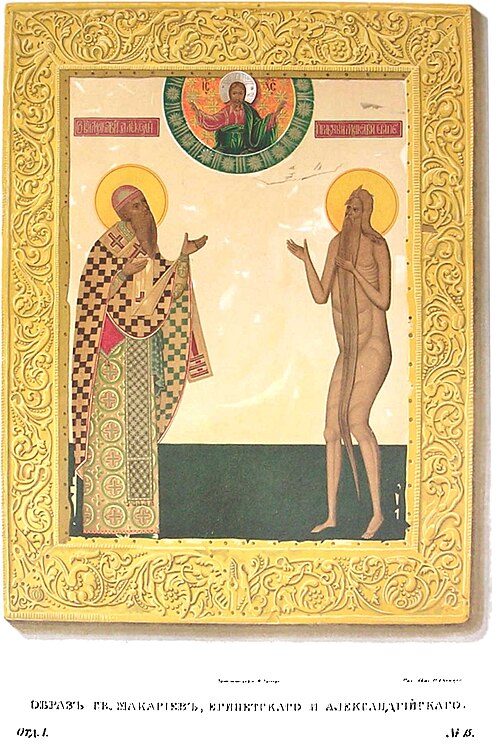
Venerable
Macarius of Alexandria
Hermit of the Nitrian Desert
Monk in the Nitrian Desert, a little younger than Macarius of Egypt, who died in 395.
- Feast
- January 9old style January 22
- Reposed
- 3934th century
- Place
- Kellia
- Order
- Venerables
Life
Venerable Macarius of Alexandria was a monk and priest of the Nitrian desert and of Kellia in Egypt in the fourth century. He was somewhat younger than Macarius of Egypt, and for this reason he is also called Macarius the Younger. The Church remembers him as a disciple of Saint Anthony and a guide to thousands of hermits. He passed to the Lord about 394; the sources give the years 393 or 395. He is also called Macarius the Citizen (in Greek Politikos).
Beginnings
Macarius was born at Alexandria, about the year 300 (by other reckonings, 293). Until the age of forty he was a merchant, according to some sources of sweets, according to others of fruit, while Philip of Side writes that he was a teacher in a school. He was baptized at forty and went off into the desert. The chief reports about him are kept by Palladius of Helenopolis, who knew him personally, in the Lausiac History, and by Rufinus of Aquileia in the History of the Monks of Egypt.
After some years of ascetic struggle he was ordained a presbyter and made abbot of the settlement called Kellia, between the mountain of Nitria and Scetis, where hermits lived in silence, each in his own cell. Many miracles are ascribed to him, and more than five thousand monks were under his guidance. Socrates Scholasticus notes that, while Macarius of Egypt was severe, Macarius of Alexandria received those who came with gentleness and drew the young to ascetic life by his kindness.
His struggle
Palladius describes him in old age as bent and thin, his beard hardly growing because of his labours. He ate only hard millet or seeds soaked in water, and gave his body to the bites of the great mosquitoes. A brother once saw him fill a basket with sand and carry it up a hill to pour it out. Asked what he was doing, he answered that he was wearing out the one who wears him out, that is, the devil.
Hearing of the very strict rule of the monastery at Tabennisi, led by Venerable Pachomius the Great, he went there dressed in secular clothes. Throughout Great Lent he ate no bread and drank no water; no one saw him eat or sit, but he plaited baskets of palm leaves standing up. The monks told Pachomius to cast him out, since he was not human. Pachomius learned by revelation who he was, and the brothers hurried to ask the saint's blessing. Macarius then returned to his own monastery.
Exile and repose
At the age of 73 he was exiled by the emperor Valens, together with Macarius of Egypt, to an island, which they then Christianized. According to Orthodox tradition he fell asleep on 2 January 395, according to the Coptic tradition on 1 May 395. Tradition says that he lived to over a hundred years. The Serbian Church commemorates him on 19 January by the old calendar.
A monastic rule, a few short sayings of the Fathers and a homily on the end of the souls of the righteous and of sinners are attributed to him. The authenticity of these writings is doubtful, however, and some manuscripts give the homily to a monk Alexander. The monastery of Sourp Magar in Cyprus bears his name.
Commemorated the same day January 9
 Julian and BasilissaHoly MartyrsJan 9
 Polyeuctus of MeliteneMartyrJan 9
- Peter of SebasteSaint · Bishop of SebasteJan 9
- Hadrian of CanterburyVenerable · Abbot of CanterburyJan 9
 Anastasius of AntiochMartyrJan 9
 Eustratius the WonderworkerVenerable · Disciple of John the GreatJan 9
 Jonah of KyivVenerable · Founder of Jonah MonasteryJan 9
- WaningusSaint · Founder of Fécamp AbbeyJan 9
- Anthony of AntiochHieromartyr · Priest of AntiochJan 9
- Agnellus of NaplesSaint · Bishop of NaplesJan 9
- Antonina of NicomediaMartyrJan 9
- BaeithinSaintJan 9