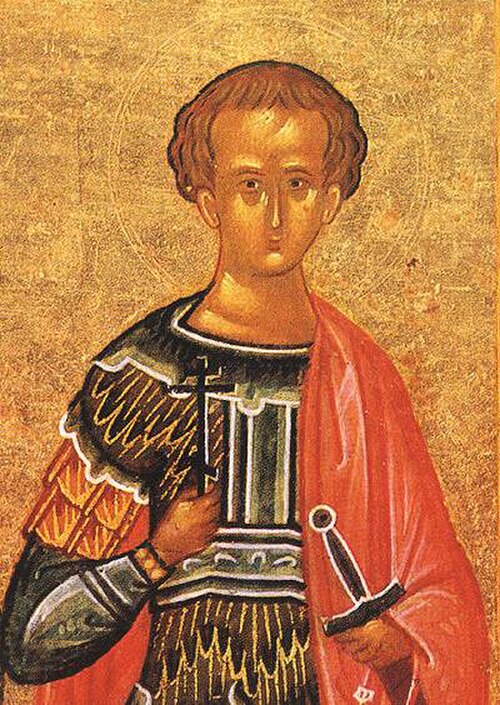
Martyr
Polyeuctus of Melitene
Martyr of Melitene in Roman Armenia, put to death on 10 January 259.
Life
The Holy Martyr Polyeuctus was a Roman officer of Melitene in Lesser Armenia (modern Malatya, in Turkey) and the first martyr of that city. He received the crown of martyrdom on 10 January 259, in the reign of the emperor Valerian.
According to tradition Polyeuctus was a man of means serving in the army, a friend of another officer, Nearchus, a steadfast Christian, while he himself, though living a pure life, was still a pagan. When the persecution began, Nearchus told him that they would soon be parted, since he would be taken to torments, and Polyeuctus might renounce their friendship. Polyeuctus told him a dream: he had seen Christ, who took off his old garment and clothed him in a shining one (in another version, set him on a winged horse). From that moment, he said, he wished to serve Christ alone.
Polyeuctus went out into the city square, tore down the imperial edict that required everyone to worship idols and, meeting a procession carrying twelve idols through the streets, dashed them to the ground and trampled them. His father-in-law Felix, the governor charged with carrying out the edict, learned of it with sorrow and told him that if he did not repent he would have to condemn him. According to the account, Felix, Polyeuctus's wife Paulina and their children begged him in tears to renounce Christ, but the saint did not move. He was tortured and then beheaded. On the way to the place of execution he saw Nearchus in the crowd and joyfully called to him to remember their pledge. Nearchus died later as a martyr, in fire.
The saint was buried at Melitene, where a church was built in his name. Tradition says that the parents of Saint Euthymius the Great prayed in this church for a son. Between 524 and 527 another church, a great basilica, was raised in his honour at Constantinople by Anicia Juliana; the excavations of the 1960s showed that until Hagia Sophia it was the largest in the city, richly decorated with oriental motifs. The relics there were later moved to the church of the Holy Apostles. His cult also reached Metz, in the West.
He is regarded as patron of vows and treaties, in both East and West. His story lies behind Pierre Corneille's tragedy Polyeucte (1642), and later the operas of Gounod and Donizetti. He is celebrated on 9 January in the Orthodox Church; the ancient Armenian calendars and the Catholic calendar commemorate him on 7 January.
Commemorated the same day January 9
 Macarius of AlexandriaVenerable · Hermit of the Nitrian DesertJan 9
 Julian and BasilissaHoly MartyrsJan 9
- Peter of SebasteSaint · Bishop of SebasteJan 9
- Hadrian of CanterburyVenerable · Abbot of CanterburyJan 9
 Anastasius of AntiochMartyrJan 9
 Eustratius the WonderworkerVenerable · Disciple of John the GreatJan 9
 Jonah of KyivVenerable · Founder of Jonah MonasteryJan 9
- WaningusSaint · Founder of Fécamp AbbeyJan 9
- Anthony of AntiochHieromartyr · Priest of AntiochJan 9
- Agnellus of NaplesSaint · Bishop of NaplesJan 9
- Antonina of NicomediaMartyrJan 9
- BaeithinSaintJan 9