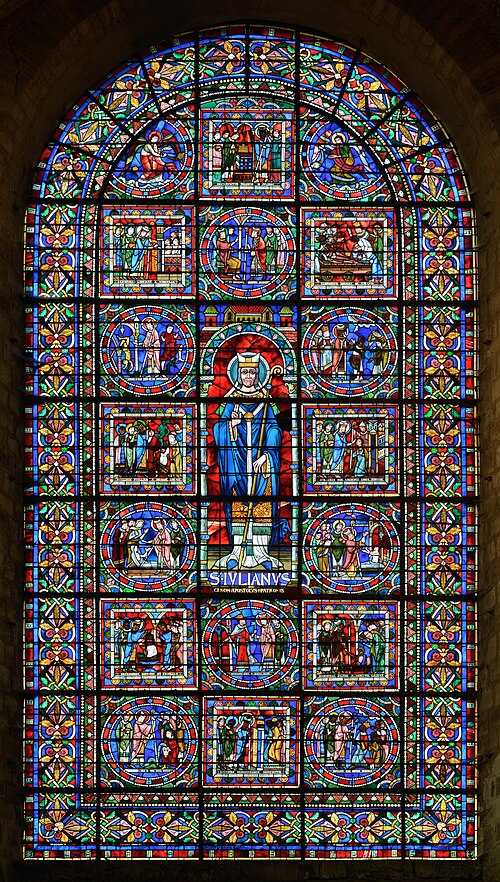
Saint
Julian of Le Mans
First Bishop of Le Mans
Honored as the first bishop of Le Mans in Gaul, in both the Orthodox and the Catholic Church.
- Feast
- January 14old style January 27
- Reposed
- 4004th century
- Place
- Saint-Marceau
- Order
- Hierarchs
Life
Saint Julian is venerated as the first bishop of Le Mans in Gaul, and is remembered in both the Orthodox and the Roman Catholic Church. According to tradition he lived in the third or fourth century. The Western Church commemorates him on 27 January, the Orthodox on 13 July (26 July by the civil calendar).
He is said to have been a Roman nobleman, consecrated bishop at Rome, and sent to Gaul around the middle of the third century with the priest Thuribius and the deacon Pavatius to preach the Gospel to the Cenomani. Their capital, Civitas Cenomanorum, now Le Mans, was suffering from a lack of drinking water. According to legend Julian thrust his staff into the ground and prayed, and water gushed out. The miracle opened the way for him to preach freely in the city. Serbian sources tell that he healed a blind man at the gate of the local chief's residence. The chief fell at the bishop's feet and asked for baptism. After a three-day fast Julian baptized the chief and his family, and most of his subjects followed. The chief gave his house to the Church to be the city's first cathedral and supported it with money. Julian cared for the poor, the sick and orphans, healed illnesses, and by prayer raised the dead children of grieving parents, and according to tradition even a dead man. He broke the hold of idolatry in the region. In old age he retired as a hermit on the banks of the Sarthe and died at a great age.
Other traditions make him sent by the Apostle Peter or one of the seventy-two disciples, or confuse him with Simon the Leper, but these arose when an apostolic origin was sought for the see. The Cathedral of Saint-Julien in Le Mans is dedicated to him. His feast was kept in England too, because Henry II was born at Le Mans, and at least nine Benedictine monasteries kept it. Most of his relics, kept at the convent of Notre-Dame-du-Pré, were burned or scattered by the Huguenots in 1562. His head is shown in the cathedral of Le Mans, where it has been since 1254. On Orthodox icons he is shown with an infant in his arms.
Commemorated the same day January 14
 Sava of SerbiaSaint · First Archbishop of the SerbsJan 14
 NinoEqual-to-the-Apostles · Enlightener of GeorgiaJan 14
 Felix of NolaConfessor · Presbyter of NolaJan 14
 Dacius of MilanSaint · Archbishop of MilanJan 14
- Macrina the ElderSaint · Grandmother of Basil the GreatJan 14
 PotitusMartyr · Early martyrJan 14
 Fathers slain at Sinai and RaithuHoly Venerable Martyrs · Monks slain at Sinai and RaithuJan 14
 Acacius of TverSaint · Bishop of Tver and KashinJan 14
- Paul the FatherSaintJan 14
- Adam of SinaiVenerable MartyrJan 14
- Anthony ChirkovVenerable MartyrJan 14
- Baodan Mor of Inis MorVenerableJan 14