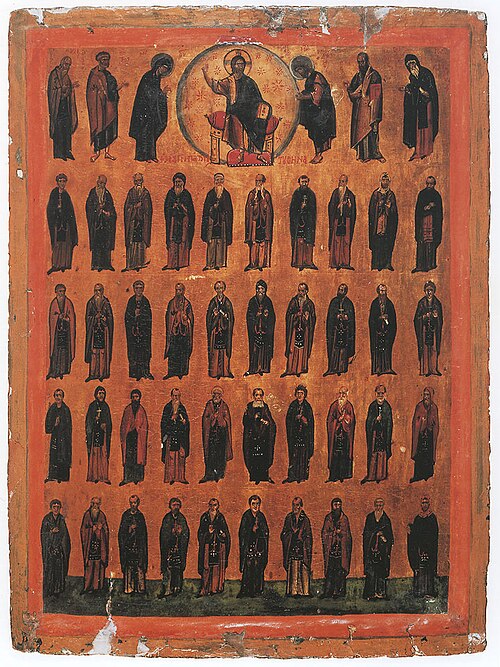
Holy Venerable Martyrs
Fathers slain at Sinai and Raithu
Monks slain at Sinai and Raithu
Monks slain at Sinai and Raithu, commemorated together on January 14 in the Orthodox Church.
- Feast
- January 14old style January 27
- Era
- unknown
- Order
- Martyrs
Life
The Holy Fathers slain at Sinai and Raithu are the monks and hermits of the desert of Sinai and of Raithu, on the shore of the Red Sea, who were killed by pagan nomadic tribes in ancient times. The Church commemorates them together on 14 January. The old synaxaria mingle two distinct raids: one in the fourth century, known from the account of the monk Ammonius, and one in the fifth century, described by Saint Nilus of Sinai. Among the names preserved are Isaiah, Sabbas, Moses and his disciple Moses, Jeremiah, Paul, Adam, Sergius, Domnus, Proclus, Hypatius, Isaac, Macarius, Mark, Benjamin, Eusebius and Elias.
The account of the monk Ammonius
The first testimony is that of the monk Ammonius, who lived in a cell at Canopus near Alexandria. By his own account he left because he could no longer bear the heavy persecution and daily dangers endured by the faithful, so that even their most holy bishop Peter had to hide and flee from place to place, and because he wished to venerate the Tomb of the Lord and the other holy places. The synaxaria place these events under Diocletian, but the historian Tillemont showed that the bishop Peter was the successor of Saint Athanasius, who became patriarch in 373, and that the persecution was that of the Arian emperor Valens. Some calendars give the year 371.
From Jerusalem Ammonius set out with other pilgrims for Sinai and after eighteen days reached the holy mountain. He stayed there for some days, visiting the cells of the hermits and seeing their ascetic life. Then he witnessed a sudden raid by the Saracens, who usually lived at peace with the monks but, after the death of their chief, had given themselves over to plunder.
The martyrs of Sinai
The Saracens killed everyone they found in the surrounding cells. The monks who lived nearer took refuge, together with their superior, Doulas, in a fortified tower. The raiders killed all those they caught at Gethrabbi, Chobar, Kodar and other places around the mountain and turned towards the tower. But then a flame appeared miraculously on the summit of Sinai, which terrified the barbarians so much that they fled, leaving even their camels behind.
Thanking God for their deliverance, the monks came down from the tower and gathered the bodies of the slain: there were thirty-eight, twelve of them at Gethrabbi and the rest in other places. Two hermits, Isaiah and Sabbas, had been found still alive but gravely wounded; they died one after the other on the fourth day after the others' end. According to the calendars, one of them had prayed to God not to leave him alive after his brethren. The martyrdom took place on the second day of the Egyptian month of Tybi.
News from Raithu
They had just buried the slain, with tears not yet dry on their faces, when an Ishmaelite came to tell them that the hermits of the desert of Raithu had also been attacked and killed. The place was two days' journey away, on the shore of the Red Sea, where, according to Scripture, there were twelve springs and seventy palm trees; today it is thought to have been near the port of El-Tor. A few days later one of the hermits of Raithu arrived at Sinai; he had escaped and wished to remain at Sinai for ever, since his desert had been destroyed. At the request of Doulas and the brethren he told everything that had happened.
Raithu was not a coenobitic monastery but a scattering of cells over an area twelve miles wide, in caves and in the mountains above the sea. The hermits gathered only on Sundays for common prayer. Through their example, and above all through the gift of driving out evil spirits possessed by a monk named Moses, the Ishmaelites around Pharan had been baptised; Moses had also healed Obedianus, their chief. Also named were Moses' disciple Psoes, and Joseph with his disciple Gelasius, who once saw his teacher at prayer surrounded by flames. There were forty-three hermits in all.
The martyrdom of the fathers of Raithu
The raid of the Blemmyes, a people from the opposite shore of the Red Sea, was announced by two men who had escaped from them, arriving from Ethiopia on merchant ships: the barbarians had seized a ship and wanted to be carried in it to Clysma, near present-day Suez. The laymen of Pharan, some two hundred men, armed themselves to defend their wives, children and herds of camels, while the monks took refuge in their church, surrounded by a brick wall the height of two men. The barbarians landed and spent the night near the mountain. In the morning battle was joined; the barbarians were more numerous, and a hundred and forty-seven Pharanites fell, while the rest fled.
Then the Blemmyes rushed upon the enclosure, thinking that treasure was hidden there. They climbed the wall with long beams, opened the gates and went in. First they seized the monk Jeremiah and demanded that he show them the superior. Unafraid of their drawn swords and fierce shouts, Jeremiah refused and was the first to receive the crown of martyrdom. Then Abbot Paul came out to them alone and told them that he was the one they sought. Tortured for a whole hour to make him say where money was hidden, he gave no answer, and in their fury they split his skull with an axe. Then they burst into the church with drawn swords and killed everyone they found.
The narrator had hidden immediately after the abbot's death in a grove of palm trees, from where he saw all that followed. Finding nothing in the church, the barbarians went back to the springs to sail for Clysma, but found their ship wrecked: a local sailor, left under the guard of a single barbarian, had freed himself, cut the rope and deliberately run the ship aground. In their rage the barbarians killed the Pharanite women and children they had taken captive and set fire to the palm grove. Meanwhile six hundred Ishmaelites armed with bows arrived from Pharan; in the battle all the barbarians were killed, and eighty of the Ishmaelites fell.
The narrator came out of hiding and found thirty-nine monks slain around the church; besides himself, three remained alive. Together with the victors and their chief Obedianus they buried the martyrs. Towards evening one of the survivors, named Domnus, died of his wounds. The fathers of Raithu suffered on the same day as those of Sinai.
Ammonius wrote this account after returning to Canopus, in the Egyptian language; it was translated into Greek by a priest named John, who found it with a hermit near Naucratis. On it rests, at times word for word, the synaxarion in the Menologion of Emperor Basil II, from the beginning of the eleventh century.
The second raid
A second slaughter of the fathers of Sinai took place, according to the calendars, about a hundred years later, at the time when Saint Nilus, who had come from Constantinople, was living there as an ascetic, and he described it as an eyewitness. He relates that the barbarians burst in like mad dogs, shouting unintelligibly, took all the provisions gathered for the winter, forcing the monks to carry them, led them out of the church and stripped the eldest, lining them up to be killed.
The first made to bow his neck was the priest of the holy place. Two barbarians struck him in turn with their swords, from one side and the other. The priest uttered no groan, did not change his expression and showed no sign of pain, but only made the sign of the cross and said quietly, “Blessed be the Lord”. He fell with dignity, and Nilus writes that a certain beauty could be seen on his body that covered its nakedness.
Veneration
The Orthodox Church celebrates all these venerable martyrs on 14 January (27 January in the New Style). They are also listed on the same day in the Roman Martyrology.
Commemorated the same day January 14
 Sava of SerbiaSaint · First Archbishop of the SerbsJan 14
 NinoEqual-to-the-Apostles · Enlightener of GeorgiaJan 14
 Felix of NolaConfessor · Presbyter of NolaJan 14
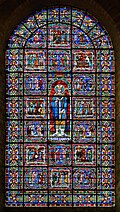 Julian of Le MansSaint · First Bishop of Le MansJan 14
 Dacius of MilanSaint · Archbishop of MilanJan 14
- Macrina the ElderSaint · Grandmother of Basil the GreatJan 14
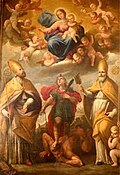 PotitusMartyr · Early martyrJan 14
 Acacius of TverSaint · Bishop of Tver and KashinJan 14
- Paul the FatherSaintJan 14
- Adam of SinaiVenerable MartyrJan 14
- Anthony ChirkovVenerable MartyrJan 14
- Baodan Mor of Inis MorVenerableJan 14