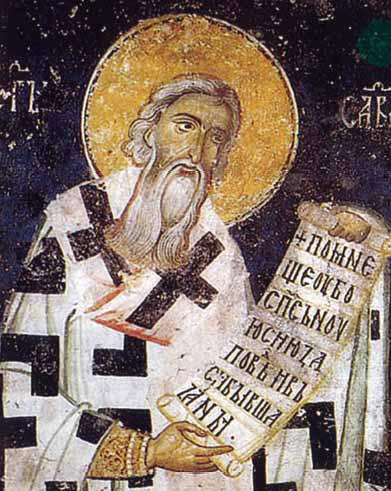
Saint
Sava of Serbia
First Archbishop of the Serbs
A king's son who became an Athonite monk, founder of the autocephalous Church of Serbia and its first archbishop.
- Feast
- January 14old style January 27
- Reposed
- 123513th century
- Place
- Veliko Tarnovo
- Order
- Hierarchs
Life
Saint Sava of Serbia, called the Enlightener or the Illuminator, was a prince's son, a monk on Mount Athos and the first archbishop of the autocephalous Serbian Orthodox Church. He was also a writer, a diplomat and the founder of Serbian law, and the Serbs count him the greatest figure of their people. He founded the monastery of Hilandar on Athos. The Church remembers him on 14 January (27 January on the new style), the day of his repose. The Serbs call the feast Savindan, and the saint is the patron of Serbia, of the Serbs and of schools.
Youth
Baptized Rastko, he was born in 1169 or 1174 at Miščiće, in the Deževa valley, the youngest son of Grand Prince Stefan Nemanja, founder of the Nemanjić dynasty, and of Ana. His older brothers were Vukan and Stefan, who was to be called the First-Crowned. His biographers say he was born after a pause in the couple's childbearing and was therefore especially dear. At the Serbian court the brothers received a good education in the Byzantine tradition. Rastko showed himself serious and strict with himself, and around 1190, as the youngest son, he was given to rule Hum, a land between the Neretva and Dubrovnik.
Teodosije the Hilandarian writes that Rastko was mild and kind to all, a lover of the poor and full of respect for the monastic life, with no wish for fame, wealth or throne. After two years, in the autumn of 1192 or soon after, he left Hum and went secretly to Mount Athos, urged on by Athonite monks who often visited the Serbian court and by a Russian monk who had helped him decide.
On Athos
On Athos he entered the Russian monastery of Saint Panteleimon, where he was tonsured a monk with the name Sava. He then went to Vatopedi, where he stayed seven years and came to know the Greek theological and church writings. His father tried to bring him home, but Sava answered that he had done all that is asked of a Christian ruler and called him to join him in the true Christian life. Nemanja listened. He called an assembly at Studenica, gave up the throne on 25 March 1196 in favour of his middle son, Stefan, and the next day received the tonsure, with the name Simeon. In the autumn of 1197 he came to Athos.
The two toured the monasteries of the Holy Mountain together. Sava went to Constantinople to Emperor Alexios III Angelos and asked him to grant him and his father the abandoned monastery of Hilandar. In July 1198 the emperor issued the charter, and the restoration began quickly. The founding charter of Hilandar dates from 1199, and Sava wrote the typikon of the monastery, modelled on that of the Euergetis monastery in Constantinople, and the typikon of the hermitage at Karyes, where he also built a chapel of Saint Sabbas the Sanctified, whose name he bore. Simeon fell asleep on 13 February 1199. In 1204 Sava received the rank of archimandrite. He is also counted among the founders of the Athonite monasteries of Vatopedi, Karakallou, Xiropotamou and Philotheou.
Return to Serbia
After troubles on Athos with the Latin bishops and Boniface of Montferrat, following the Fourth Crusade, Sava returned to Serbia in the winter of 1205 and 1206 or 1206 and 1207, with the relics of his father, which he laid in his foundation, the monastery of Studenica. He reconciled his quarrelling brothers and completed the canonization of Nemanja as a saint.
As abbot of Studenica Sava drew up the monastery's typikon, in which he set it as independent of the bishopric of Raška and the archbishopric of Ohrid. It was the first step toward the autocephaly of the Serbian Church. He also wrote the Life of Saint Simeon, his father, the first Serbian life of a saint. In 1217 he left again for Athos, probably dissatisfied that his brother Stefan had accepted a royal crown from Rome through a papal legate.
Archbishop of Serbia
On 15 August 1219, the feast of the Dormition of the Mother of God, Patriarch Manuel I of Constantinople, at Nicaea, consecrated Sava the first archbishop of the autocephalous Serbian Church, with the support of Emperor Theodore I Laskaris. Sava obtained the right for the Serbian archbishops to be consecrated by the synod of their own bishops, without the consent of the Latin patriarch of Constantinople. This was important because the Serbian Church looked toward Byzantium, not toward Rome.
Back in Serbia, he held an assembly at Žiča, where he chose bishops from among his disciples and sent them to their sees with books of law. The seat of the archbishopric was at the monastery of Žiča, and bishops were placed at Zeta, Hum, Dabar, Moravica, Budimlja, Toplica, Hvosno, Raška, Lipljan, Prizren and elsewhere, many of them on the border with the Catholic West, to support Orthodoxy. The Greek bishop at Prizren was replaced by a Serb, his disciple. In the same year he issued the Zakonopravilo, the nomocanon that became the first constitution of Serbia and the foundation of Serbian law.
Pilgrimages and repose
After the crowning of his nephew Radoslav, Sava set out in 1229 for the Holy Land, visited nearly all the holy places and gave generously. Patriarch Athanasius of Jerusalem received him gladly. He bought for the Serbian monks the monasteries of Saint John the Theologian on Mount Sion and of Saint George at Acre, and from Mar Saba he brought to Hilandar the icon of the Three-Handed Mother of God. He then travelled for four years through the land, giving monastic rules after the model of Athos and Palestine.
When Radoslav was succeeded on the throne by Vladislav, in 1234, Sava set out on a second journey to the Holy Places, leaving as his successor his disciple Arsenije Sremac. He went to Acre, Jerusalem, Alexandria, Sinai, Antioch and Constantinople, and then, instead of returning by Athos, stopped at Tarnovo, the Bulgarian capital, where he was received by Emperor Ivan Asen II and Patriarch Joachim. Sick and exhausted, feeling the end near, he sent his companions to Serbia with gifts for his "children". He fell asleep in the night between Saturday and Sunday, on 14 January 1235 (some sources give 1236), and was buried in the church of the Holy Forty Martyrs.
Relics and veneration
King Vladislav earnestly asked for the relics from his father-in-law, Emperor Asen. After several embassies he was allowed to take them, and on 6 May 1237 they were carried with great honour to the monastery of Mileševa. Not only Orthodox but also Catholics and Muslims came to his tomb. In 1594, after an uprising of the Serbs in the Banat who carried the icon of Sava on their banners, Grand Vizier Sinan Pasha ordered the relics brought to Belgrade and burned them on the Vračar plateau, on 27 April. His left hand is believed to have been saved and is kept at Mileševa. Near the place of burning stands today the cathedral of Saint Sava, begun in the 1930s and completed in 2004, one of the largest churches in the world.
Churches bear his name throughout Serbia, in Bosnia, Croatia and Montenegro, and his image is found in nearly every Serbian church. He is honoured by Greeks, Bulgarians, Romanians and Russians, while the Serbs honour him as father and enlightener of their people, the figure most deeply bound to the soul of the nation.
Commemorated the same day January 14
 NinoEqual-to-the-Apostles · Enlightener of GeorgiaJan 14
 Felix of NolaConfessor · Presbyter of NolaJan 14
 Julian of Le MansSaint · First Bishop of Le MansJan 14
 Dacius of MilanSaint · Archbishop of MilanJan 14
- Macrina the ElderSaint · Grandmother of Basil the GreatJan 14
 PotitusMartyr · Early martyrJan 14
 Fathers slain at Sinai and RaithuHoly Venerable Martyrs · Monks slain at Sinai and RaithuJan 14
 Acacius of TverSaint · Bishop of Tver and KashinJan 14
- Paul the FatherSaintJan 14
- Adam of SinaiVenerable MartyrJan 14
- Anthony ChirkovVenerable MartyrJan 14
- Baodan Mor of Inis MorVenerableJan 14