Confessor
Felix of Nola
Presbyter of Nola
Priest of Nola near Naples who gave his goods to the poor and was tortured in the persecution of Decius.
- Feast
- January 14old style January 27
- Reposed
- 3134th century
- Place
- Nola
- Order
- Confessors
Life
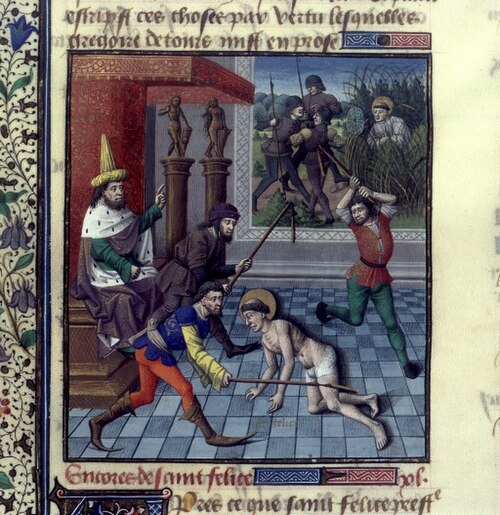
Saint Felix of Nola was a priest of the Church of Nola, near Naples in Italy, in the third century, a confessor of the faith in the persecution of the Emperor Decius. He sold his goods and gave them to the poor, was arrested and tortured for Christ, and then lived in humble poverty into great old age. The main source for him is the writings of Saint Paulinus of Nola, and the Church remembers him on 14 January.
Youth and priesthood
Felix was the elder son of Hermias, a Syrian centurion who had retired to Nola. After his father's death he gave almost all his property to the poor and took the path of service in the Church. He was ordained priest by Saint Maximus, bishop of Nola, and worked with him.
The persecution
When the persecution of Decius began, about the year 250, Maximus fled to the mountains, while Felix was arrested, beaten, chained and thrown into prison. One night an angel appeared to him and commanded him to go to the help of Maximus. The chains fell, the doors opened and Felix went out. The bishop was alone, ill and exhausted by cold and hunger. Felix hid him in an abandoned building, and according to tradition a spider quickly spun its web over the door, so that the soldiers, thinking the place deserted, went away.
A second attempt to take Felix failed in the same way: he hid in a ruined building, and a spider's web across the entrance made his pursuers think that no one had gone in. The Russian sources say that he stayed hidden six months in a dry well. The two escaped notice until the end of the persecution, with the death of Decius in 251.
His humility
After Maximus died, the faithful wanted Felix as bishop, but he urged them to choose Quintus, a priest senior in service by only seven days. His remaining property had been confiscated during the persecution and he would not take it back. He rented a little land, which he worked with his own hands, and whatever he had beyond bare necessity he gave to the poor, always giving the better of two garments. He died in great old age on 14 January, though the year remains uncertain. Some accounts assign him a martyr's death, either in 255 under Valerian or in the persecution of Decius; in the Roman Catholic calendar he is counted a confessor who survived his torments. Other sources mention a Felix, bishop of Nola, who suffered in the time of Martianus, but it is thought to be the same saint.
Veneration
Five churches were built at the place where he was first buried, outside the city of Nola. His relics are in Nola Cathedral, with portions at Rome and Benevento. Saint Paulinus, who served as doorkeeper at one of these churches, testifies to the crowds of pilgrims who came to his tomb; from his poems and letters the lives of the saint were later composed by Saint Gregory of Tours, Bede the Venerable and the priest Marcellus. Felix is honoured as patron of lost animals and of spiders.
Commemorated the same day January 14
 Sava of SerbiaSaint · First Archbishop of the SerbsJan 14
 NinoEqual-to-the-Apostles · Enlightener of GeorgiaJan 14
 Julian of Le MansSaint · First Bishop of Le MansJan 14
 Dacius of MilanSaint · Archbishop of MilanJan 14
- Macrina the ElderSaint · Grandmother of Basil the GreatJan 14
 PotitusMartyr · Early martyrJan 14
 Fathers slain at Sinai and RaithuHoly Venerable Martyrs · Monks slain at Sinai and RaithuJan 14
 Acacius of TverSaint · Bishop of Tver and KashinJan 14
- Paul the FatherSaintJan 14
- Adam of SinaiVenerable MartyrJan 14
- Anthony ChirkovVenerable MartyrJan 14
- Baodan Mor of Inis MorVenerableJan 14