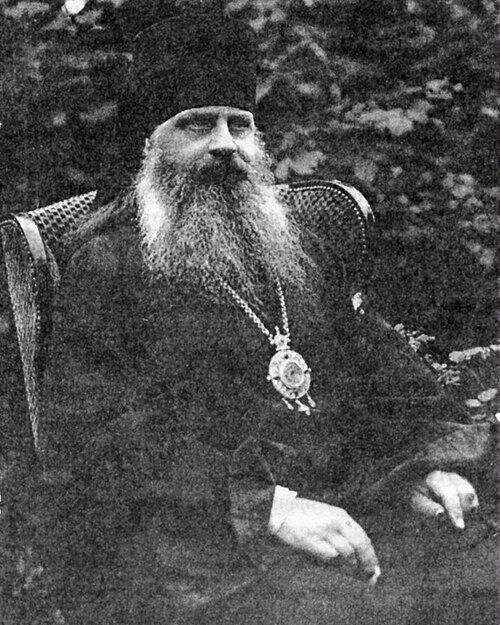
Hieromartyr
Juvenaly Maslovsky
Archbishop of Ryazan
Archbishop of Ryazan and Shatsk, who died a martyr in Tomsk in 1937; canonized in 2000.
- Feast
- September 10old style September 23
- Reposed
- 193720th century
- Place
- Tomsk
- Order
- Martyrs
Life
Saint Juvenaly Maslovsky, the Hieromartyr (in the world Evgeny Alexandrovich Maslovsky, 1878 to 1937), was archbishop of Ryazan and Shatsk, a master of the order of services, a beloved preacher and a confessor in the Soviet camps. He was shot at Tomsk in the night of 24 to 25 October 1937. He was numbered among the saints in 1992, as a saint of Ryazan, and in 2000 for the whole Russian Church. His veneration has, however, been called into question in recent years.
Youth and monasticism
He was born at Livny, in Orel province, to the nobleman Alexander Maslovsky and his wife, Anna. He graduated from the classical gymnasium at Grodno (1899) and the Kazan Theological Academy, with the degree of candidate in theology (1903). On 10 February 1901 he was tonsured a monk, with the name Juvenaly. On 25 February 1901 he was ordained hierodeacon, and on 3 June 1902 hieromonk. From 1903 he was a member of the Urmia Spiritual Mission in Persia. From 1904 he taught homiletics at the Pskov seminary. From October 1906 he was abbot of the cenobitic monastery of Saint Eleazar in the diocese of Pskov, and from 23 October 1910 abbot of the Yuriev monastery at Novgorod, of the first class, with the rank of archimandrite.
Bishop of Kashira and of Tula
By imperial decree of 29 July 1914 he was named bishop of Kashira, vicar of the diocese of Tula, and was consecrated on 24 August that year at Petrograd. He received the Order of Saint Anne, second class (1913) and first (1916), and the Order of Saint Vladimir, third class (1915). From 27 May 1917 he governed the diocese of Tula temporarily. In the elections at Tula of 23 July 1917 he received 86.5 percent of the votes (417 of 482), and on 29 July 1917 was named bishop of Tula and Belev, by the wish shown by clergy and laity at the diocesan congress.
He was a member of the Local Council of 1917 and 1918, in its first two sessions, in section XI. In 1918 he was wounded by Red soldiers when they fired on a procession at Tula. From 1919 he was bishop of Tula and Venev, and from 1920 of Tula and Odoev, a member of the Holy Synod and of the Higher Church Council. In 1922 he was sentenced to ten years of strict isolation for serving a prayer service before a newly renewed icon of the Mother of God and for opposing the confiscation of church valuables. In 1923 he was released.
Archbishop of Kursk and Solovki
From 17 October 1923 he was archbishop of Kursk and Oboyan. In February 1924 he was arrested and in 1925 sentenced, for "anti-Soviet agitation and counter-revolutionary activity", to three years in the Solovki Special Purpose Camp. There he worked as a watchman. He took part in drawing up the "Solovki Epistle" of the bishops in the camp to the Soviet authorities, which proposed that Church and state not interfere in each other's affairs.
In the camp he began to work on a "Solemn Archieraticon", which came to be three thousand pages. He knew the church typikon perfectly and astonished contemporaries by his exceptional memory of church chants. He tried to link the practice of the episcopal services of ancient Rus, contained in the ceremonials of the cathedrals of the Dormition in Moscow, the Transfiguration at Kholmogory, the Transfiguration at Nizhny Novgorod and Saint Sophia at Novgorod, with the Church's present practice, and to bring various local particularities under common rules for all episcopal services. The manuscript was lost in 1935. He supported the "Declaration" of Metropolitan Sergius (Stragorodsky) on loyalty to the Soviet power, and at his request was released from the camp.
Pastor of Ryazan
From 27 April 1928 he was archbishop of Ryazan and Zaraysk, a member of the Provisional Holy Synod. In May 1928 Metropolitan Sergius sent him to Metropolitan Agathangel of Yaroslavl, who had separated from him after the "Declaration", to seek agreement, and the archbishop succeeded in softening the conflict between the two metropolitans. From 7 August 1929 he was archbishop of Ryazan and Shatsk. In 1932 he received the cross on the klobuk.
Those who knew him at this time left testimonies. Elena Leonardovna Volnaya recalls that in his sermons one felt that what he called us to do were not abstract truths but his own inner life, by which he himself lived. His prayerfulness was passed on to the faithful, and they were like one family with the father-archpastor at its head. Archpriest Anatoly Pravdolyubov recalls that Archbishop Juvenaly made a special impression on him. He lived in a poor little house on the edge of town, very simply, and sometimes received him in his garden. He was loved by the children with a love that was even excessive, he shone with the beauty of the best of the old princes, he was a wonderful connoisseur of the order of services and a skilful arranger of the beauty of worship, surrounded by young, strict hieromonks with beautiful voices and a rare ability for singing together.
He received into the diocese priests returned from exile, giving them parishes and helping them materially. In 1935 the hieromonk Anatoly (Kupryashkin), a priest of the Starozhilovo district, escaped from custody and hid nearly a week in the archbishop's house, but was betrayed by someone, arrested again and exiled. To Hegumen Cyril (Zelenin), returned from exile, he gave a parish, and after the authorities expelled him for organizing a community of believers and working with youth, he hid him too, and some time later sent him to a new parish. His trials at the end of his time on the see of Ryazan can be judged from his words: life has become hard, no one can be trusted, since you do not know what people surround you, people sell themselves and become GPU agents.
Arrest and the camp
On 22 January 1936 he was arrested, taken to Moscow, held in the Taganka and Butyrka prisons and sentenced to five years in camps. He was accused of having been the organizer and inspirer of a counter-revolutionary group of clergy, monks and churchmen, of systematically holding counter-revolutionary conversations, of serving a solemn memorial service for the former tsar Nicholas II, of making a counter-revolutionary speech at the twentieth anniversary of his consecration (1934), of permitting secret tonsures and of gathering student youth around the church.
He was taken to Sibirlag, arriving on 15 July. In one letter he said he would like to share all he had lived through in recent times, how much that was edifying, consoling, joyful and mystical, and that hence he had good spirits and peace in his soul and the awareness of how insignificant we are and how great is the power of God and His mercy to us. He was sent to a camp point in the village of Chistyunka, near Topchikha station, then to one in the village of Voroshilovka. He worked as a card-index accountant in the finance section, as a bookkeeper, at ordinary labour, ten hours a day, as head of the tool storeroom and as a watchman. On 30 June 1937, because of his health, he was moved to the invalid labour colony at Tomsk.
Martyrdom
In September 1937 he was arrested as a "participant in the counter-revolutionary Cadet-monarchist organization Union for the Salvation of Russia". On 13 October the Special Council of the UNKVD of the Novosibirsk region sentenced him to death. In the night of 24 to 25 October he was shot on Kashtachnaya hill in Tomsk and buried there, in a common grave.
Glorification
In preparing the canonization of the new martyrs carried out by the Russian Church Outside Russia in 1981, his name was entered in the working list. When the nominal list was published, at the end of the 1990s, Archbishop Juvenaly's name was not included, nor were those of other bishops among the supporters of Metropolitan Sergius. He was glorified in the Synaxis of the Saints of Ryazan on 23 June 1992 by decree of Patriarch Alexy II. In August 2000 the Jubilee Bishops' Council of the Russian Church numbered him among the New Martyrs and Confessors of Russia for veneration throughout the Church.
In Ryazan a Foundation of the Hieromartyr Juvenaly of Ryazan was established. On 25 October 2004 a solemn session in his memory was held in the Theatre on Sobornaya, with Archbishop Paul of Ryazan and Kasimov, representatives of the diocese, the authorities and the city. In 2004 Metropolitan Juvenaly (Tarasov) of Kursk retired and received the schema with the name of Saint Juvenaly Maslovsky, who had served on the see of Kursk before Solovki. At the end of 2012 it became known that his name, among 36 new martyrs, had been dropped from the Church's calendar for 2013 without explanation from the official bodies of the Russian Church. No decision of decanonization was taken by the Holy Synod or by the Bishops' Council of February 2013. In the opinion of Protodeacon Andrei Kuraev, this may have happened because of the discovery of new documents containing facts that do not fit the Christian idea of how a saint should behave under interrogation and even under torture. Of his writings there remain speeches, letters from the camp (1995) and letters and words of instruction from his Ryazan time (2004).
Commemorated the same day September 10
 PulcheriaRight-Believing · Empress of ByzantiumSep 10
 Aubert of AvranchesSaint · Bishop of AvranchesSep 10
 Salvius of AlbiSaint · Bishop of AlbiSep 10
 Menodora, Metrodora and NymphodoraHoly Martyrs · Virgin martyrsSep 10
 Benjamin of the Kiev CavesVenerable · Monk of the Kiev CavesSep 10
 Palladius PopovHieromartyr · Priest of IzhmaSep 10
 Victor of ChalcedonMartyr · SoldierSep 10
 Tatiana GrimblitMartyr · NurseSep 10
- Sophia of SicilyMartyrSep 10
 Varus ShmarinHieromartyr · Bishop of LipetskSep 10
 Sosthenes of ChalcedonSaintSep 10
- Agapius of NovaraSaint · Bishop of NovaraSep 10