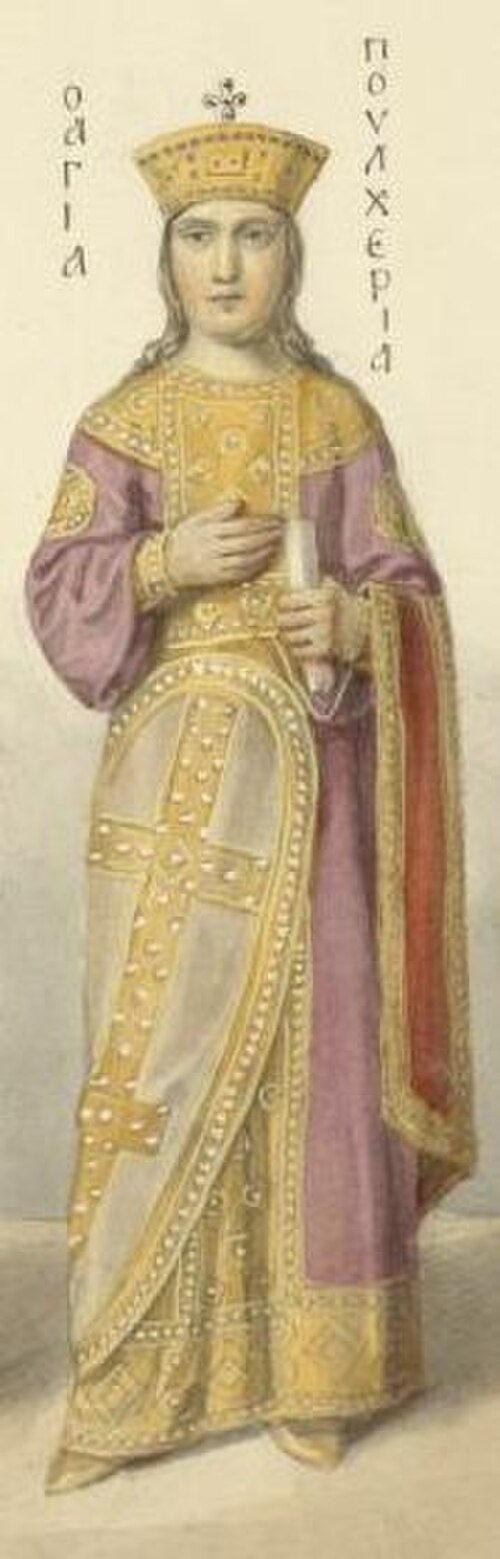
Right-Believing
Pulcheria
Empress of Byzantium
Byzantine empress, adviser to her brother Theodosius II and wife of Emperor Marcian.
- Feast
- September 10old style September 23
- Reposed
- 4535th century
- Place
- Constantinople
Life
Saint Pulcheria the Right-Believing was the daughter of the emperor Arcadius, the sister and adviser of Theodosius II, and later the wife of the emperor Marcian. By her love of the right faith, her foundations, and her support for the Councils of Ephesus and Chalcedon, she had great influence on the Church in the fifth century. The Church commemorates her on 10 September.
Youth and vow
She was born in Constantinople on 19 January 398 or 399, the second child of the emperor Arcadius and the empress Eudoxia. She had a younger brother, Theodosius, born in 401, and two younger sisters, Arcadia and Marina. After Arcadius died in 408, Theodosius, aged seven, remained as sole emperor. In 414, at fifteen, Pulcheria was proclaimed Augusta and became the guardian of her brother. She then made a vow of virginity, on 4 July, and her sisters followed her. The historian Sozomen tells that no man was allowed into her palace, to avoid scandal, and the court took on the look of a monastery: chanting and reading of Scripture, fasting twice a week, plain garments, and charity toward strangers and the poor.
Sozomen says that she trained Theodosius in how to behave as emperor, and some historians think she governed the state until he came of age. Others believe the burden was carried by a body of counsellors. Her synaxarion life says that she taught her brother letters and the fear of God, and found him a wife in Athenais, the daughter of an Athenian philosopher, whom she brought to baptism and who took the name Eudocia.
Defender of the faith
Pulcheria had a part in the Third Ecumenical Council at Ephesus in 431, which condemned Nestorius for denying the title of Mother of God to the Virgin Mary. She built churches of the Mother of God in Constantinople: Blachernae, Hodegetria and Chalkoprateia. She also built churches and houses for the poor, and the district of Pulcherianai in the city carries her name. According to the sources, she had the relics of Saint Flavian brought back with honour. In time her influence at court declined, especially through the work of the eunuch Chrysaphius and her rivalry with Eudocia, and the council of Ephesus in 449, called the "Robber Council," was a defeat for the right faith. Saint Flavian died of the beatings he received there. Pope Leo the Great praised her piety.
Marcian and Chalcedon
Theodosius died on 26 July 450, after a fall from his horse. Pulcheria took the lead again. On 25 November 450 she married the general Marcian, on the condition that he respect her vow of virginity, which he did. The Church declared that Christ Himself had blessed the union. After the wedding the two removed Chrysaphius. Together they convened the Fourth Ecumenical Council at Chalcedon in 451, attended by some four hundred and fifty bishops. The Council condemned the teachings of Nestorius and Eutyches and confessed Christ perfect God and perfect man, in one Person, in two natures. The Fathers hailed Marcian as a new Constantine and Pulcheria as a new Helena. According to the synaxarion and the OCA, she also found the relics of the Forty Martyrs of Sebaste.
Repose
Pulcheria passed to the Lord in July 453 in Constantinople (the exact day is not known with certainty), aged about fifty-four. She left her wealth to the poor and to the Church. Her death grieved the city. The Church placed her among the saints, and her commemoration is on 10 September.
Commemorated the same day September 10
 Aubert of AvranchesSaint · Bishop of AvranchesSep 10
 Salvius of AlbiSaint · Bishop of AlbiSep 10
 Menodora, Metrodora and NymphodoraHoly Martyrs · Virgin martyrsSep 10
 Benjamin of the Kiev CavesVenerable · Monk of the Kiev CavesSep 10
 Palladius PopovHieromartyr · Priest of IzhmaSep 10
 Victor of ChalcedonMartyr · SoldierSep 10
 Tatiana GrimblitMartyr · NurseSep 10
 Juvenaly MaslovskyHieromartyr · Archbishop of RyazanSep 10
- Sophia of SicilyMartyrSep 10
 Varus ShmarinHieromartyr · Bishop of LipetskSep 10
 Sosthenes of ChalcedonSaintSep 10
- Agapius of NovaraSaint · Bishop of NovaraSep 10