Martyr
Sophia of Sicily
According to oral tradition, born into a noble Byzantine family, the daughter of a pagan; she died a martyr in Sicily.
- Feast
- September 10old style September 23
- Reposed
- 2213rd century
- Place
- necropolis of Pantalica
- Order
- Martyrs
Life
Holy Martyr Sophia of Sicily is venerated as a martyr in Sicily. Our calendar gives the commemoration on 10 September, but the source says 18 September, the day of her martyric death. According to oral tradition, she was born into a noble family of Byzantium; she died on 18 September 221, at twenty-nine. She is not entered in the Roman Martyrology; her veneration is local, in Sicily, and her legend does not rest on historical sources, so we present her as a saint of tradition.
Her father was a pagan, named Constant, probably a governor. He named his daughter Sophia after the Greek goddess of wisdom. Having lost her mother early, she was shut up by her father, to keep her from the eyes of strangers, with her nurse in a tower, until the age of twelve. Once a Christian named Timothy came to her, who taught her the faith of Christ, baptized her and left as a gift icons of the Saviour, of the Mother of God and of Saint John the Baptist. After secret prayers before the holy icons, the saint resolved to give her virginity to Christ.
Her father, learning of her conversion, asked her to renounce the faith. She stayed firm, endured scourging and remained in prison until she was freed by her companions in Christ. Saint Sophia then decided to settle on the shore near Syracuse. Here, through her prayers, a lame man was healed who begged alms and called on the pagan gods, but who came to believe that only the Triune God can help those in need. Then, to escape the gaze of men, the saint chose to live in solitude in one of the caves on the territory of Pantalica. The prefect of Pantalica, Martial, made efforts to find the young maiden. He questioned two shepherds, one of whom pointed out where she dwelt. He dragged her by the hair out of her hiding place and brought her back to her homeland. There, before her father, he subjected Saint Sophia to torments, then beheaded her. It was 18 September 221. Her father, after these outrages against his daughter, accepted Christianity three years later.
The beginning of the veneration of Saint Sophia is placed in the tenth century, when Sicily was under Byzantine rule. The veneration is linked with the aristocratic Gaetani family, who in the sixteenth century raised a church in her honour at Sortino. After the destructive earthquake of 1693 in Sicily, Pietro Gaetani made efforts to rebuild the church in Baroque style. In the parish of San Nicolò di Zafferia, at Messina, an image of the saint in monastic dress is preserved, from 1300. In the church of Saint Sebastian at Sortino there are two other images, in one of which the saint is among other holy virgins and in the other together with the Holy Family. Although she is not included in the Roman Martyrology, on 29 August 1538 the king of Sicily received a letter from Pope Paul III of 11 March 1535 confirming that Saint Sophia is the patroness of Sortino.
Commemorated the same day September 10
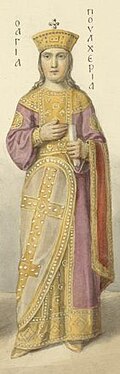 PulcheriaRight-Believing · Empress of ByzantiumSep 10
 Aubert of AvranchesSaint · Bishop of AvranchesSep 10
 Salvius of AlbiSaint · Bishop of AlbiSep 10
 Menodora, Metrodora and NymphodoraHoly Martyrs · Virgin martyrsSep 10
 Benjamin of the Kiev CavesVenerable · Monk of the Kiev CavesSep 10
 Palladius PopovHieromartyr · Priest of IzhmaSep 10
 Victor of ChalcedonMartyr · SoldierSep 10
 Tatiana GrimblitMartyr · NurseSep 10
 Juvenaly MaslovskyHieromartyr · Archbishop of RyazanSep 10
 Varus ShmarinHieromartyr · Bishop of LipetskSep 10
 Sosthenes of ChalcedonSaintSep 10
- Agapius of NovaraSaint · Bishop of NovaraSep 10