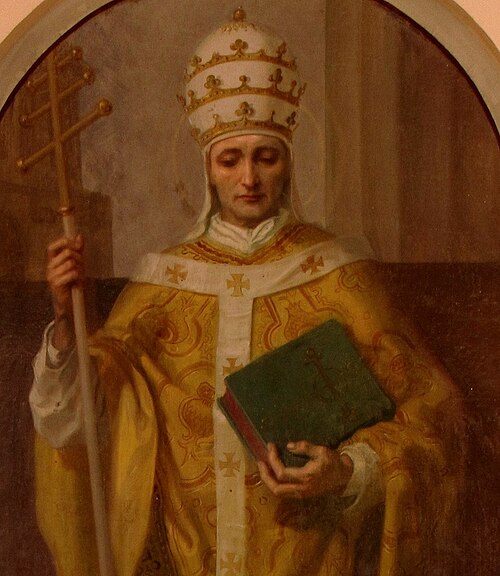
Saint
Leo IX
Pope of Rome
Pope of Rome from 1049 to 1054, a reformer of the Western Church, who reposed in 1054.
Life
Leo IX, born Bruno of Egisheim-Dagsburg, was pope of Rome from 12 February 1049 until his death on 19 April 1054, a reformer of the Western Church. He was born on 21 June 1002 at Egisheim in Upper Alsace. He is honored as a saint in the Roman Catholic Church, which remembers him on 19 April. The Orthodox Church does not venerate him.
He was the youngest son of Count Hugh IV of Nordgau and Hedwig of Dagsburg; his father was a first cousin of the emperor Conrad II. At five he was entrusted to the care of Berthold, bishop of Toul, who had a school for the sons of nobles. In 1017 he became a canon at Saint Stephen's in Toul. In 1024, when his cousin Conrad took the throne, relatives sent him to court to serve in the king's chapel. As a deacon, in 1026, he led the Toul contingent in Conrad's expedition to Italy, and during this time Bishop Herimann died and Bruno was elected in his place. Consecrated in 1027, he governed the diocese of Toul for over twenty years, in times of famine and war. He rendered important political services to Conrad II and to Henry III and knew how to make peace.
As pope he held the Easter synod of 1049 and summoned a meeting of the higher clergy at Reims, in which reforming decrees were passed. At Mainz he held a council at which the Italian, French and German clergy were represented and ambassadors of the Byzantine emperor were present; simony and other abuses were condemned. In 1053 he arbitrated a dispute between the archbishop of Carthage and the bishop of Gummi. From June 1053 to March 1054 he was held hostage at Benevento by the Normans, in honorable captivity, until he acknowledged their conquests in Calabria and Apulia.
Patriarch Michael Cerularius of Constantinople, through Leo of Ohrid, wrote to the pope denouncing the use of unleavened bread and the fasting days in the Latin Church. In 1054 Leo IX sent the patriarch a letter, citing at length the so-called Donation of Constantine, which he believed genuine, to support the primacy of the pope. Before his death he had sent a legatine mission, under Cardinal Humbert of Silva Candida, to Constantinople. Humbert ended the negotiations by delivering a bull excommunicating the patriarch, legally invalid because the pope had died in the meantime. The patriarch answered with his own excommunication, and this exchange is commonly regarded as the official split between the Eastern and Western Churches. The pope had died at Rome on 19 April 1054, not long after his return.
He is a saint of the West; no Orthodox synodal canonization is known.
Commemorated the same day April 19
 ExpeditusMartyr · Centurion of MeliteneApr 19
 Alphege of CanterburyHieromartyr · Archbishop of CanterburyApr 19
 Tryphon of ConstantinopleSaint · Patriarch of ConstantinopleApr 19
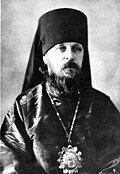 Viktor OstrovidovConfessor · Bishop of Izhevsk and VotkinskApr 19
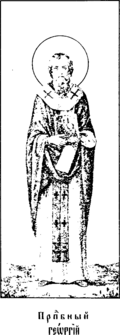 George the ConfessorSaint · Bishop of Antioch in PisidiaApr 19
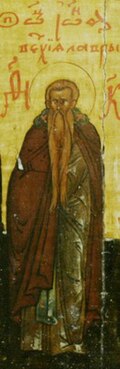 John PalaiolavritesVenerableApr 19
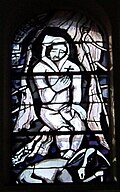 Gerold of WalsertalVenerable · Hermit in VorarlbergApr 19
- Agathangelos of EsphigmenouNew Martyr · Monk of EsphigmenouApr 19
- Agathangelus of SmyrnaVenerable MartyrApr 19
- Antoninus of NicomediaMartyrApr 19
- AristonicusMartyrApr 19
- BassusMartyr · Martyr of AfricaApr 19