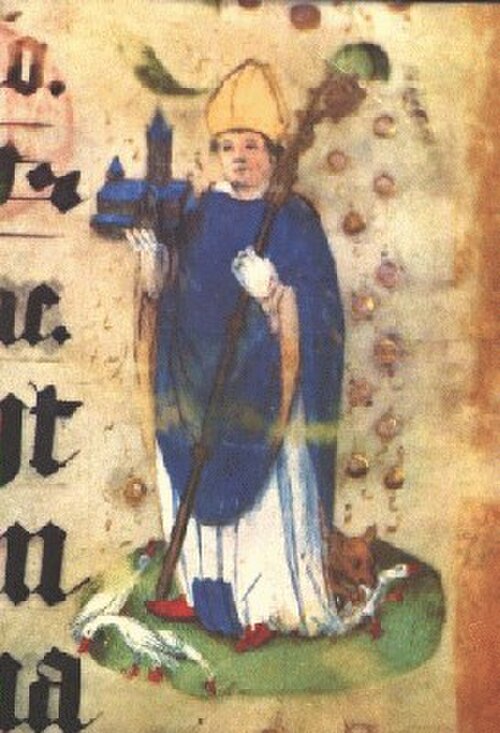
Saint
Ludger of Münster
Bishop of Münster
First Bishop of Münster and enlightener of the Saxons and Frisians, reposed in 809.
Life
Saint Ludger of Münster (Liudger), born around 742 and died on 26 March 809, was a missionary among the Frisians and Saxons, the founder of Werden Abbey and the first bishop of Münster in Westphalia. He is called the apostle of Saxony. A friend and pupil of Alcuin, he won the Saxons by gentleness, more than the armies of Charlemagne.
Youth and studies
His parents, Thiadgrim and Liafburg, were wealthy and noble Christian Frisians. In 753 he saw Saint Boniface, the apostle of Germany, and the impression was deep, especially after the saint's martyrdom. At his own request he was sent to the cathedral school of Utrecht, and in 767 he accompanied Alubert to York, where he was ordained deacon and studied under Alcuin; after a year he returned to Utrecht and later went back to York, where his friendship with Alcuin lasted all his life. In 772 he went home, taking valuable books with him, and after the death of Gregory of Utrecht (775) he wrote his life. He was sent to Deventer to restore the chapel destroyed by the pagan Saxons and to find the relics of Saint Lebuin.
The mission among the Frisians
Ordained priest at Cologne on 7 July 777, he was entrusted with the missions of East Frisia, with Dokkum, the place of Boniface's martyrdom, as centre. After seven years, in 784, Widukind persuaded the Frisians to drive out the missionaries and burn the churches. Ludger escaped with his disciples and in 785 was at Rome, received by Pope Hadrian I, and then withdrew to Monte Cassino, where he lived by the Rule of Saint Benedict without taking vows. The arrival of Charlemagne at Monte Cassino in 787 put an end to his retreat. He was appointed missionary to five districts east of the river Lauwers, where he knew the language and customs of the people. He also worked on the island of Bant, since sunk beneath the sea, and on Heligoland, where he destroyed the remains of paganism, built a church and rededicated the pagan spring as a baptismal font. He is said to have cured of blindness the bard Bernlef, the last of the Frisian skalds, and to have made him a Christian.
Westphalia and the bishopric
In 793 Charlemagne wished to make Ludger bishop of Trier, but he declined, offering instead to preach to the Saxons of north-western Saxony. He built a monastery of canons at Mimigernaford, which took from it the name Münster, as well as the churches of Billerbeck, Coesfeld, Nottuln and others. For his sister Gerburgis he built a home at Nottuln, from which came the first convent in Westphalia (about 803). The abbey of Werden, founded about 800 and consecrated in 804, on land he had acquired, fulfilled his desire to found a Benedictine house. On 30 March 805, at Alcuin's recommendation, Charlemagne had him consecrated bishop of Münster. His chief concern was a good and efficient clergy; he taught his students personally and took some of them on his missionary journeys. He also founded the monastery of Helmstedt. In his lifetime he was criticised for giving to the poor money that should have gone to adorn his churches.
Repose and veneration
On Passion Sunday 809 (the fifth Sunday of Lent in the western reckoning) he heard Mass at Coesfeld, preached, then at Billerbeck preached again and celebrated his last Mass. That evening he died peacefully among his followers, at the age of sixty-six. A dispute arose between Münster and Werden for his remains; his brother Hildegrim decided for Werden, where they still lie, with portions brought to Münster and Billerbeck. He is the patron of Werden, East Frisia and Deventer. He is a saint of the undivided Church, commemorated on 26 March (new style; 8 April in the old style).
Commemorated the same day March 26
 Braulio of ZaragozaSaint · Bishop of ZaragozaMar 26
 CastulusMartyrMar 26
 Basil the YoungerVenerable · Visionary of ConstantinopleMar 26
 Emmanuel of SirmiumMartyrMar 26
 LarissaMartyr · Gothic martyr of CrimeaMar 26
 Malchus of SyriaVenerableMar 26
- AbippusSaintMar 26
- Alla of GothiaMartyrMar 26
 George the Elder of SofiaNew Martyr · New Martyr of SofiaMar 26
- 26 Martyrs in the CrimeaHoly MartyrsMar 26
- Abibas of GothiaMartyrMar 26
- Abraham of LatrosVenerableMar 26