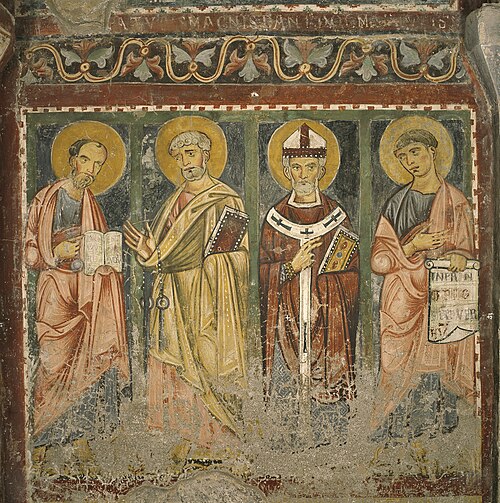
Hieromartyr
Magnus of Anagni
Bishop of Anagni
Italian bishop and martyr, patron of Anagni, who died in the third century.
Life
Saint Magnus, Hieromartyr, bishop of Anagni, is venerated as patron of the city of Anagni in Lazio and is remembered on 19 August. The sources about him are mixed and uncertain, so tradition keeps him mainly through local stories and the veneration of his relics.
According to tradition, Magnus was born in the second century at Trani or at Fabrateria Vetus, into the family of a man named Apollonius. From his youth he was a shepherd, to help his family, and gave his meagre earnings to the needy. He and his father were baptized by Redemptus, bishop of Trani. After Redemptus died, the people and clergy chose Magnus as bishop. As bishop he spread the faith at Fondi, Aquino and Anagni. At Anagni he baptized a woman, Secundina, who later suffered as a martyr. To escape persecution he took refuge in Rome, then returned home, hiding on the way. Soldiers found him in a cave near Fondi and beheaded him near Fabrateria Vetus, in Lazio.
According to tradition, in the ninth century his relics were moved from Fondi to Veroli by a man named Plato. A Muslim leader, Musa, is said to have turned the shrine into a stable, but the horses died, and in fear he sold the relics to the people of Anagni. The relics were placed in the cathedral of Anagni in the time of Bishop Zacharias. Magnus was proclaimed patron of the city, and the thirteenth-century crypt of the cathedral is dedicated to him and painted with scenes of his life and death. He is also honoured at Colle San Magno. The story of a skull and an arm brought from Anagni to Rome, to Santi Michele e Magno and then to Saint Peter's Basilica, belongs to the same tradition, as do the relics sent in 1901 to Louisville, Kentucky.
Scholars have long asked who he really was. It is now thought that the figure may combine an early martyr of Lazio with a Lombard bishop of Trani. In the ninth and tenth centuries his cult became interwoven with that of Saint Andrew the Tribune and his 2,597 companions from Cilicia, but from the eleventh century the cathedral of Anagni kept his episcopal heritage, and his Passion was written there around 1100. The Roman Martyrology names only Magnus of Anagni and states that the data about his life are uncertain. He should not be confused with Saint Magnus of Cuneo, a soldier of the Theban Legion remembered on the same day.
Commemorated the same day August 19
 Sebald of NurembergVenerable · Hermit, patron of NurembergAug 19
- Agapius of CaesareaMartyrAug 19
 Andrew StratelatesMartyr · Roman commander and martyrAug 19
 Theophanes the New of DocheiariouVenerable · Athonite of DocheiariouAug 19
- Badulf of AinayVenerable · Abbot of AinayAug 19
- Bertulf of BobbioVenerable · Abbot of BobbioAug 19
- Bonyu the MacedonianSaintAug 19
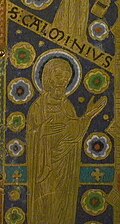 CalminiusVenerableAug 19
- ClydogMartyrAug 19
- Cyril of PontusSaintAug 19
- Donatus of ValVenerableAug 19
- Elaphius of ChalonsSaint · Bishop of Châlons-sur-MarneAug 19