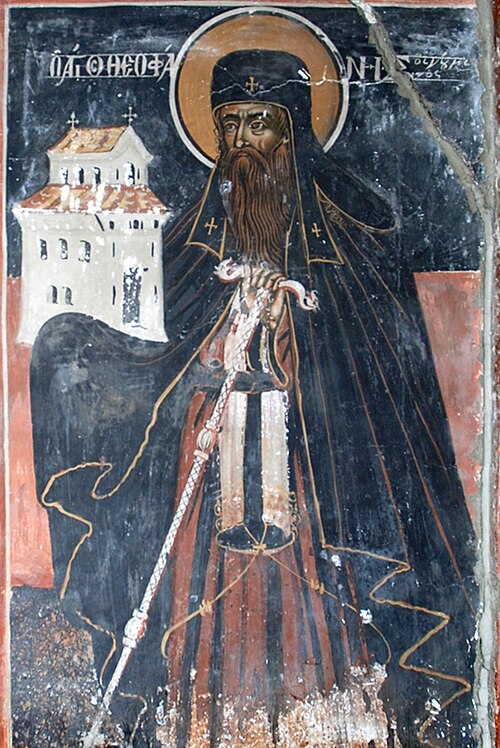
Venerable
Theophanes the New of Docheiariou
Athonite of Docheiariou
Athonite monk of Docheiariou Monastery, who died at the Monastery of Saint John the Baptist near Veria.
- Feast
- August 19old style September 1
- Reposed
- 160016th century
- Place
- Saint John the Baptist Monastery, Veria
- Order
- Venerables
Life
Saint Theophanes the New (Theophanes of Naousa, Theophanes the Wonderworker, Theophanes of Docheiariou) the venerable was a Greek monk of the sixteenth century, patron of the city of Naousa in Macedonia. He first struggled at the Docheiariou monastery on Athos, then at Veria, and founded the monastery of the Holy Archangels near Naousa. He died on 19 August, the day on which he is commemorated. The exact year of his death is not certain; the sources place him in the sixteenth century, and the archive record gives as an approximate date the year 1600.
Athos and the rescue of his nephew
For his life there are two main written sources: one printed in Venice in 1764 and another in Thessalonica in 1883. He was born at Ioannina at the beginning of the sixteenth century. From youth he left for Mount Athos and entered the brotherhood of the Docheiariou monastery, one of the first seaside monasteries one sees on arriving at the Athonite peninsula. By constant effort to keep his mind clean of thoughts and the temptations of the evil one, he acquired, by the grace of God, inner peace and spiritual maturity, putting the salvation of his soul above material needs. His virtue brought him forward among the brethren of the monastery, who, after the death of the previous abbot, chose him abbot. In this service he was distinguished by faithful practice of the evangelical virtues and conformity to the divine will, and was a just and loving spiritual father to the other brethren.
During the years of his abbacy on Athos he received a letter from his sister, who told him of a heavy blow that her family had suffered: the Ottomans had seized her son and taken him to Constantinople, to put him in the janissary corps, which meant conversion to Islam and military service under foreign authority. Shaken and deeply anxious for the salvation of his nephew, the saint left the Mountain for a time and went to Constantinople. There, after searching, he managed to find him in time, before he was forced to change his faith, and with many persistent efforts he finally managed to obtain his release and take him along. After returning to Athos, the saint put his nephew through a period of trial, according to monastic tradition, and then tonsured him a monk. But the young man's presence in the monastery was not accepted by all: part of the brotherhood expressed concern, fearing possible reprisals by the Ottoman authorities, thinking that the young man's release might provoke the wrath of the Turks. This caused division among the brethren: some placed their trust in the will of God, while others insisted on the need for caution and avoiding danger.
Veria and Naousa
Faced with the scandal and disturbance, Saint Theophanes, with discernment and spiritual sensitivity, decided to remove the cause of division. With his nephew he left the monastery and went first to Thessalonica and then to Veria, with, perhaps, Ioannina, his place of origin, as a distant goal. While in Veria, the saint and his nephew were moved by what they heard of the local skete and decided to visit it. They were hosted at the monastery of Saint John the Baptist, where they stayed, since they found spiritual rest. Their presence was much valued by the monastery's brotherhood, who gave them a blessing to build a kathisma, that is, a small monastic dwelling, a short distance from the monastery, so that they could remain near and benefit others spiritually by their life and example. The saint built this kathisma dedicated to the Mother of God a little below the monastery, in the direction of the river, about ten minutes away. Soon, besides his nephew, other monks gathered beside him who wished to submit to his spiritual guidance. As the number of brethren grew, the need arose for a more suitable and wider place, but the skete of Veria was already overfull: about fifty brotherhoods had settled in the valley, and all the available places were taken.
Seeking a new possibility, the saint found a suitable place near Naousa, where he founded the monastery of the Most Great Taxiarchs (the Holy Archangels). For a time he and his disciples travelled the road between Veria and Naousa to organize and complete the building work. At the beginning of the work, the chief mason of the monastery raised objections to the chosen site. The saint, seeking divine light, prayed to the Archangels to reveal to him the place pleasing to them. They laid the monastery's plans on a certain spot and asked God, through the Archangels, to show the suitable place. Indeed the plans moved in an inexplicable way to the spot Saint Theophanes had first indicated, which was taken as a divine sign and confirmation of the rightness of his choice. During the building another incident occurred, characteristic of his holiness: a bear devoured the donkey that carried the building materials, and the saint, with a spiritual power that bears witness to his holiness, subdued the beast and yoked it in the animal's place, using it to continue the work. This marvel was recorded in local tradition and spread his fame as a wonderworker further.
Throughout the building of the monastery of the Holy Archangels at Naousa he had appointed an abbot of the monastery of Saint John the Baptist. He spent the last years of his life between the Naousa monastery and the Veria one. He died on 19 August, in the kathisma of the Mother of God. In the Naousa uprising of 1822 the Veria monastery and the kathisma were destroyed. At the beginning of the twentieth century the saint's skull was found by the people of Naousa; his relics are kept in the church of the Dormition of the Mother of God.
Commemorated the same day August 19
 Sebald of NurembergVenerable · Hermit, patron of NurembergAug 19
 Magnus of AnagniHieromartyr · Bishop of AnagniAug 19
- Agapius of CaesareaMartyrAug 19
 Andrew StratelatesMartyr · Roman commander and martyrAug 19
- Badulf of AinayVenerable · Abbot of AinayAug 19
- Bertulf of BobbioVenerable · Abbot of BobbioAug 19
- Bonyu the MacedonianSaintAug 19
 CalminiusVenerableAug 19
- ClydogMartyrAug 19
- Cyril of PontusSaintAug 19
- Donatus of ValVenerableAug 19
- Elaphius of ChalonsSaint · Bishop of Châlons-sur-MarneAug 19