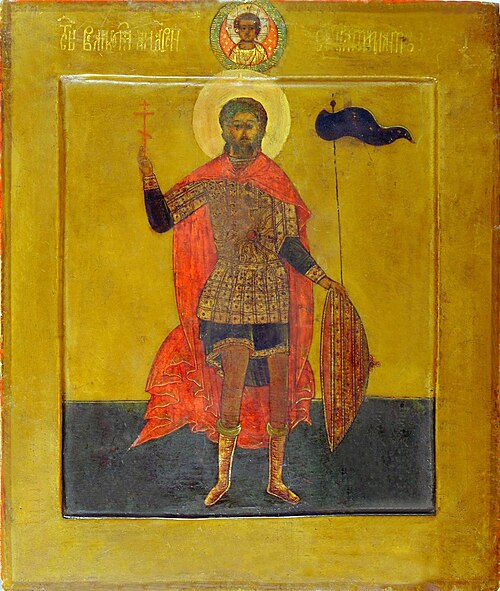
Martyr
Andrew Stratelates
Roman commander and martyr
Roman officer of the 3rd century, martyred in the Taurus mountains with 2,593 soldiers.
Life
Saint Andrew Stratelates the Martyr (Andrew the Commander, Andrew the Tribune) was a senior officer of the Roman army, a Syrian by birth, killed for faith in Christ with his 2,593 soldiers in the Taurus mountains in the time of Emperor Maximian. The Orthodox Church and the Catholic Church commemorate him on 19 August. The sources disagree on the year of his death: one gives about 302, another 294 or 305, and the chronology of Maximian's reign is itself given differently.
Victory over the Persians
Little is known of his early life except that he was a Syrian by birth and a military commander in the Roman army in the time of the Emperor Maximian. The English source gives the years of the reign as 284 to 305, the Russian one 285 to 310; the Romanian source calls him "Maximian Galerius" and places his death on Sunday, 19 August, in the year 294 or 305. The Serbian and Russian sources give about 302. The Ukrainian one says only that he lived in the fourth century.
For his courage, invincibility and justice, the future saint was loved in the Roman army. When a great Persian army invaded the Syrian lands, the governor Antiochus entrusted Andrew with the command of the Roman forces and gave him the title "stratelates", that is, "commander in chief". Saint Andrew chose a small detachment of brave soldiers, who were pagans. The Russian source says that he himself had not yet been baptized but had come to believe in Jesus Christ; the Ukrainian one, that he believed in Christ in secret. Before battle he told the soldiers that the pagan gods are demons and cannot help in battle and preached to them Jesus Christ as the almighty God of heaven and earth, who helps all who believe in Him. The soldiers entered the battle calling the Savior to their aid. The small detachment put the numerous Persian army to flight. The Ukrainian source adds that the soldiers, seeing that the victory had come with heavenly help, turned to faith in Christ. Andrew returned from the campaign with glory, after a total victory, to Antioch.
Trial and torture
But some envious men told the governor Antiochus that he was a Christian and had converted to his faith the soldiers under his command. Saint Andrew was summoned to trial and there confessed his faith in Christ. For this he was subjected to torture. It is told that he himself lay on a bed of bronze made red-hot, and as soon as he asked the Lord's help, the bed cooled. The soldiers were crucified on trees, but not one denied Christ. The English source says only that some of the soldiers were crucified and others locked in prison. Throwing the saints into prison, Antiochus sent the emperor a report, not daring to condemn the famous victor alone, so as to decide whether to put him to death. The emperor knew how much the army loved Saint Andrew and, fearing a revolt, sent an order to free the martyrs, but secretly ordered them to be put to death, on one pretext or another, one by one.
Freed, Saint Andrew came with his band of soldiers to Tarsus. There they were baptized by the local bishop Peter and Bishop Nonus of Beroea (the Serbian and Ukrainian sources say only that they received baptism at Tarsus). Then the soldiers moved to the region of Taxanata. Antiochus wrote to the governor of the province of Cilicia, Seleucus, that under the pretext of pursuing deserters he should overtake the band of Saint Andrew and kill them; the English source says that after local persecutions in the Cilician city Andrew fled toward Mount Taurus. Seleucus overtook the martyrs, halted in the gorges of the Taurus mountains, where by a revelation they were to suffer. Saint Andrew, calling the soldiers his brothers and children, urged them not to fear death. He prayed for all who would honor their memory and asked the Lord to send people a healing spring in the place where their blood would be shed. During this prayer the martyrs, who did not resist, were cut down with swords (about 302). At that moment a spring flowed out of the ground. Bishops Peter and Nonus, who with their clerics had secretly followed Saint Andrew's band, buried their bodies. One of the clerics, long tormented by an evil spirit, drank from the spring and was healed at once. The news spread among the people of the surrounding area and they began to come to the spring and, by the prayers of Saint Andrew and the 2,593 martyrs who suffered with him, received gracious help from God.
The Serbian source says that the emperor's army overtook them in the gorge while they were praying and killed them to the last man, and the English one that the Roman army ambushed them and slaughtered Saint Andrew and all 2,593 soldiers. The place is called in the Serbian source "the Armenian mountain Taurus", and in the Ukrainian "near the Armenian city of Melitene (Lesser Armenia)", where idolaters cut them down with swords; the Russian source speaks of the Taurus mountains of Cilicia. The number of the martyrs is the same in all the sources that give it: 2,593 (the Ukrainian one writes "2 thousand 593").
Iconography and commemoration
In Byzantine icon painting there were several types of depicting Andrew Stratelates. The most widespread is that of a young soldier-martyr in armor, with dark hair and a small beard. In ancient Russian art he was usually shown in armor and cloak, with a cross in his hand, a short beard and curly hair with grey in it; in church paintings, usually on a pillar, standing, with spear, bow and shield. In the Hermeneia of Dionysius of Fourna it is said of the appearance of Saint Andrew: "an old man with curly hair". A seventeenth-century icon-painters' manual, published by Sergei Bolshakov in 1903, says he has grey, curly hair, the beard of John the Theologian, is in armor, with a green cloak, checkered breastplate, green robe, blue lining, purple trousers, a cross in the right hand, a spear in the left, and the shield on the left.
The Orthodox Church celebrates him on 19 August by the Julian calendar; the Ukrainian source gives 1 September, which corresponds to the same day by the new calendar.
Commemorated the same day August 19
 Sebald of NurembergVenerable · Hermit, patron of NurembergAug 19
 Magnus of AnagniHieromartyr · Bishop of AnagniAug 19
- Agapius of CaesareaMartyrAug 19
 Theophanes the New of DocheiariouVenerable · Athonite of DocheiariouAug 19
- Badulf of AinayVenerable · Abbot of AinayAug 19
- Bertulf of BobbioVenerable · Abbot of BobbioAug 19
- Bonyu the MacedonianSaintAug 19
 CalminiusVenerableAug 19
- ClydogMartyrAug 19
- Cyril of PontusSaintAug 19
- Donatus of ValVenerableAug 19
- Elaphius of ChalonsSaint · Bishop of Châlons-sur-MarneAug 19