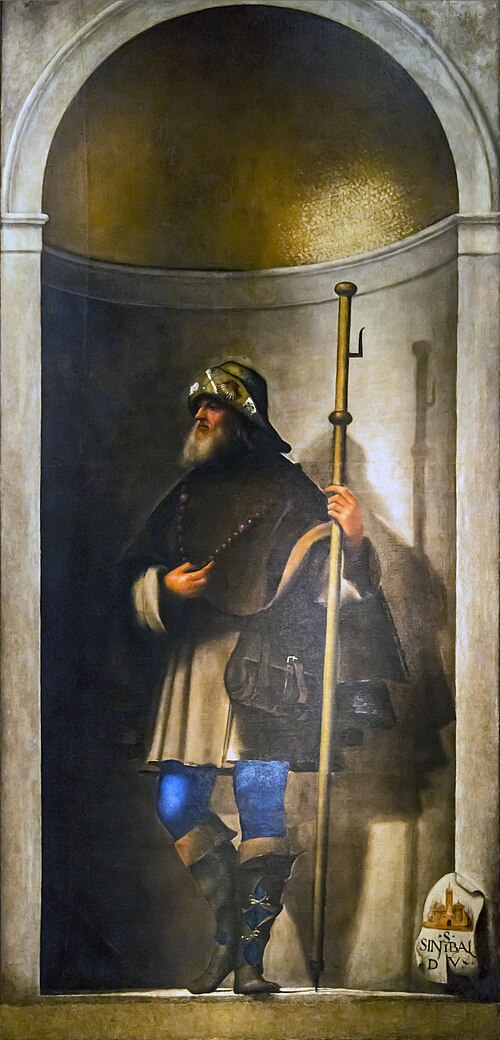
Venerable
Sebald of Nuremberg
Hermit, patron of Nuremberg
Anglo-Saxon missionary to Germany who lived as a hermit in the forest near Nuremberg, whose patron he is.
- Feast
- August 19old style September 1
- Reposed
- 8008th century
- Place
- Nuremberg
- Order
- Venerables
Life
Saint Sebald is venerated as a missionary and hermit of Franconia who lived in the forest near Nuremberg, of which city he remains the patron. Very little about his life is certain, and the Church holds above all the traditions and the memory of his veneration.
All that is known is that he lived as a hermit in the woodland of Poppenreuth, west of Nuremberg. The legends about him differ. An early tradition, from about 1280, says he was of Franconian origin, a contemporary of Emperor Henry III, and that after a pilgrimage to Italy he became a preacher at Nuremberg. Another text calls him a Frankish nobleman who met Willibald and Winibald in Italy, which would place him in the eighth century, and who then became a missionary in the forest that bears his name. Other accounts make him the son of the king of Denmark, or a student at Paris married to a French princess, whom he left on their wedding night to go on pilgrimage to Rome. In these versions the pope gave him the mission of evangelising the forests around Nuremberg.
According to tradition he worked miracles: he healed the blind, filled a jug with wine, and caused the earth to swallow a mocker. The best known story is the "miracle of the icicles". On a winter night he took shelter in the hut of a poor family whose weak fire gave no warmth, and the man said he had no more wood. Sebald asked the wife to break the icicles from the eaves and bring them, then threw them on the hearth, where they blazed into a strong fire.
His veneration appears in the sources at the end of the eleventh century, in a passing mention in the chronicle of Lambert of Hersfeld under the year 1072. In 1255 he became co-patron, with Saint Peter, of the newly rebuilt parish church, where his tomb was venerated. His feast, 19 August, appears in a calendar of Olomouc of 1131 to 1137. In 1397 his relics were moved to the new choir of the church and carried in procession each year, and the kings and emperors of Germany prayed before his shrine when they came to Nuremberg. On 26 March 1425 Pope Martin V canonized him at the request of the council of Nuremberg. From 1429 the florins of the city bore his image.
Around 1480 Sigmund Meisterlin wrote a Latin Life of Saint Sebald. Between 1508 and 1519 Peter Vischer the Elder and his sons made the bronze shrine in the church of Saint Sebald, a masterpiece of the German Renaissance. His veneration survived the Reformation. In Italy he is venerated under the name Sinibaldo.
Commemorated the same day August 19
 Magnus of AnagniHieromartyr · Bishop of AnagniAug 19
- Agapius of CaesareaMartyrAug 19
 Andrew StratelatesMartyr · Roman commander and martyrAug 19
 Theophanes the New of DocheiariouVenerable · Athonite of DocheiariouAug 19
- Badulf of AinayVenerable · Abbot of AinayAug 19
- Bertulf of BobbioVenerable · Abbot of BobbioAug 19
- Bonyu the MacedonianSaintAug 19
 CalminiusVenerableAug 19
- ClydogMartyrAug 19
- Cyril of PontusSaintAug 19
- Donatus of ValVenerableAug 19
- Elaphius of ChalonsSaint · Bishop of Châlons-sur-MarneAug 19