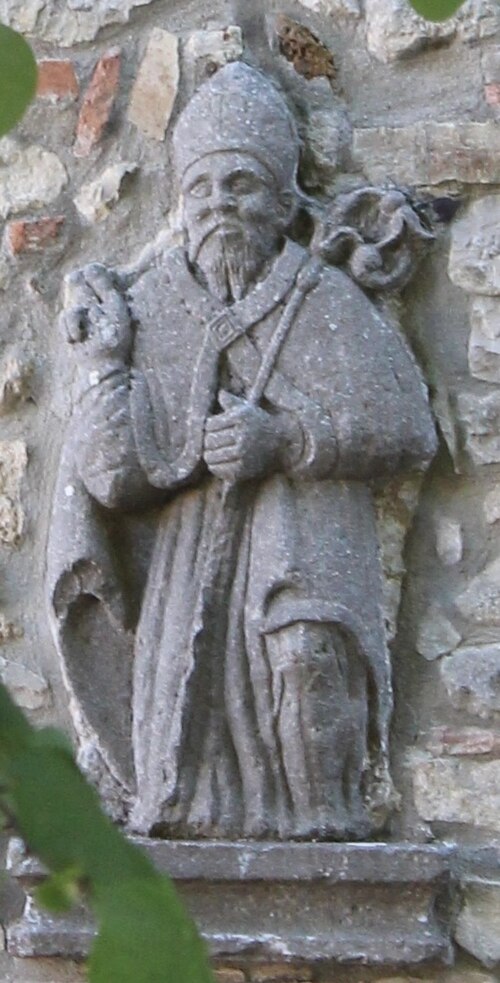
Saint
Marcianus of Frigento
Bishop of Frigento
Born in Greece to a Christian family, he gave his wealth to the poor and became bishop of Frigento in Italy.
Life
Saint Marcian was bishop of Frigento, in Italy, in the fifth century. He is venerated as a saint in the Roman Catholic Church, patron of the towns of Frigento and Taurasi. His commemoration is on 14 June, according to the Benevento manuscript; Philip Ferrari and Du Sollier give 14 July, which does not fit. We have no Orthodox act of canonization, so we call him a saint of the undivided Church in the West.
He was born in Greece, into a Christian family. After the death of his parents he sold all his property to distribute it to the poor and needy. Soon the fame of his virtue and holiness spread throughout the country, and many faithful began to come to him from all parts. For this reason he left his homeland and went to Italy, where he led a hermit's life near Frigento. Because of the various healings and miracles connected with his name, Marcian became an object of veneration for the faithful, who came to him from all sides.
One day, among those who visited him was Laurence, elected bishop of Canosa, who was going to Rome to receive the Pope's blessing. He stopped at Frigento and asked Marcian to accompany him to the capital. Not far from the city Pope Leo the Great met them, and found only Laurence, because Marcian had gone to pray in the church of the Mother of God called the "Rotunda". Pope Leo and Laurence went to this church. There the Pope spoke with Marcian, for whose appointment as bishop the will of God was revealed to him. After the episcopal consecration, Marcian and Laurence returned home. Marcian's life abounds in miracles and healings up to the day of his death. His reputation for holiness continues to this day, and many miracles have been shown at his grave.
The Life of Saint Marcian was first published by Ferdinando Ughelli in 1662, in volume eight of his Italia Sacra, from an ancient manuscript now lost. Probably from the same manuscript, Philip Ferrari composed a short text in 1613. In 1723 the second edition of the Life was printed in the Acta Sanctorum, with a commentary by the Bollandist Jean-Baptiste Du Sollier. The texts of Ughelli and Du Sollier are in substance identical. Some manuscripts in the chapter library of Benevento and in the Biblioteca Casanatense have other descriptions of the Life, with a prologue and with the story of the translation of the relics from Frigento to Benevento, made in the time of Bishop Ursus of Benevento, in the first half of the ninth century. The Benevento manuscript gives 14 June as the day of commemoration. The two Lives were printed in Italian translation in 2012.
Commemorated the same day June 14
 ElishaProphet · The ProphetJun 14
 Methodius I of ConstantinopleSaint · Patriarch of ConstantinopleJun 14
 Mstislav Rostislavich the BraveRight-Believing · Prince of Smolensk and NovgorodJun 14
 Fortunatus of NaplesSaint · Bishop of NaplesJun 14
 Elisei of SumaVenerable · Monk of Solovetsky MonasteryJun 14
 Animaisa of OstretsovoVenerable · NunJun 14
 Paul SvetozarovHieromartyr · Archpriest of Ivanovo-VoznesenskJun 14
- Demetrius SemyonovHieromartyr · PriestJun 14
- Niphon KausokalybitesVenerable · Athonite monkJun 14
- Aetherius of VienneSaint · Bishop of VienneJun 14
- Alexander ParusnikovHieromartyrJun 14
- AnastasiusHoly MartyrsJun 14