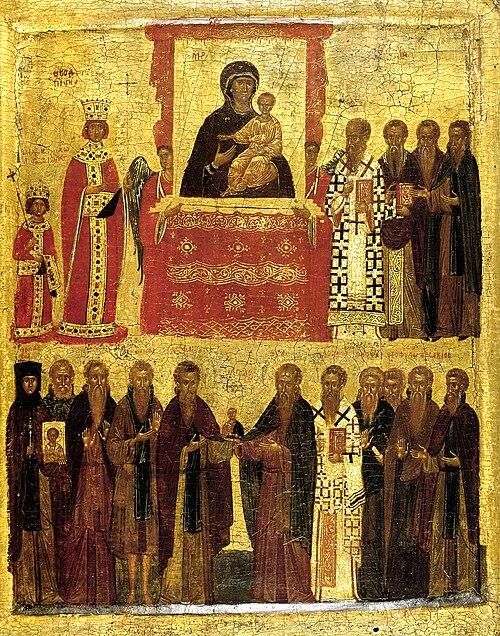
Saint
Methodius I of Constantinople
Patriarch of Constantinople
Patriarch of Constantinople from 843 to 847, known for restoring the veneration of the holy icons.
Life
Saint Methodius I the Confessor was patriarch of Constantinople from 843 until his death on 14 June 847. He is best known for restoring the veneration of the holy icons in 843, closing the second period of iconoclasm, which the Church celebrates on the Sunday of Orthodoxy. He is commemorated by the Orthodox and Catholic Churches on 14 June.
Youth and confession
He was born in 787 or 788 at Syracuse in Sicily, to a wealthy family. As a young man he came to Constantinople to find a place at court, but was moved by a monk’s word and entered the monastery of Chenolakkos in Bithynia, where he was a disciple of Patriarch Nicephorus I and, it seems, became abbot. In 815 Emperor Leo V the Armenian deposed Nicephorus and renewed iconoclasm. Methodius went to Rome, perhaps sent by Nicephorus, and stayed there, copying books and keeping in touch with Theodore the Studite. He returned to Constantinople in 821, with a letter from Pope Paschal I asking that Nicephorus be restored and iconoclasm abandoned, but was seized by Emperor Michael II. According to his Life he received seventy lashes and was held a long time in terrible conditions on the islands of the Marmara Sea; according to other accounts he was merely kept in a monastery cell, where he wrote several texts. The accounts of torture in later hagiography have exaggerated or symbolic details. From this time we have the Life of Euthymius of Sardis, written by him, who tended the persecuted bishop until his death in 831. In 828-829 Michael II eased the persecution, and Methodius returned to Constantinople.
Under the emperor Theophilos, Michael’s son, he was seized again and imprisoned; he escaped and was hidden by friends, and the emperor tried to win him by argument. According to some, Theophilos brought him to the palace and kept him under guard. Toward the end of the reign the persecution eased.
The patriarch
Theophilos died in 842. The minister Theoktistos persuaded Empress Theodora, regent for her two-year-old son Michael III, to allow the restoration of the icons. The iconoclast patriarch John VII the Grammarian was deposed, and Methodius, bishop of Cyzicus, was chosen patriarch, on 4 March 843. A synod anathematized iconoclasm, and on 11 March 843 Methodius, with Theodora, Michael III and Theoktistos, made a triumphal procession from the church of Blachernae to Hagia Sophia, bringing the icons back into the church. This day, called the “Triumph of Orthodoxy”, has been celebrated every year since on the first Sunday of Great Lent. Methodius composed for this day the order of service still used in the Orthodox Church.
His last years passed in peace, labouring much and guiding the Church and his flock wisely. In his short patriarchate he followed a gentle line toward clergy who had been iconoclasts; the synod deposed the most prominent of the iconoclast hierarchs, but there was neither persecution nor anathemas for the rest. In his time the relics of Patriarch Nicephorus and of Saint Theodore the Studite were brought back. It is told in one account that some heretics paid a woman to accuse him, and Methodius showed his body, wasted by fasting, to the judges, who saw that he was innocent.
Methodius was learned, copied and wrote manuscripts. He wrote polemical works, saints’ lives, liturgical pieces, sermons and poems; three marriage rites and some pastoral teachings and church hymns survive. He died on 14 June 847 and was buried with honour in the church of the Holy Apostles.
Commemorated the same day June 14
 ElishaProphet · The ProphetJun 14
 Mstislav Rostislavich the BraveRight-Believing · Prince of Smolensk and NovgorodJun 14
 Fortunatus of NaplesSaint · Bishop of NaplesJun 14
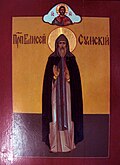 Elisei of SumaVenerable · Monk of Solovetsky MonasteryJun 14
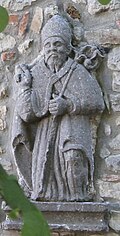 Marcianus of FrigentoSaint · Bishop of FrigentoJun 14
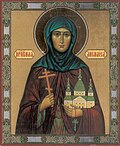 Animaisa of OstretsovoVenerable · NunJun 14
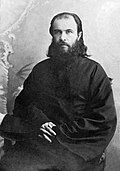 Paul SvetozarovHieromartyr · Archpriest of Ivanovo-VoznesenskJun 14
- Demetrius SemyonovHieromartyr · PriestJun 14
- Niphon KausokalybitesVenerable · Athonite monkJun 14
- Aetherius of VienneSaint · Bishop of VienneJun 14
- Alexander ParusnikovHieromartyrJun 14
- AnastasiusHoly MartyrsJun 14