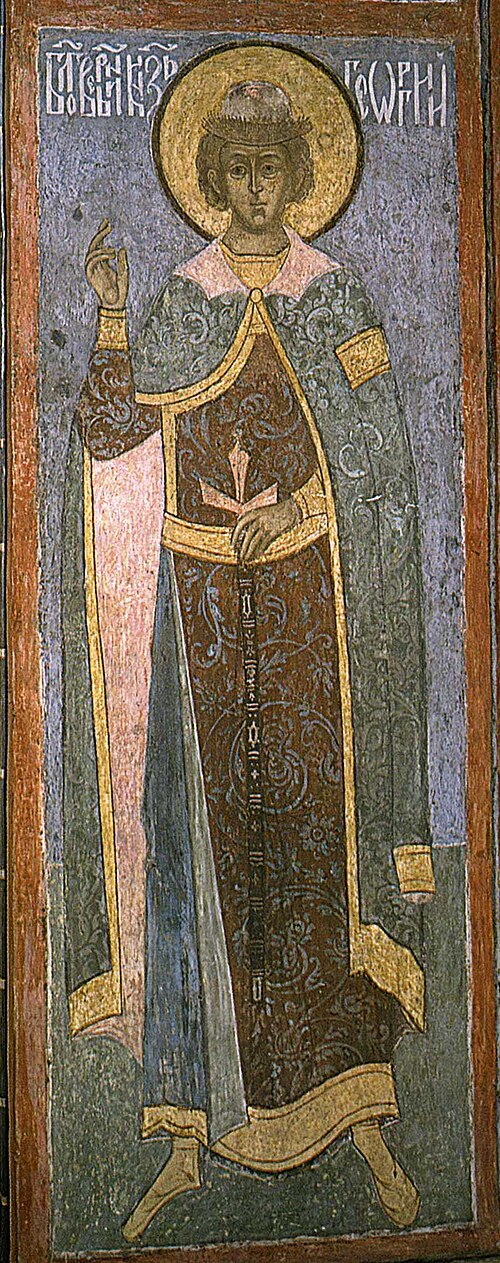
Right-Believing
Mstislav Rostislavich the Brave
Prince of Smolensk and Novgorod
Prince of Smolensk from 1175 to 1177 and of Novgorod from 1179 to 1180, called the Brave.
- Feast
- June 14old style June 27
- Reposed
- 118012th century
- Place
- Veliky Novgorod
Life
Saint Mstislav Rostislavich the Brave, the Right-believing Prince, was prince of Smolensk and then of Novgorod, and died on 14 June 1180. He is venerated as a saint of the Russian Church, remembered locally on 14 June (27 June on the new calendar), and his relics lie in the cathedral of Saint Sophia in Novgorod.
In holy Baptism he received the name George (in some sources, Theodore). He was the fourth of the five sons of Rostislav Mstislavich, who was briefly Grand Prince of Kiev in 1167. He was prince of Belgorod in 1161 and again from 1171 to 1173, prince of Toropets from 1167 and prince of Smolensk from 1175 to 1177. The nickname “the Brave” was not used in his lifetime but appeared in a Novgorod chronicle. The chroniclers describe him as pious, kind, loved by the people, and attentive to the clergy, churches and monasteries.
In 1168 he took part, with other princes, in the great victory over the Polovtsy on the steppe. The next year he besieged Novgorod with his brother Roman and Yuri Bogolyubsky, but Bogolyubsky's army was defeated. In 1171 and in 1172-1173 he helped his uncle and then his brothers, Roman and Rurik, to take the throne of Kiev. In 1174 Andrey Bogolyubsky sent an envoy to Kiev demanding that the Rostislavichi leave the city. In reply Mstislav shaved the head and beard of an envoy and sent him back, which was an insult and a breach of law, for the Russkaya Pravda set a fine for shaving a man's beard. For this Andrey besieged him for nine weeks at Vyshgorod, but could take neither him nor the city.
In 1179 the Novgorodians called him to rule, and he entered the city on 1 November. In the winter of 1179-1180 he led the Novgorodian army, of twenty thousand men, against the Chud, with success. In the spring of 1180 he wished to march toward Polotsk, but his elder brother, Roman of Smolensk, stopped him. He fell ill, lost the use of his tongue and, according to the chronicle, grew very thin before death, and died on 13 or 14 June 1180. He was buried after the divine Liturgy celebrated by Archbishop Ilya of Novgorod, the abbots of the Novgorodian monasteries and the clergy, in the tomb of Vladimir Yaroslavich in the cathedral of Saint Sophia, in the side chapel of the Nativity of the Mother of God. His relics were found incorrupt, according to one source, in 1634, and were placed in a new shrine in 1879.
He was first married to a daughter of Yaroslav Osmomysl, then to Theodosia, daughter of Gleb of Ryazan. His son Mstislav Mstislavich the Daring was one of the most important princes of Rus' before the Mongol invasion, and his other sons, Vladimir and David, were princes of Pskov and Toropets. His memory is also kept on the day of the Synaxis of Russian and Novgorod saints, in the second and third weeks after Pentecost.
Commemorated the same day June 14
 ElishaProphet · The ProphetJun 14
 Methodius I of ConstantinopleSaint · Patriarch of ConstantinopleJun 14
 Fortunatus of NaplesSaint · Bishop of NaplesJun 14
 Elisei of SumaVenerable · Monk of Solovetsky MonasteryJun 14
 Marcianus of FrigentoSaint · Bishop of FrigentoJun 14
 Animaisa of OstretsovoVenerable · NunJun 14
 Paul SvetozarovHieromartyr · Archpriest of Ivanovo-VoznesenskJun 14
- Demetrius SemyonovHieromartyr · PriestJun 14
- Niphon KausokalybitesVenerable · Athonite monkJun 14
- Aetherius of VienneSaint · Bishop of VienneJun 14
- Alexander ParusnikovHieromartyrJun 14
- AnastasiusHoly MartyrsJun 14