Hieromartyr
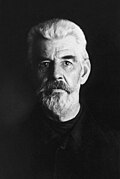
Michael Lyubertsev
A hieromartyr of the Russian Church, who died in 1937.
Life
Holy Hieromartyr Michael Lyubertsev, a priest, was born on 21 October 1883 in the town of Ostashkov in Tver province, to the tailor Sergei Lyubertsev. He graduated from the theological school and from 1901 to 1907 was a teacher at the fourth parish school in his native town. Resolving to choose a strictly churchly path, in 1907 he entered the Transfiguration church at Ostashkov as a reader.
In 1912 he was ordained a deacon for one of the churches of the town of Staritsa, where he served until 1918, when, returning to Ostashkov, he served at the Znamensky monastery. He saw with his own eyes the Bolshevik attack on the Nilova hermitage and the seizure of valuables from the churches of Ostashkov. At the end of the 1920s the persecution of the Orthodox Church grew fiercer. In 1931 the OGPU arrested Bishop Tikhon (Rozhdestvensky) of Velikiye Luki and, with him, the clergy of Velikiye Luki, Toropets and Ostashkov, the residents of the Nilova hermitage, many nuns and novices, in all one hundred and ninety-one people: ninety-nine hieromonks and monks, twenty-five married priests and deacons, and sixty-seven laymen, peasants, officers of the tsarist army and nobles. Deacon Michael was arrested on 19 March 1931. The arrested were accused that, against the order of the Soviet authorities, who had closed all the monasteries in the region, they had organized an illegal monastery, which by the high ideal of Christian struggle attracted many lay people, that they had formed circles for schoolchildren to study the Law of God, and that they had founded sisterhoods in Velikiye Luki, Toropets and Ostashkov, among whose members theological literature was widely spread. Wishing to give the accusations a political character, the authorities said that their religious activity had led to the collapse of the collective farms in those districts.
Deacon Michael was sentenced to three years of exile in the Russian North. Prison and exile did not break his spirit, but on the contrary strengthened his faith and hope in God. Though he had a large family, three sons and two daughters (the youngest were six and ten), he was resolved to serve God and the holy Orthodox Church to the end. He returned from exile in 1934 and was ordained a priest for the Dormition church in the village of Shchuchye, Ostashkov district, where he served until his martyric end in 1937.
The authorities tried to confine the influence of the Church within the church walls, and hindered the priest from going with molebens to the distant villages of his parish, and from confessing and communing those who could not come to church. Father Michael nevertheless visited them all, went through the villages with processions and served molebens in houses and in the fields. For his spiritual children he was a true shepherd and a caring father. But, not wishing to be reproached that he acted without trying to gain the permission of the executive committee, he went to ask it of the authorities, but almost always received a refusal.
On 18 June the faithful of one village of the parish asked the village council for permission for molebens in houses and a procession with icons on Trinity, and the council refused. On 22 July Father Michael was summoned to the collective-farm board, where the chairman of the village council, in the presence of the farmers, proposed that he subscribe to the state loan. "To subscribe to the loan is a good thing," the priest answered. "But they do not sell me bread at the cooperative. They do not let me go round the parish with molebens. And besides I pay a very large tax anyway... Still I shall subscribe, but on condition that you allow me to serve in houses. For example on 2 August, on Elijah's day, in the village of Lukyanovo." "Good," the chairman answered, "let the citizens who wish submit an application and the council will consider it." That same evening Father Michael called to him one of the members of the "twenty" (the parish council) and told him to ask again for permission for molebens and a procession with icons on Elijah's day, and to say to the council that if they allowed the moleben all the faithful would subscribe to the loan. The application was written, the signatures gathered and the documents submitted the next day, 23 July, but the council refused. The next day an NKVD worker submitted the documents for the priest's arrest, writing that Lyubertsev, with counter-revolutionary intentions, had agitated to wreck measures in the village and had agitated against the loan, urging the farmers to subscribe only if the village council would allow the service and the going through the villages with icons.
The same day Father Michael was arrested and imprisoned at Ostashkov. As material evidence of his crimes, a book of the writings of Saint John of Kronstadt and twelve illustrations of Sacred History were taken from his house. The next day an NKVD investigator questioned him. In prison and at the interrogations Father Michael conducted himself fearlessly and freely and, asked whether he admitted guilt, answered that in no way did he. A member of the village council was summoned, who said that the priest used to say that they should see to it that the council took account of the believers and that believers should stand firm for the faith. A member of the twenty said that the priest often urged believers to stand for the faith and to defend the Church, that of the collective farms he used to say that they should not wait for life to change for the better, and that on the question of the war, at the end of April, before Pascha, he said that war would come soon and that it was hard to say who would win, because victory over the fascists would depend on how the peasants went to defend the USSR. A collective farmer said that in June there had been a great drought and the priest had begun to work among the believers to obtain permission for icon processions through the villages and to pray for rain. The village council refused, and the priest then said that there was no rain because they had angered God and that for trampling on the faith all would be cruelly punished.
On 31 August the NKVD troika sentenced him to death, and the priest Michael Lyubertsev was shot on 4 September 1937. He was glorified in the year 2000. He is commemorated on 4 September, the day of his death, in the new style, with the Synaxis of the New Martyrs and Confessors of the Russian Church (a movable day) and, on 18 July, with the Synaxis of the Saints of Tver (a movable day).
Commemorated the same day August 22
 AriadneRight-Believing · Byzantine empressAug 22
 Gorazd of PragueHieromartyr · Bishop of PragueAug 22
 Symphorian of AutunMartyr · Martyr of AutunAug 22
 AgathonicusMartyrAug 22
- Alexis OrlovHieromartyr · Archbishop of OmskAug 22
- Isaac of OptinaVenerable · Abbot of OptinaAug 22
- Theodore SmirnovHieromartyr · Bishop of PenzaAug 22
 Basil SmirnovHieromartyr · PriestAug 22
- Bogolep of UglichVenerableAug 22
- Acindynus of PotamiaMartyrAug 22
- Adrian Vozhakov of OleksandriiaHieromartyrAug 22
- Alexander RatkovskyHieromartyrAug 22