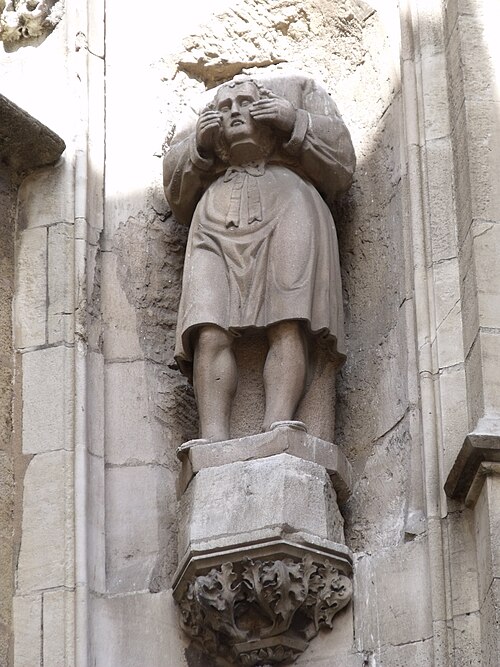
Saint
Mitre of Aix
Saint of Aix-en-Provence
Saint born in Thessalonica who died at Aix-en-Provence in Gaul in 466.
- Feast
- November 13old style November 26
- Reposed
- 4665th century
- Place
- Aix-en-Provence
Life
Saint Mitre of Aix was, according to tradition, a young man born at Thessalonica who died a martyr at Aix-en-Provence in Gaul. His story has come down to us mainly through legend, and the years of his life are usually given as 433-466. He is commemorated on 13 November.
According to the account, Mitre was born into a well-off family in Thessalonica. At twenty-four he left his parents and went to Gallia Narbonensis, where he entered the service of Arvendus, an official at Aquae Sextiae, today Aix-en-Provence. Arvendus lived lawlessly, keeping another man's wife, and Mitre, a Christian, rebuked him, so that his master came to hate him. Other servants also persecuted him for his faith in Christ.
Mitre tended a vineyard of his master. To have a pretext for getting rid of him, Arvendus had his servants strip the grapes, then accused Mitre of stealing the crop, making wine of it and giving it to the poor. The saint prayed to the Lord, and the grapes were seen again on the vines. Arvendus insisted that the miracle was sorcery. Mitre was shut in a tower of the count's palace, condemned to death and beheaded in the courtyard of the court.
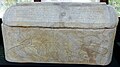
According to the legend, the saint took up his head, carried it to the church in Aix dedicated to the Mother of God (Notre-Dame de la Seds), of which he became patron, and only there did he die. His relics were moved on 23 October 1383 to the cathedral of Saint-Sauveur in Aix. It is said that one of the columns near his tomb had a shining hole from which a healing liquid flowed. The translation gave the cathedral a saint of the same standing as the other two great churches of Provence, which held Victor of Marseille and Genesius of Arles. A sarcophagus in the cathedral's chapel of Saints Cosmas and Damian is regarded as the saint's original tomb. Today his relics lie in a white marble tomb in the chapel of Saint Lawrence, outside the cathedral walls.
A chapel was dedicated to him in Aix in the seventeenth century. The cathedral keeps a painting by Nicolas Froment from 1470-1475, and the town of Saint-Mitre-les-Remparts bears his name. He is sometimes called Merre or Metre. The writer Émile Zola, who grew up in Aix, mentions him in the first chapter of "The Fortune of the Rougons".
Commemorated the same day November 13
 John ChrysostomSaint · Archbishop of ConstantinopleNov 13
 Nicholas I of RomeSaint · Bishop of RomeNov 13
 Abbo of FleuryVenerable Martyr · Abbot of Fleury AbbeyNov 13
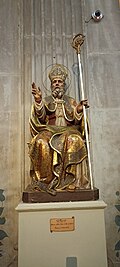 Floridus of Città di CastelloSaint · Bishop of Città di CastelloNov 13
 Leonianus of VienneVenerableNov 13
- Arcadius of AfricaMartyrNov 13
- Amantius of Città di CastelloVenerableNov 13
- AnthusaSaintNov 13
- Antoninus of Caesarea in PalestineHieromartyrNov 13
- Arcadius, Paschasius, Probus and Eutychian of AfricaHoly Martyrs · Martyrs of AfricaNov 13
- BairrfionnSaintNov 13
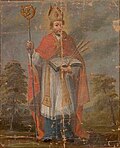 Brice of ToursSaint · Bishop of ToursNov 13