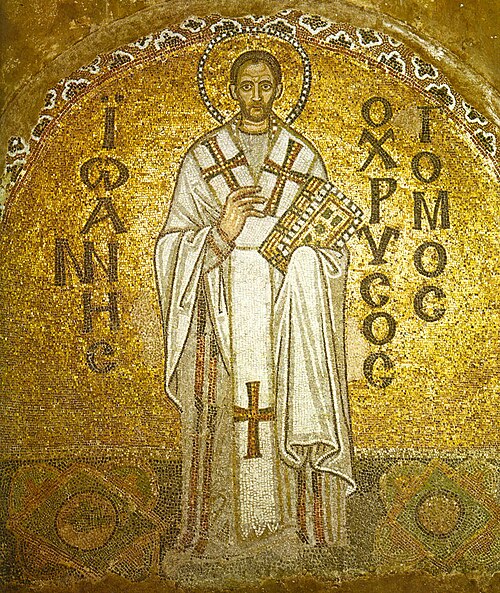
Saint
John Chrysostom
Archbishop of Constantinople
Great preacher and hierarch, author of the Divine Liturgy served on most Sundays.
- Feast
- November 13old style November 26
- Reposed
- 4075th century
- Place
- Comana Pontica
- Order
- Hierarchs
Life
Saint John Chrysostom, archbishop of Constantinople, is the greatest preacher of the Church and one of the Three Holy Hierarchs. He lived in the fourth century, shepherded his flock with zeal and died in exile. The Divine Liturgy served on most days of the year bears his name. The Church honours him as a great teacher of the world.
Childhood and ascetic struggle
He was born at Antioch around the year 347 into the family of an officer. His father, Secundus, died soon after his birth, and his mother, Anthusa, widowed at twenty, did not remarry but devoted herself to raising her son in the faith. The young man studied under the finest philosophers and rhetoricians but turned from pagan wisdom to the study of Scripture. Bishop Meletius of Antioch loved him like a son, taught him the faith and baptized him in 367. After three years he was tonsured a reader. He studied with Diodorus of Tarsus and the presbyter Flavian, teachers of the ascetic life. After his mother's death he became a monk, calling monasticism "the true philosophy".
John fled from the episcopal office, but secretly helped his friend Basil to be ordained. At this time he wrote Six Discourses on the Priesthood, a great work of Orthodox pastoral theology. He spent four years in the wilderness under the guidance of an experienced elder, the last two in a cave in complete silence. Fasting and watching damaged his stomach and kidneys, and he was forced to return to Antioch. There he wrote on virginity, on Providence and on the monastic life.
Preacher of Antioch
Meletius ordained him deacon in 381, and Bishop Flavian ordained him priest in 386. For twelve years he preached in church, usually twice a week and sometimes daily. For the beauty of his words he was given the name Chrysostomos, "golden mouth". He explained whole books of Scripture, Genesis, the Psalms, the Gospels of Matthew and John and the epistles of Saint Paul, as well as many homilies for feasts, on the saints and in defence of the faith. He spoke on repentance, almsgiving and the duty of the rich toward the poor. In his time the Church of Antioch fed up to three thousand virgins and widows daily, not counting the sick and strangers.
In 387, when the people of Antioch overturned the statues of the emperor and feared punishment, his sermons calmed and strengthened the city.
Archbishop of Constantinople
In 397, after the death of Archbishop Nectarius, John was elected to the see of Constantinople, being taken there almost by force. He reformed the life of the clergy, used the archbishop's means for hospitals and hostels for pilgrims, fasted strictly, sent missionaries to the Goths, the Scythians, Phoenicia and Persia, and set a bishop over the Bosphorus in the Crimea. He ordered the services, introduced antiphonal singing at vigils and composed prayers for the mysteries of the Church. From the pulpit he rebuked the luxury and injustice of the powerful, sparing not even the imperial court.
For this he made enemies, among them Empress Eudoxia, Theophilus of Alexandria and Bishop Severian of Gabala. A synod held at the Oak, near Chalcedon, deposed him unjustly, and the emperor sent him into exile. That same night an earthquake struck, Eudoxia took fright and called him back. After only two months a new accusation roused her anger, and in March 404 another unjust council again decreed his exile. As he left, the church of Hagia Sophia and the Senate building burned down. Eudoxia died in October 404.
Exile and repose
From his exile at Cucusus he wrote letters of consolation to friends and disciples, among them the deaconess Olympias, and 245 of them survive. In the winter of 406, sick, he received an order to be taken farther, to Pityus on the Black Sea. He travelled three months under military escort, in rain and frost, but never arrived, for his strength failed at Comana. The night before his end the martyr Basiliscus appeared to him: "Do not despair, brother John, tomorrow we shall be together." After receiving the Holy Mysteries, he fell asleep in the Lord on 14 September 407, with the words, "Glory to God for all things."
Relics and veneration
In 438, thirty years after his death, his relics were brought back to Constantinople in the reign of Theodosius II, the son of Eudoxia, at the request of Patriarch Proclus, the saint's disciple. The emperor's envoys could not lift the coffin until the emperor wrote the saint a letter asking forgiveness. The body was found incorrupt. Theodosius stood in tears by the coffin and asked forgiveness for his mother. The relics were placed in the Church of the Holy Apostles, where, according to the OCA, the people cried out, "Father, take up your throne", and the saint is said to have replied, "Peace be to all". Much of the relics was taken by the crusaders to Rome in 1204, and a portion was returned to the Orthodox Church on 27 November 2004 and is kept in the Church of Saint George in Istanbul. His head is kept at the Vatopedi monastery on Mount Athos.
The Orthodox Church commemorates him on 13 November, the day by which the news of his death is said to have reached Constantinople, on 27 January, the translation of his relics, and on 30 January in the synaxis of the Three Holy Hierarchs, with Basil the Great and Gregory the Theologian. The actual day of his repose, 14 September, was set aside because it is the feast of the Elevation of the Holy Cross.
Commemorated the same day November 13
 Nicholas I of RomeSaint · Bishop of RomeNov 13
 Abbo of FleuryVenerable Martyr · Abbot of Fleury AbbeyNov 13
 Mitre of AixSaint · Saint of Aix-en-ProvenceNov 13
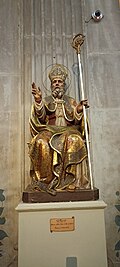 Floridus of Città di CastelloSaint · Bishop of Città di CastelloNov 13
 Leonianus of VienneVenerableNov 13
- Arcadius of AfricaMartyrNov 13
- Amantius of Città di CastelloVenerableNov 13
- AnthusaSaintNov 13
- Antoninus of Caesarea in PalestineHieromartyrNov 13
- Arcadius, Paschasius, Probus and Eutychian of AfricaHoly Martyrs · Martyrs of AfricaNov 13
- BairrfionnSaintNov 13
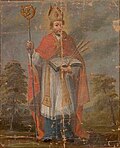 Brice of ToursSaint · Bishop of ToursNov 13