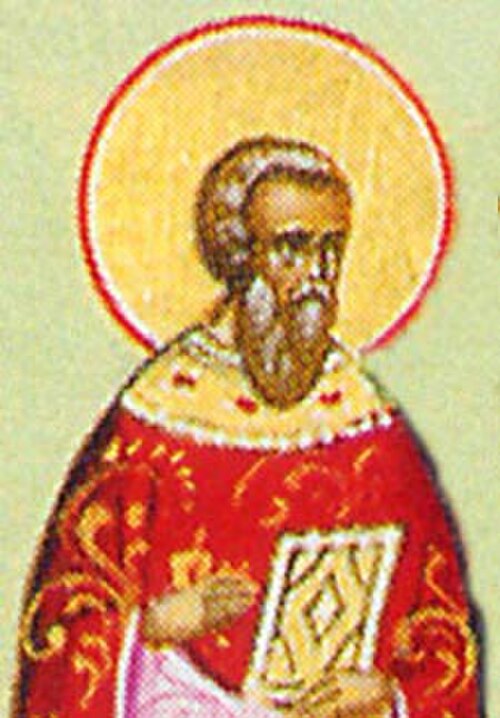
Hieromartyr
Myron of Cyzicus
Priest of Cyzicus
Priest from Achaea, who died a martyr in the time of Emperor Decius, around the year 250.
Life
Saint Myron of Cyzicus (born around 201, died around 250), hieromartyr, was a rich and honored priest of Achaia, put to the sword at Cyzicus, in the time of the emperor Decius. He is commemorated on 17 August (30 August by the new calendar) and is the patron of the island of Antikythera, in Greece.
Life
Myron lived in Achaia in the time of the emperor Decius (249-251), when the proconsul of that Roman province was Antipater. The Greek source says he came from the region of Corinth, in the Peloponnese, from a rich and aristocratic family; the Serbian one has him born around 201, in the time of the emperor Septimius Severus. He came of a rich and honored line, was presbyter of the local church, famed for gentleness of nature and mercy, and had love for God and people; according to the Greek source he became a priest in youth.
According to tradition, in 250, on the day of the feast of the Nativity of Christ, Antipater burst with his servants into the church in which Myron was serving, to seize the most prominent of the Christians and force them to take part in pagan sacrifices (according to the Greek source, to seize the faithful and kill them). Myron, who had earlier been a friend of Antipater, rebuked and reproached him (the Greek source: he was not frightened by the Roman guard and called him a "ravening wolf"). Antipater ordered Myron seized and tried him in the agora, before the temple of Dionysus. He wanted to force him by tortures to offer sacrifice; after terrible tortures, which Myron bore steadfastly, the governor ordered him led to Cyzicus, for interrogation before the emperor. The Greek source says that Antipater imprisoned him and hung him up by the hands, while the Roman soldiers mocked him, then that he was sent to Cyzicus, in Mysia of Asia Minor, where the proconsul there put him to death by beheading. Feeling that Myron had conquered him in everything, Antipater took his own life (according to the Russian source). The archon of Cyzicus, learning of the martyr, at once condemned him to beheading.
Veneration
The Orthodox Church keeps his day on 17 (30) August. In Russia, a side chapel was dedicated to Myron in the regimental church of the Life-Guards Jäger Regiment, whose regimental feast fell on the saint's day.
His veneration on Antikythera is especially lively. The few inhabitants of the little island today, as well as the hundreds of Antikytherans in the diaspora (America, Australia, Chile and so on), venerate Saint Myron in a quite special way, a saint less known to the wide world, but patron of Antikythera. The saint's link with the island goes back to the distant past. It is known that for almost three centuries (from about 1420 until 1780-1782) the island was uninhabited: in reprisal for a piratical attack of its inhabitants on a Venetian ship, the Venetian garrison killed all the inhabitants and the island lay desolate until about the end of the eighteenth century. In this interval, hunters from Crete went to Antikythera to hunt goats and sheep, which then as now were abundant on the island. The story tells how the icon of Saint Myron was found there. According to local tradition, Cretan hunters went to Tsirigotto, as Antikythera was called under Venetian rule, to hunt goats. They found by chance in a small cave an icon of the saint. They took it and set it up a little farther, building a makeshift icon-stand. When they came back to build a little church, they found the icon elsewhere and decided to build the church there. These things took place between 1450 and 1780, it is not known when exactly. The building of the saint's church was the cause of the colonization of the island by Cretans, whose descendants are the present inhabitants.
The small church at first was enlarged, cells and auxiliary rooms were added, and for a long time it also housed nuns. The saint's feast, every year on 17 August, has since been the most important day of the year for the island. On that day the Antikytherans honor their patron saint with magnificent services, and also with traditional Cretan festivities, in remembrance of the link of the place with the Cretans. Indeed, since the occasion of the finding of the icon was the hunting of goats and sheep, boiled goat and sheep meat, prepared in the monastery grounds by the inhabitants, is offered to the pilgrims. Metropolitan Seraphim of Kythira and Antikythera composed a megalynarion in his honor.
Commemorated the same day August 17
 ThyrsusMartyr · Martyr of Apollonia in PhrygiaAug 17
 Alypius of the CavesVenerable · Icon painter of the Caves LavraAug 17
 Elias of EnnaVenerable · Monk from SicilyAug 17
 Theodoret of KolaVenerable · Archimandrite, enlightener of the SamiAug 17
 Pimen of UgreshaVenerable · Abbot of Nikolo-Ugresha MonasteryAug 17
 Tbeli AbuserisdzeSaint · Georgian scholarAug 17
 Safta BrâncoveanuVenerableAug 17
- Nazaria of VăratecVenerable · First abbess of Văratec MonasteryAug 17
- Olympias of VăratecVenerable · Founder of Văratec MonasteryAug 17
- AeglonVenerableAug 17
- Alexis VelikoselskyHieromartyrAug 17
- AmorVenerableAug 17