Venerable
Theodoret of Kola
Archimandrite, enlightener of the Sami
Archimandrite, enlightener of the Sami, who created their script and translated liturgical texts; died in 1571.
- Feast
- August 17old style August 30
- Reposed
- 157116th century
- Place
- Solovetsky Monastery
- Order
- Venerables
Life
Saint Theodoret of Kola (1481-1571) was a Russian monk and archimandrite, the enlightener of the Sami (Lapps) of the Kola Peninsula, the first to create a script for the Sami language and to translate service texts into it. A disciple of the northern elders, a founder of monasteries, abbot in Suzdal and the tsar's envoy to Constantinople, he lived a life full of trials and reposed in 1571 at Solovki. He was glorified as a local saint in 2002.
Sources
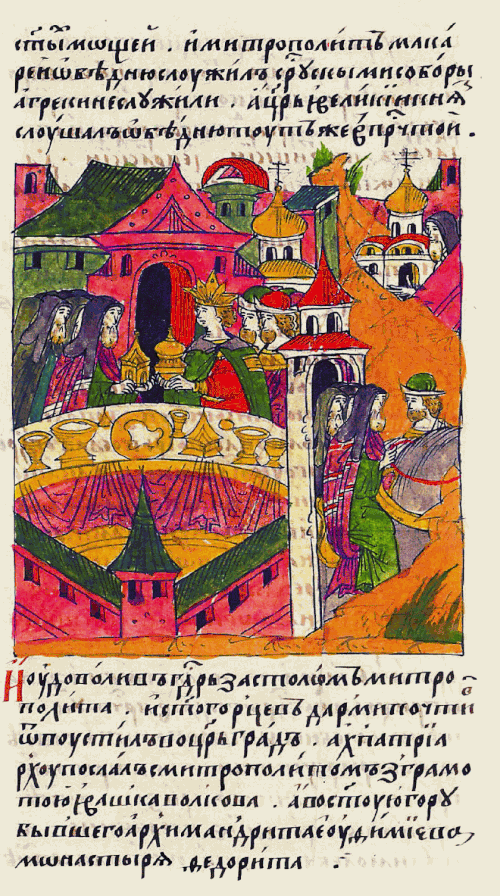
His life is known from the biography written by his spiritual son, Prince Andrei Kurbsky, in his History of the Grand Prince of Moscow. The Solovki Patericon merely quotes Kurbsky. The prince's information is confirmed by other documents of the time.
Youth
He was born in 1481 in Rostov. It is not known for certain where he received his excellent education, for he knew theology and Greek well. Metropolitan Mitrofan (Badanin) suggests it may have been the Monastery of Saint Gregory the Theologian in Rostov, where his fellow countryman Saint Stephen of Perm, enlightener of the Zyrians, had studied; in another work the same author holds that the skete on the river Shuya was the centre where Theodoret and other young monks were formed as scholars and theologians.
From the age of twelve he worked as a copyist of books at the Solovki Monastery. Around 1494 he entered obedience to the elder Zosima in the wilderness on the river Shuya, where for fifteen years he learned the foundations of monastic life. In 1509 Archbishop Serapion of Novgorod ordained him hierodeacon. After a time he set out on a pilgrimage to the monasteries, visiting Saint Alexander of Svir and the elders beyond the Volga. Shortly before his death Zosima summoned his disciple, and Theodoret hurried to the Shuya.
Missionary to the Sami
After the death of his spiritual father, Theodoret withdrew to the mouth of the river Kola, then uninhabited. There he met a hermit named Mitrofan, who had lived in those forests for about five years, in all likelihood Saint Tryphon of Pechenga, and built himself a cell.
Soon he began to preach among the Sami: in summer at their camps on the rivers Vaenga and Tuloma, in winter among the Sami who came to the river Kola to hunt. Despite the fierce opposition of the local shamans (noaidi), part of the population was baptised. By 1531 a settlement of Orthodox Sami had grown up near his first cell, with two churches, of the Annunciation and of Saint Nicholas, the beginning of the future town of Kola.
The fruits of his preaching required churches and priests for the newly baptised. In 1530 Theodoret and Mitrofan went to Novgorod to Archbishop Macarius and returned with builders for the churches, together with Hieromonk Elias, sent to consecrate them. In 1532 Theodoret and Hieromonk Elias consecrated the churches at Niva, Ponoy, Kola and Pechenga.
Confessor to the archbishop
In 1533 Theodoret went to Novgorod for ordination, and in 1534 he was ordained hieromonk and became the confessor of Archbishop Macarius, the future Metropolitan of Moscow. He then went to the Beloozero region. He spent some time at the Kirillo-Belozersky Monastery, and at the end of the 1530s lived for four years at the hermitage of Porphyry. It seems that there he created the script for the Sami language and translated service texts from Slavonic, probably building on the alphabet made in 1372 by Saint Stephen of Perm for the Zyrian language on the basis of Cyrillic. There he drew close to the elder Artemy and other representatives of the “non-possessors”, monks who preached monastic poverty.
Founder of monasteries
Around 1540 Theodoret returned to Kola with rich gifts and other monks and founded there the coenobitic Holy Trinity Monastery, which newly baptised Sami also joined. In these years he baptised more than two thousand Sami. In 1548, however, the brethren drove out their abbot for his “too strict” rule. According to Church tradition, for which there are no archival documents, he then founded the Kandalaksha Monastery, where he was abbot from 1548 to 1551.
Abbot in Suzdal and persecution
In 1551, at the request of Artemy, who had become abbot of the Trinity Lavra, Theodoret was appointed abbot of the Monastery of the Saviour and Saint Euthymius in Suzdal. There he proved a zealot for piety and strict monastic order, which displeased both the brethren of this rich and powerful monastery and Bishop Athanasius (Paletsky) of Suzdal, whom he openly rebuked for love of money and drunkenness.
At the council of 1554, where he was a witness in the trial of Artemy, his opponents accused him of being Artemy's friend and of heresy, but heresy could be proven neither against Artemy nor against Theodoret. Artemy was nevertheless condemned for other faults and sent to Solovki. Theodoret appears in documents as abbot until October 1554, but then, through the efforts of the bishop of Suzdal, he was confined in the Kirillo-Belozersky Monastery. He was released only through the intercession of Metropolitan Macarius and then spent some time at the Transfiguration Monastery in Yaroslavl.
Envoy to Constantinople
In January 1557 he was sent to Constantinople to obtain from the Eastern patriarchs recognition of the title of tsar assumed by Ivan the Terrible in 1547; he also carried secret instructions concerning the political situation in the Ottoman Empire. On this journey, which lasted almost a year, he visited Mount Athos and Jerusalem. The mission was brilliantly accomplished, and the tsar wished to reward him with rich gifts and any church office he desired. Theodoret refused them all, asking only to be allowed to remain in peace and stillness in his cell until his end. He settled at the Spaso-Prilutsky Monastery near Vologda, from where he went several times to the Sami he had baptised on the river Kola.
Last years
In 1562, after Prince Kurbsky's flight to Lithuania, Theodoret, his confessor, was interrogated. A Dutch merchant, Simon van Salingen, relates that in 1568 he spoke with a “Russian philosopher” in whom Theodoret is easily recognised: he had written a history of Karelia and Lapland and had dared to create a script for a language in which no one had ever written; he showed him the alphabet and a manuscript with the Creed, the Lord's Prayer and an account of his own experiences. These writings have not survived.
Shortly before his death he withdrew to Solovki, where he reposed in peace on 17 August 1571 and was buried by the south wall of the Transfiguration Cathedral.
Glorification
Already in his lifetime he became known for many miracles, and a popular canon, akathist and prayers to him circulated in manuscripts. Nevertheless, for four centuries he was not glorified or entered in the calendars, because, together with the other “elders beyond the Volga”, he had fallen into disgrace after the councils of 1553-1554. By the end of the nineteenth century, however, he was being called “blessed”.
On 30 August 2002, in the church of the Annunciation in the town of Kola, he was glorified as a saint of the diocese among the venerable. He is commemorated in the Synaxis of the Saints of Kola and locally on 17 (30) August, the day of his death; he is also honoured in the Synaxes of the Saints of Vologda, Solovki and Novgorod. Bishop Mitrofan (Badanin) composed his life, troparion and kontakion. A wooden church at the Murmansk dependency of the Tryphon of Pechenga Monastery, a church in Severomorsk and a chapel are dedicated to him. On 29 August 2021, the 450th anniversary of his death, a monument to him by the sculptor Sergei Isakov, funded by the townspeople, was unveiled in Kandalaksha.
Commemorated the same day August 17
 ThyrsusMartyr · Martyr of Apollonia in PhrygiaAug 17
 Alypius of the CavesVenerable · Icon painter of the Caves LavraAug 17
 Elias of EnnaVenerable · Monk from SicilyAug 17
 Myron of CyzicusHieromartyr · Priest of CyzicusAug 17
 Pimen of UgreshaVenerable · Abbot of Nikolo-Ugresha MonasteryAug 17
 Tbeli AbuserisdzeSaint · Georgian scholarAug 17
 Safta BrâncoveanuVenerableAug 17
- Nazaria of VăratecVenerable · First abbess of Văratec MonasteryAug 17
- Olympias of VăratecVenerable · Founder of Văratec MonasteryAug 17
- AeglonVenerableAug 17
- Alexis VelikoselskyHieromartyrAug 17
- AmorVenerableAug 17