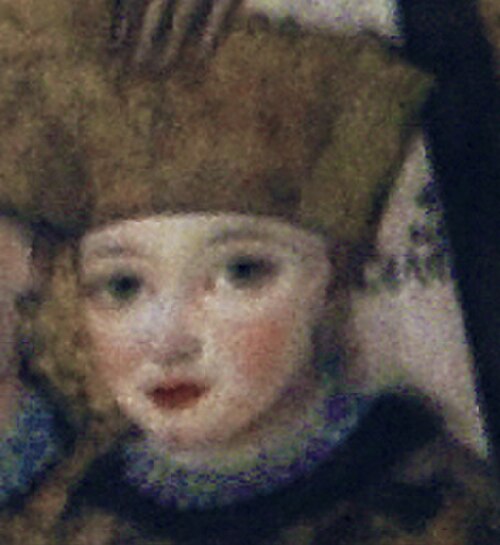
Venerable
Safta Brâncoveanu
Romanian noblewoman and philanthropist, born in 1776, who died in 1857 at Văratec Monastery.
- Feast
- August 17old style August 30
- Reposed
- 185719th century
- Place
- Văratec Monastery
- Order
- Venerables
Life
Venerable Elisabeta (Safta) Brâncoveanu, born in 1776 into the great Moldavian boyar family of Balș, was the wife of Ban Grigore Brâncoveanu, a founder of churches and a benefactor of the poor, and at the end of her life a schemanun at Văratec Monastery. She passed to the Lord in 1857. The Holy Synod of the Romanian Orthodox Church canonized her on 1 July 2025, with her feast on 17 August.
Childhood and marriage
Safta was the daughter of Vornic Teodor Balș, buried in the boyar necropolis at the church of Saint Demetrius-Balș in Iași, and of Zoița (Zoe Ruset-Rosetti). After her husband's death her mother withdrew to Văratec, where she received the monastic name Elisabeta. Safta received a fine education in Moldavia and learned several languages, among them Greek, in which it was said she had no equal among the women of her time. A contemporary held her up as a model for all the daughters of the Romanian nation.
In 1793 she married Ban Grigore Brâncoveanu of Wallachia, a capable, hard-working and well-read man and a patriot, in the words of the prose writer Constantin Gane. Their marriage was one of the happiest, but they had no children. In March 1824 they adopted a little girl, Zoe Mavrocordat, the daughter of Safta's sister Catrina Mavrocordat. She became Zoe Basarab Brâncoveanu and, at the death of her adoptive parents, inherited the great Brâncoveanu fortune. They gave her in marriage to the postelnic Gheorghe Bibescu, who later became prince of Wallachia.
Foundations and the Brâncoveanu Hospital
Ban Grigore and Lady Safta cared for the church of the Holy Trinity at Brașov, the Bistrița monastery in Vâlcea and the Viforâta monastery, on whose wall their portraits as founders can be seen, and they saw to the rebuilding of the church of Domnița Bălașa.
In April 1832 Ban Grigore passed to the eternal life and was buried at the church of Saint George the New in Bucharest, beside his ancestor Constantin Brâncoveanu. Safta was left alone, and on 8 June she wrote to Metropolitan Veniamin Costache of her grief, like a sword that had pierced her soul. Between 1835 and 1838 she saw to the fulfilment of the couple's dream, a hospital for the needy, where anyone could be treated without payment. Building began in 1836 and was finished in October 1837. The Brâncoveanu Hospital worked without interruption from 1838 to 1984 and was the first public institution of its kind in the Romanian lands.
Nun and repose
Her mother, the schemanun Elisabeta, was already at Văratec, and Safta visited her from time to time. Around 1840 she too entered monastic life, and soon afterwards received the great schema in the community of the monastery. She fell asleep in her cell at Văratec in 1857 and was buried, as she wished, in the churchyard. At her burial Father Neofit Scriban, invited also at her wish, gave an address.
Her bones now lie in the ossuary beneath the altar of the church of the Dormition at Văratec. In the same common grave are the remains of other nuns, and a reliquary with the bones of Moș Gheorghe Lazăr, known as a man of holy life who lived as a pilgrim. The Church commemorates her on 17 August.
Commemorated the same day August 17
 ThyrsusMartyr · Martyr of Apollonia in PhrygiaAug 17
 Alypius of the CavesVenerable · Icon painter of the Caves LavraAug 17
 Elias of EnnaVenerable · Monk from SicilyAug 17
 Theodoret of KolaVenerable · Archimandrite, enlightener of the SamiAug 17
 Myron of CyzicusHieromartyr · Priest of CyzicusAug 17
 Pimen of UgreshaVenerable · Abbot of Nikolo-Ugresha MonasteryAug 17
 Tbeli AbuserisdzeSaint · Georgian scholarAug 17
- Nazaria of VăratecVenerable · First abbess of Văratec MonasteryAug 17
- Olympias of VăratecVenerable · Founder of Văratec MonasteryAug 17
- AeglonVenerableAug 17
- Alexis VelikoselskyHieromartyrAug 17
- AmorVenerableAug 17