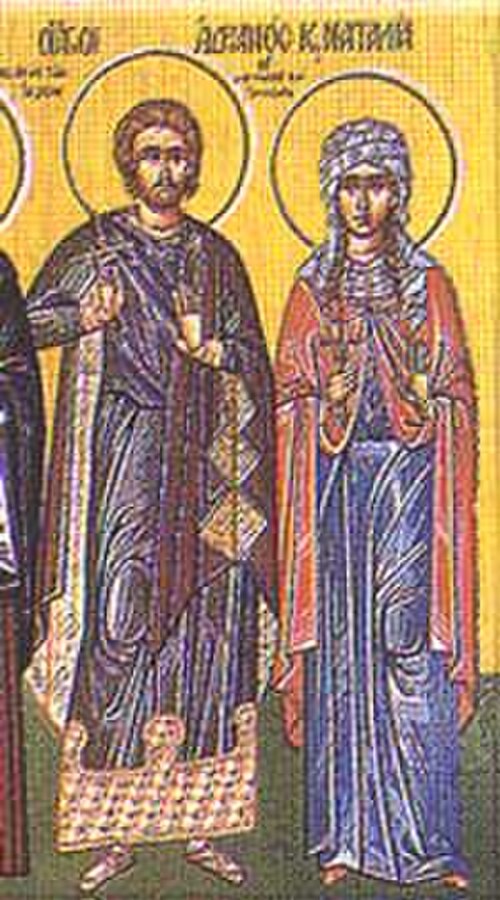
Martyr
Natalia of Nicomedia
Wife of Saint Adrian of Nicomedia
Wife of the martyr Adrian of Nicomedia, counted among the bloodless martyrs in the early 4th century.
Life
Saint Natalia was the wife of the holy martyr Adrian of Nicomedia and lived at the beginning of the fourth century, during the great persecution of Christians. She strengthened her husband in the faith until his martyrdom, kept his relics with devotion and died in peace beside them. The Church honours her among the bloodless martyrs, who received their crown through suffering of the soul, and the faithful regard her, together with Saint Adrian, as a patron of marriage.
Nicomedia in the time of persecution
Natalia lived in Nicomedia, a city of Bithynia on the shore of the Sea of Marmara in Asia Minor, where the Turkish city of Izmit stands today. Nicomedia was then an imperial residence, full of the villas and estates of wealthy officials.
In those years the persecution launched by Emperor Galerius Maximian broke out. The Christian faith had reached even the imperial household. According to tradition, when the emperor returned victorious from war, he arranged a great pagan festival at Nicomedia with golden statues and altars of sacrifice. When the crowd began to be sprinkled with sacrificial blood, a storm broke out with thunder and lightning. The people fled in panic, many were trampled, and the emperor himself ran away in fear.
The persecution grew harsher. Again according to tradition, on the night of the Nativity twenty thousand Christians gathered for the feast were burned in the churches of Nicomedia.
Natalia and Adrian
According to her Life, for which there are no reliable historical sources, Natalia grew up in a wealthy family, and some sources say she was raised as a Christian. She married a young man named Adrian, noble and rich, who according to some accounts was twenty-eight years old and head of the praetorium at Nicomedia. Adrian was a pagan, and this grieved Natalia, who was secretly a Christian.
When the emperor came to Nicomedia, the two had been married for just over a year, sometime between 305 and 311. Natalia had free access to the prisons and helped the Christians held there a great deal, tending their wounds.
At that time twenty-three Christians were seized and subjected to terrible tortures. Adrian, who was conducting the inquiry, watched their sufferings and marvelled at their patience and faith. He began to ask them about God and what reward they expected from Him. The martyrs answered with the words of the Apostle, that eye has not seen nor ear heard the things God has prepared for those who love Him.
Touched by the grace of God, Adrian declared before all that he too believed in Christ and was ready to die for Him, although he was not yet baptized. He was put in chains and thrown into prison with the others.
In prison
When Natalia heard this, she was filled with joy that her husband had come to know Christ and that the crown of martyrdom awaited him. She hurried to the prison, fell at his feet, kissed his chains and spoke to him of the eternal blessedness before him. She begged him, when he stood before God, to ask that she might soon follow him, so that they would not be parted in eternity. According to some accounts, since women were forbidden to enter, she came to him dressed as a young man.
The hymns of the Church say of her that by holy conversation she wisely led Adrian into paradise.
Before the execution Adrian was allowed to go home to see his household, in the hope that he would renounce Christ. When he knocked at the door and Natalia heard his voice, she was horrified and would not open, thinking he had lost courage and fled from martyrdom.
Adrian told her that he had come only to say farewell and that he would go firmly to his sufferings with the other Christians. Natalia understood that he now needed her support to be strengthened before death, and Adrian returned to the prison.
The martyrdom of Saint Adrian
The next day Natalia asked the prison governor for permission to be present when the Christians were sentenced, and it was granted. Seven days of interrogation and waiting followed, during which she prayed without ceasing for God to strengthen Adrian and his companions.
Adrian was brought before the emperor, who demanded that he renounce his faith, but he confessed Christ. According to some accounts he was thrown to a lion, which did not touch him. He was then beaten with staves and cruelly tortured.
Learning that the martyrs' legs were to be broken with hammers on an anvil, Natalia asked that they begin with Adrian, fearing that if he watched the others suffer he might falter. She stayed beside him to the end, held his feet on the anvil herself and strengthened his faith in the crucified Christ. She had the consolation of seeing him give up his soul to God with courage.
When the executioner had crushed his legs, Natalia held out Adrian's right hand so that it too would be cut off. She asked to keep this hand, its fingers joined for the sign of the cross, took it home, placed it in a reliquary and prayed beside it.
The bodies of the martyrs were to be burned outside the city as those of criminals, so Natalia could not bury them. According to tradition, however, a storm arose and put out the fire, and the Christians secretly took the bodies and carried them far away.
Widowhood and flight
Soon it became known that the wealthy Natalia was a widow, and suitors began to come. She prayed to God and to her husband to help her remain a widow and not marry again. About two years passed in this way.
The emperor had not forgotten her and, according to tradition, ordered her to marry, and a rich military commander sought her hand. Natalia took the reliquary with Adrian's hand, secretly boarded a ship and fled from Nicomedia.
The commander set out after her in another ship. Natalia prayed to God for protection, and a storm arose at sea in which the pursuing ship fell behind and was lost from sight. The storm did not abate, and Natalia prayed to Christ and to Saint Adrian. According to her Life, in a ray of light from heaven she saw Adrian and understood with joy that he had reached the Kingdom of Heaven and was hearing her prayers. The ship came safely to shore.
Her repose
Natalia then wandered for a long time, hiding in the remote parts of Bithynia, until she learned from Christians where the remains of Saint Adrian and those executed with him were kept. According to tradition they had been taken to the neighbourhood of Byzantium, where Constantinople would later rise.
She went there, opened the reliquary and placed the hand with the other relics. Her strength was exhausted by the sorrows of her soul. According to some sources Adrian appeared to her in a dream and called her to receive the crown of glory as well. Praying beside the holy relics, Natalia gave up her soul in peace.
Thus, through the suffering of her heart, she was counted a martyr and followed her husband into the Kingdom of Heaven. The Church numbers her among the bloodless martyrs, like Saint Sophia, mother of the three virgin martyrs.
Her Life and relics
The Life of Saints Adrian and Natalia was most probably composed in the fifth century. The long version was translated into Slavonic toward the end of the eleventh century, and the short one in the twelfth century in the Prologue of Constantine of Mokissos. In the first half of the fourteenth century it was translated again, probably by Serbs on Athos, in the Stichic Prologue, and in the sixteenth century both versions were placed under 26 August in the Great Menaion Reader.
In the fourth century Saint Metrophanes, bishop of Byzantium, built a church of the holy martyrs Adrian and Natalia in Constantinople, where their relics were kept. Later the relics were taken to Rome, where Pope Honorius I dedicated a church to the martyrs in the Forum, founded in the year 630.
The relics of Saint Natalia are now in Milan, in the Basilica of San Lorenzo Maggiore, in a chapel behind the altar that is especially dear to Russian Orthodox women.
Veneration
In the time of Saint Bartholomew of Grottaferrata a small chapel dedicated to Saints Adrian and Natalia was added to the monastery church there. In Russia churches are dedicated to them in Moscow, including a chapel of the Cathedral of Saint Basil the Blessed and the church built between 1914 and 1917 in the former settlement of Losinoostrovsky, in Saint Petersburg, where the church at Staro-Panovo, destroyed in 1942, is being rebuilt as a memorial church, and in Penza, where a church of Saint Natalia was consecrated in 2012.
On icons Saint Natalia is shown holding a scroll bearing the exhortation that all worldly, perishable and soul-destroying things should vanish from the mind. In Russian tradition her day is linked to the folk feast called Natalia Ovsyanitsa, at the time of the oat harvest.
Saints Adrian and Natalia are commemorated together on 26 August (8 September, New Style), and couples preparing for marriage often ask their help for a union steadfast in faith.
Commemorated the same day August 26
 ZephyrinusSaint · Bishop of RomeAug 26
 Hadrian of NicomediaMartyr · Roman officerAug 26
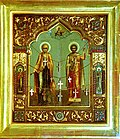 Adrian and NataliaHoly MartyrsAug 26
 Orontius of LecceSaint · First Bishop of LecceAug 26
 Elena of MoscowVenerable · First Abbess of Novodevichy ConventAug 26
 Maria of DiveevoFool-for-Christ · Fool for ChristAug 26
- Adrian of UglichVenerable · HieromonkAug 26
- Cyprian of StorozhevoVenerableAug 26
 Roman MedvedConfessor · PriestAug 26
- Rufinus of CapuaSaint · Bishop of CapuaAug 26
- AireidVenerableAug 26
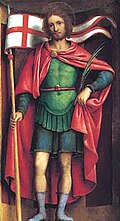 Alexander of BergamoMartyrAug 26