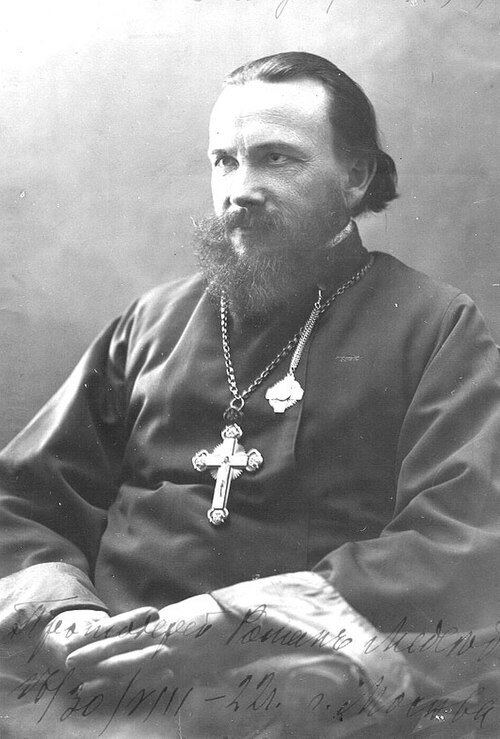
Confessor
Roman Medved
Priest
Priest born in Zamość, glorified in 2000 as a confessor, who died in 1937 in Maloyaroslavets.
- Feast
- August 26old style September 8
- Reposed
- 193720th century
- Place
- Maloyaroslavets
- Order
- Confessors
Life
Saint Roman Medved (1874-1937), confessor, was a priest, spiritual son of Saint John of Kronstadt, rector of the naval cathedral at Sevastopol and then of churches in Moscow, imprisoned for his faith. He fell asleep on 8 September 1937 at Maloyaroslavets and was glorified in August 2000. He is commemorated on 26 August (8 September).
Formation and early years
He was born at Zamość, in Lublin province, the second of seven children of the teacher Ivan Iosifovich Medved and the midwife Maria Matveevna. He lost his father at twelve. Like his brothers, he studied at the Kholm seminary, whose rector was Archimandrite Tikhon (Belavin), the future patriarch, and in 1894 entered the Saint Petersburg Theological Academy, from which he graduated in 1898 as candidate of theology. During his studies he met the future Bishop Theophan (Bystrov) and John of Kronstadt, became his spiritual son and undertook nothing afterward without his blessing. He was assistant inspector and inspector of the Vilnius seminary until 1900. On 7 January 1901 he married, with the blessing of the pastor of Kronstadt, Anna Nevzorova, a priest's daughter and also a spiritual daughter of Father John. On 3 March 1901 he was ordained priest by Bishop Anthony of Chernigov for the church of the Exaltation of the Cross on the estate of Nikolai Neplyuev.
In 1902 he was moved to Saint Petersburg, to the church of Saint Mary Magdalene at the school for medical assistants, where a large community and a temperance society formed. Theophan recommended him to the Grand Duchesses Militsa and Anastasia Nikolaevna. In 1907, ill with tuberculosis together with his wife, he was sent as regimental priest to Tomaszów. In the same year he was named rector of the Saint Vladimir Cathedral in Sevastopol and dean of the shore units of the Black Sea Fleet, where he had four churches and about fifty priests under him, until 1918. In 1914 he was elected secretary of the first congress of military and naval clergy. In January 1918 he escaped being shot by revolutionary sailors, leaving in time by train for Moscow, where he met Patriarch Tikhon, who blessed him to serve in local churches. In the autumn of 1918 he was appointed rector of Saint Basil's Cathedral, in place of Archpriest John Vostorgov, shot in September. After its closure, in February 1919, he was rector of the church of Saint Alexis, Metropolitan of Moscow, in Glinishchevsky Lane, and with the Patriarch's blessing founded the Brotherhood of Zealots of Orthodoxy in the name of Saint Alexis.
Persecution
In May 1919 he was called up to the Red Army and asked in court to be exempted for religious convictions. The court decided on exemption, but People's Commissar Pyotr Krasikov contested the decision, and at a new trial, on 30 August 1919, his request was rejected. After Metropolitan Sergius's declaration of 1927 he wrote a letter to clergy and laity urging them not to break canonical ties with Metropolitan Sergius. At the end of the 1920s, on the decision of the spiritual council of the Vysoko-Petrovsky Monastery, he officially divorced his wife to spare his family persecution. In 1930 he was evicted from the church apartment and moved to a dacha built by his spiritual children, where he received confessions and gave advice.
On 16 February 1931, the day after the Presentation of the Lord, he was arrested by the OGPU together with about thirty members of the brotherhood of Saint Alexis, and all were imprisoned at Butyrka. On 10 May 1931 he was sentenced to ten years in camp, sent in June to the White Sea-Baltic camps and reached Kem. By a decision of 19 April 1932 the sentence was reduced by a third because of his health. On 26 July 1936 he was released, settled near Volokolamsk, then at Valentinovka, and three months later went to Cherkasy to an old friend. On 25 May 1937 he broke his hip, and his wife took him to Maloyaroslavets. In July he escaped arrest because of his grave condition. He fell asleep on 8 September 1937 and was buried in the town cemetery.
Glorification
On 3 August 1999, with the blessing of Patriarch Alexy II, his relics were found and taken to Moscow, to the church of the Protection of the Mother of God on Lyshchikova Gora. At the Jubilee Council of Bishops in August 2000 he was glorified among the New Martyrs and Confessors of Russia. In 2010 the foundation stone of a church dedicated to him was laid at Sevastopol.
Commemorated the same day August 26
 ZephyrinusSaint · Bishop of RomeAug 26
 Hadrian of NicomediaMartyr · Roman officerAug 26
 Adrian and NataliaHoly MartyrsAug 26
 Orontius of LecceSaint · First Bishop of LecceAug 26
 Natalia of NicomediaMartyr · Wife of Saint Adrian of NicomediaAug 26
 Elena of MoscowVenerable · First Abbess of Novodevichy ConventAug 26
 Maria of DiveevoFool-for-Christ · Fool for ChristAug 26
- Adrian of UglichVenerable · HieromonkAug 26
- Cyprian of StorozhevoVenerableAug 26
- Rufinus of CapuaSaint · Bishop of CapuaAug 26
- AireidVenerableAug 26
 Alexander of BergamoMartyrAug 26