Hieromartyr
Nicholas Poretsky
Cleric martyred for the faith of Christ in 1933, during the Soviet persecution.
Life
Holy Hieromartyr Nicholas Poretsky was a priest in Kuzminki, near Moscow, and died in exile, at Shenkursk, in 1933.
He was born in 1865 in the village of Porechye in the Tver province, in the family of a psalm-reader. The family had five children, three brothers and two sisters, and all three brothers became priests. He finished the seminary and married Lyubov Dmitrievna Zvereva, daughter of the priest of the church of the Blachernae Icon in the village of Kuzminki, a beautiful village near Moscow, which belonged to Prince Golitsyn. Having become a priest, he took over the parish in which his father-in-law, the archpriest Dimitri Zverev, had served. He was respected and loved by all, from the simple peasant to Prince Golitsyn. The Lord had given him the gift of the wise priest, kind and, when needed, strict. Besides the church service, he was an inspector of schools and went there on inspections, awaited with emotion and fear, but always just. He received the mitre, two church orders and three medals.
In 1910 the matushka Lyubov Dmitrievna died, and Father Nicholas was left a widower with five children, after burying three infants. At that time he found the strength to finish the book "The Village of Blachernae, the Estate of Prince Golitsyn", which appeared in 1913 and later became a standard book for local historians. In the same year the twenty-fifth anniversary of his service in the church was solemnly celebrated. After that a heavy blow struck him: his eldest son, Nicholas, died tragically. Hearing the news in church, the priest fainted and struck the marble floor with his head, which greatly affected his health.
The persecution after the revolution touched the whole family. In 1922 he was put out with his children from the clergy house, a year later the middle daughter, Valentina, died suddenly, and a week after her funeral the son-in-law, husband of the eldest daughter, Maria, died too. He remained living with his youngest daughter, Elena. The youngest son, Dimitri, who had become a soldier, was forced to renounce publicly his father the "disenfranchised priest", did so and never saw him again, and Father Nicholas suffered much and longed for his son. In 1928, by a decision of the Mossoviet, the church where he served was closed, and the sixty-four-year-old priest was arrested and sentenced to five years of exile in the Northern Territory, at logging. At Shenkursk, where he was in exile, the feeble old man was soon freed from forest work, being useless for heavy labour. Two exiled nuns, the sisters Taisia and Rafaila Pyshkin, took him in.
He was deprived of the right of correspondence, so one of the nuns wrote to his relatives. His daughter Maria, fearing persecution for her child, moved where it was not known that her father was a repressed priest, and sent modest parcels in the nuns' names. Nor did his son Dimitri, who had disowned him before the authorities, abandon him: he secretly sent help. In 1933 Father Nicholas died at Shenkursk and was buried by the nuns who had cared for him.
He is remembered on 27 July, on 5 September (a movable day) in the Synaxis of the Saints of Moscow, on 1 November in the Synaxis of the Saints of the Archangelsk Metropolis, and on 7 February (a movable day) in the Synaxis of the New Martyrs and Confessors, in the new style.
Commemorated the same day July 14
 Heraclas of AlexandriaSaint · Patriarch of AlexandriaJul 14
 Nicodemus the HagioriteVenerable · Athonite monkJul 14
 Vincent MadelgariusVenerable · Benedictine monkJul 14
 Stephen of MakhrishchVenerableJul 14
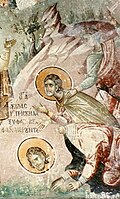 AquilaApostle · Apostle of the SeventyJul 14
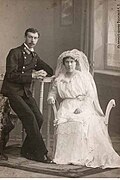 Konstantin BogoyavlenskyHieromartyr · Priest of MerkushinoJul 14
- Arsenius of AgiofarangoSaintJul 14
- Basinus of DrongenSaintJul 14
- Colman son of AingenSaintJul 14
- Deusdedit of CanterburySaint · Archbishop of CanterburyJul 14
- Emmanuel, Anezina, George and MariaHoly New Martyrs · Crypto-Christian New MartyrsJul 14
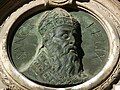 Felix of ComoSaint · Bishop of ComoJul 14