Venerable Martyr
Nicodemus the Albanian
Myrrh-streamer of Ohrid
Albanian monk martyred in 1722, whose relics are venerated at Ohrid.
Life
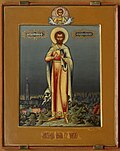
Holy Venerable Martyr Nicodemus the Albanian, also called Nicodemus of Ohrid and the Myrrh-streamer, was a tailor of Berat who renounced his faith and then, repentant, received martyrdom in 1722.
He was born at the turn of the seventeenth and eighteenth centuries in a village near Korçë, in Northern Epirus (today Albania), of pious parents. He worked as a tailor in the town of Berat. After the death of his third wife, he asked a Turk for permission to marry, for the fourth time, the Turk's young servant girl, a Christian. The Turk set as a condition that Nicodemus take up Islam. Blinded by lust, he publicly renounced his fathers' faith and compelled his wife and children to follow him. One son alone was an exception: Christians secretly sent him to Athos.
After a time God's grace awakened his conscience. Seeing with horror the weight of his sin, he resolved to follow his son to the Holy Mountain. He gave away his property, reached Athos, confessed at once, and withdrew to the skete of Saint Anne, under the guidance of a skilled elder from the monastery of the Ascension. After his tonsure his repentance was so deep that for three years he kept a very strict fast, weeping each day for his fall and praying God for forgiveness.
One night the Mother of God appeared to him, holding a crystal vessel in her hand, and told him that all his sins were forgiven, and she encouraged him for a new struggle, that he might be found worthy of the grace of martyrdom. Before leaving, the Mother of God gave him to drink a bitter draught from the crystal vessel. His spiritual father confirmed the vision and blessed him for martyrdom. Nicodemus did not wish to leave the Mountain without seeing Saint Acacius the Kausokalyvite (commemorated on 12 April). When he fell at the great elder's feet, Acacius raised him and called him by name, though he had never seen him before, and then stood in prayer. The monks present saw a heavenly light descend upon Saint Acacius, and his face shone with uncreated light. Then, turning to Nicodemus, he whispered a few words in his ear. The light then came down on Nicodemus too and turned within him into a kind of ecstasy of divine love, which made him weep aloud in repentance. As he begged Acacius to bless him and strengthen him for martyrdom, the elder gave him his staff, promising that it would give him courage to stand fearlessly before the pasha.
Strengthened by Saint Acacius's prayer and by an appearance of Christ, who showed him beforehand the trials to come, Nicodemus returned on foot to Berat, taking no food on the way. Near his workshop the Turks recognised him at once and took him to the pasha. The pasha tried in vain to turn him back to Islam and ordered him thrown into a pit below the palace. Guarded by divine grace, Nicodemus suffered no harm. He again stood before the astonished official, who gave him to the executioners. For three days they tormented him, then he was led to the place the Lord had shown him in the vision and there was beheaded on 11 July 1722.
He is remembered on 4 July (a movable day), in the Synaxis of the Athonite Saints, in the new style.
Commemorated the same day July 11
 Pius ISaint · Bishop of RomeJul 11
 Olga of KievEqual-to-the-Apostles · Princess of KievJul 11
 EuphemiaGreat Martyr · of ChalcedonJul 11
 Abundius of CórdobaHieromartyr · PriestJul 11
 Theodore the VarangianHoly MartyrsJul 11
- Arcadius of VyazmaVenerable · Recluse of VyazmaJul 11
- Nektarios of AthosVenerable MartyrJul 11
- Nicodemus of ElbasanNew Martyr · Albanian New MartyrJul 11
- Achilleus of RomeSaintJul 11
- AmabilisVenerableJul 11
- Anicius of RomeSaintJul 11
- Arcadius of NovotorskVenerableJul 11