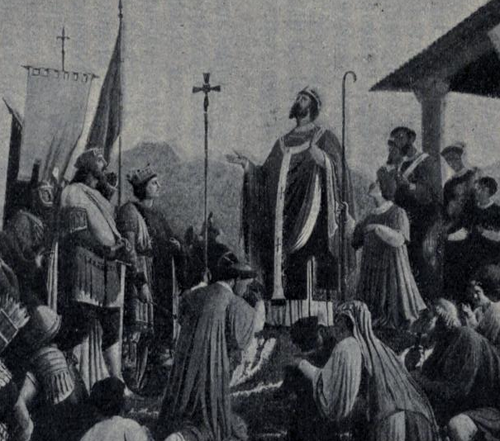
Saint
Paulinus of Aquileia
Patriarch of Aquileia
Patriarch of Aquileia from 787 until his death, theologian and poet, a scholar of the Carolingian Renaissance.
- Feast
- January 11old style January 24
- Reposed
- 8029th century
- Place
- Cividale del Friuli
- Order
- Hierarchs
Life
Saint Paulinus of Aquileia (Paulinus II) was a priest, theologian, poet and one of the great scholars of the Carolingian Renaissance, patriarch of Aquileia from 787 until his death, on 11 January 802. He lived before the separation of the Churches, and in Slovenia he is known as the apostle of the Slovenes. He is commemorated on 11 January.
Youth and the court of Charlemagne
He was born between 726 and 740 at Premariacco, near Cividale, in Friuli, in the last years of Lombard rule. He studied at the patriarchal school at Cividale and, after being ordained priest, became master of that school. He acquired a thorough Latin culture, pagan and Christian, knowledge of law and a broad training in Scripture, theology and the Fathers.
Because of his learning he came to the notice of Charlemagne in 774, when the king of the Franks conquered Lombard northern Italy. Because he remained loyal to him in the revolt of Duke Hrodgaud in 776, he received many gifts, among them an estate given by a diploma. In the same year Charlemagne called him to court as the king's master of grammar. For nearly ten years he worked at the itinerant palace school, where he also met other scholars of the age, such as Peter of Pisa, Alcuin of York, Fardulf, Arno of Salzburg and others. With Alcuin he formed a long friendship, attested by many letters.
Patriarch of Aquileia
On the death of Patriarch Siguald, in 787, Charlemagne appointed Paulinus patriarch of Aquileia. Paulinus returned from court to his see, residing at Cividale, which was also the seat of the Carolingian count of the March of Friuli, for Aquileia had been reduced, after its destruction by Attila in 452, to a small village, although the patriarchal basilica remained. As patriarch, Paulinus was able to work more actively at the reform of society. In his relations with the churches of Istria and with the patriarch of Grado, he showed prudence and pastoral zeal. From Charlemagne he obtained diplomas for the free election of future patriarchs by the chapter of Aquileia and other privileges for his patriarchate, for the monastery of St Mary in Organo and for hospitals at Cividale and Verona.
Synods and mission
Paulinus was careful of the integrity of doctrine. In 792 he took part in the council of Regensburg, which condemned Spanish Adoptionism, taught by the bishops Elipandus of Toledo and Felix of Urgell. In 794 he had a leading role at the council of Frankfurt, where Adoptionism was condemned again, and wrote against it a book sent to Spain in the name of the assembled bishops. He also took part in synods that affirmed the addition of the Filioque to the Creed. In 796 he accompanied Pepin, Charlemagne's son, on the campaign against the Avars. In late summer of that year, after the Avars were defeated, Paulinus presided over a synod of bishops in Pepin's camp on the bank of the Danube, which decided on a program of preaching and catechesis for the conquered lands, inhabited by Avars and Slavs. With his consent the synod entrusted to the bishop of Salzburg, Arno, the northern part of the patriarchate of Aquileia, the boundary between the dioceses being set on the river Drava. On Alcuin's advice it was decided that the lands should be Christianized without force. The Slovenes today regard Paulinus as their apostle, who brought them the faith peacefully.
Writings and death
Paulinus was also a poet; he wrote hymns and verses as well as theological works, printed in Migne's Patrologia Latina, volume 99. He died on 11 January 802, according to other dates in 804, at Cividale.
Commemorated the same day January 11
 HyginusSaint · Bishop of RomeJan 11
 Theodosius the CenobiarchVenerable · Organizer of cenobitic lifeJan 11
 Michael of KlopskFool-for-Christ · Monk of KlopskJan 11
 Theodosius of AntiochVenerableJan 11
- Anastasius of SuppentoniaVenerable · Abbot of SuppentoniaJan 11
 Theodosius of TrebizondVenerableJan 11
- Agapius of ApameaVenerableJan 11
- Alexander of FermoSaintJan 11
- Amphadhan of Gleann da LochSaintJan 11
- Boadin the IrishVenerableJan 11
- BrendanVenerableJan 11
- Eithne and FeidhelmHoly Right-Believing RulersJan 11