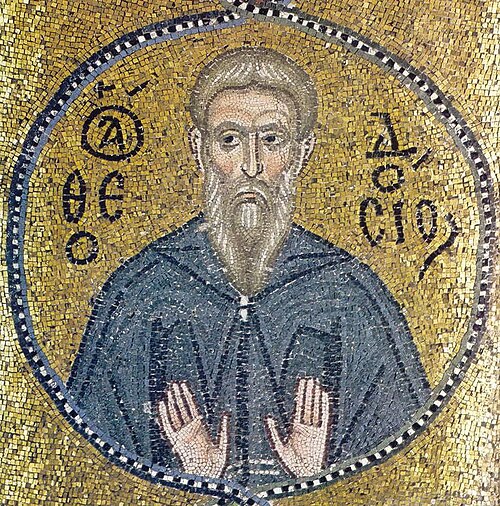
Venerable
Theodosius the Cenobiarch
Organizer of cenobitic life
Cappadocian monk, founder and organizer of cenobitic life in the Judean desert, who died in 529.
- Feast
- January 11old style January 24
- Reposed
- 5296th century
- Place
- Palestine
- Order
- Venerables
Life
Saint Theodosius the Great, called the Cenobiarch, was a Cappadocian monk, abbot and founder of communal monastic life in the Judean desert, born around 424 and fallen asleep in 529, at about one hundred and five years of age. The Church commemorates him on 11 January as the father of the communal monasteries of Palestine.
Childhood and the road to Jerusalem
He was born in the village of Mogaris near Comana in Cappadocia, of pious Christian parents, Proaeresius and Eulogia. His mother would later become a nun and take him as her spiritual father. Having a beautiful voice, he was appointed reader in church. Wishing to follow the example of Abraham and leave all for the love of God, he set out for Jerusalem around 451, at the time of the Fourth Ecumenical Council at Chalcedon.
At Antioch he went to Saint Symeon the Stylite to ask for his prayers. According to the Life, Symeon greeted him by name, embraced the young man and prophesied that he would be a shepherd of rational sheep and a saviour of many. At Jerusalem he visited the Holy Places and became a disciple of the venerable Longinus, who lived by the Tower of David. By Longinus's order he moved to the church of the Kathisma of the Mother of God, built by a pious widow halfway between Jerusalem and Bethlehem. Seeking quiet, he later withdrew into the desert, to a cave in which, by an ancient tradition, the Magi had stopped after worshipping the Lord.
The Lavra and the community
In the cave Theodosius performed great feats of asceticism: he prayed without ceasing, hung up a rope to support him if sleep overcame him, never satisfied his hunger, and ate dates, carobs, wild greens and legumes soaked in water. It is said that for thirty years he never tasted bread. Monks gathered around him, and the cave became too small. To choose the site of the monastery, he took the censer with cold coals and incense and went out into the desert. As he was returning toward the cave, fragrant smoke rose from the censer, the coals having kindled of themselves, and he understood that God had marked the place. There a church was built, then a great establishment, the Lavra of Saint Theodosius, with the rule of Saint Basil the Great, the first cenobium of Palestine. By the end of his life it housed up to four hundred monks.
His Life often mentions the miraculous multiplication of food at his prayer. He arranged houses for strangers and hospitals; monks of different languages had churches in which the services were held in each one's tongue, Greeks, Iberians and Armenians, and for Holy Communion all gathered in the great church. The community was known for its care of the sick, the elderly and the mentally impaired.
The Cenobiarch and the struggle for the true faith
A friend of Saint Sabbas the Sanctified, he was appointed together with him, in the time of Patriarch Salustius of Jerusalem (486 to 494), by the monks of the desert: Sabbas archimandrite of the hermits, Theodosius of those living in community, hence the name Cenobiarch, chief of those who live in common.
Under Emperor Anastasius, who embraced monophysitism and began to persecute those who held the Council of Chalcedon, Theodosius spoke in the name of the Palestinian monks. Coming to the church of the Holy Sepulchre, he proclaimed from the ambo an anathema against those who did not honour the four Ecumenical Councils as the four Gospels. For this he was exiled or imprisoned until the death of Anastasius, in 518.
Repose
After an illness of a year, he died in 529 and was buried in the cave of the Magi. His first Life was written a year later by Theodore, bishop of Petra, and the second by Cyril of Scythopolis. He is commemorated on 11 January.
Commemorated the same day January 11
 HyginusSaint · Bishop of RomeJan 11
 Paulinus of AquileiaSaint · Patriarch of AquileiaJan 11
 Michael of KlopskFool-for-Christ · Monk of KlopskJan 11
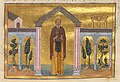 Theodosius of AntiochVenerableJan 11
- Anastasius of SuppentoniaVenerable · Abbot of SuppentoniaJan 11
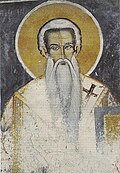 Theodosius of TrebizondVenerableJan 11
- Agapius of ApameaVenerableJan 11
- Alexander of FermoSaintJan 11
- Amphadhan of Gleann da LochSaintJan 11
- Boadin the IrishVenerableJan 11
- BrendanVenerableJan 11
- Eithne and FeidhelmHoly Right-Believing RulersJan 11