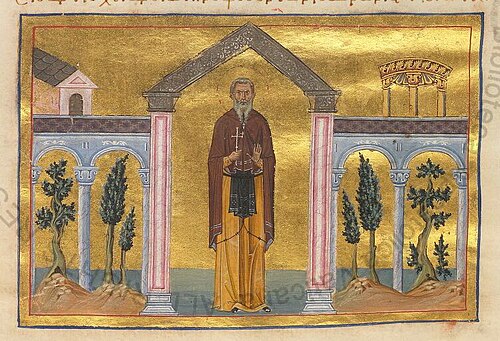
Venerable
Theodosius of Antioch
Syrian hermit of Antioch, of noble family, who left home and kin for monastic life; Theodoret tells his story.
- Feast
- January 11old style January 24
- Era
- unknown
- Order
- Venerables
Life
Venerable Theodosius was a Syrian hermit of Antioch, of the fourth and fifth centuries, of noble family, who left his house and kin to follow the monastic way. His life is told by Theodoret of Cyrrhus in chapter ten of the History of the Lovers of God. Our calendar gives his commemoration on 11 January and on 5 February.
He came from Antioch and was known for the nobility of his family. He left his house and kin and chose the monastic way. He settled in a hut in a valley to the south-east of a city of Cilicia, the valley descending to the Mediterranean Sea. Here he spent his life in monastic labours: abstinence, lying on the ground, wearing a hair shirt. He was an extremely strict ascetic and wore iron chains on his neck, his waist and both arms. He did not cut his hair, which reached his feet, and later grew longer still, so that he tied it around his hips. He also worked with his hands: he wove fans and little baskets, tilled small fields, sowed seed and gathered the fruits he needed for his food.
After some time word of him spread and many began to come, wishing to join him in his monastery. Theodosius received them and taught them. Some of the monks in his community wove sails and hair shirts, others wove fans and baskets, others tilled the soil. Because the monastery was near the sea, he built a boat and used it to carry goods: the things made by the monks. He sold them and with the money bought and brought everything the monastery needed. He cared for strangers and received them in the monastery.
The surroundings of Antioch, including Theodosius's monastery, were at that time ravaged by raids of barbarians. The leaders of the churches feared that the barbarians might seize Theodosius for gain and proposed that he settle in Antioch. The barbarians had earlier taken two church leaders captive and released them only after receiving a ransom of four thousand gold pieces for both. Theodosius heeded them, came to Antioch and settled in a refuge near the river, close to the village of Marato, where he founded a monastery. Theodoret tells of a miracle of his: above the monastery was a steep rock, dry and without water. Theodosius struck the rock with his staff, and a spring opened, from which water flowed to the monastery, and its inhabitants used it afterwards.
Theodosius died at Antioch. His body was carried through the middle of the city, accompanied by all the inhabitants, including the highest officials. Around his body quarrels broke out, because everyone wanted to carry him and touch the relics of the saint to receive a blessing from above. The relics of the ascetic were carried through the city, and Theodosius was buried in a cave, together with the bodies of Julian and Aphrahat. After him the monastery was led by Helladius, who was abbot for sixty years and then became bishop of Cilicia. After him the monastery of Theodosius was led by Helladius's disciple, Romulus.
Commemorated the same day January 11
 HyginusSaint · Bishop of RomeJan 11
 Paulinus of AquileiaSaint · Patriarch of AquileiaJan 11
 Theodosius the CenobiarchVenerable · Organizer of cenobitic lifeJan 11
 Michael of KlopskFool-for-Christ · Monk of KlopskJan 11
- Anastasius of SuppentoniaVenerable · Abbot of SuppentoniaJan 11
 Theodosius of TrebizondVenerableJan 11
- Agapius of ApameaVenerableJan 11
- Alexander of FermoSaintJan 11
- Amphadhan of Gleann da LochSaintJan 11
- Boadin the IrishVenerableJan 11
- BrendanVenerableJan 11
- Eithne and FeidhelmHoly Right-Believing RulersJan 11