Venerable
Salamanes the Silent
Syrian hermit
Syrian hermit of the 4th and 5th centuries, born at Capersana on the Euphrates, whose life is told by Theodoret of Cyrrhus.
- Feast
- January 23old style February 5
- Era
- unknown
- Order
- Venerables
Life
Venerable Salamanes the Silent was a Syrian hermit of the fourth and fifth centuries, born in the village of Capersana, on the western bank of the Euphrates. His life is told by Blessed Theodoret of Cyrrhus in chapter 19 of his History of the Monks. He is remembered on 23 January. The Church honours him as the first saint to take upon himself the labour of silence, which he kept to the end of his life.
The labour of silence
Salamanes chose the Christian labour of silence. On the other bank of the river he found a small shelter and shut himself in it, leaving neither door nor windows. Once a year he crept under the wall of the shelter and brought himself food for a whole year, and he entered into conversation with no man. He lived a very long time in his cell.
The bishop of the city to which the village of Capersana belonged, learning of his virtues, came to him, wishing to ordain him priest. He ordered a part of the wall of the cell to be broken and went in to him, laid his hands on him and read the prayer of ordination. Having made Salamanes a priest, the bishop gave him a long instruction, explaining what grace had been given him, and left the cell without hearing a single word from the ascetic. After that the prelate ordered the breach in the wall of the cell to be closed.
Moved from village to village
The people of the village of Capersana crossed the river by night, destroyed Salamanes's hut, took him and quickly carried him to their village. Salamanes showed neither resistance nor consent. In the morning they built him a hut like the former one and shut him up in it again. Salamanes kept silence and told no one anything. After some time the people of another village, on the opposite bank of the river, came by night, broke the hut and led Salamanes the Silent to their village. Salamanes did not resist, did not ask to be left, but also did not show any willingness to settle in the new place.
Theodoret of Cyrrhus writes that in this way Salamanes, having made himself dead to earthly life, repeated in the strictest sense the words of the Apostle Paul in the Epistle to the Galatians (2:19 and 20): crucified with Christ, he no longer lives himself, but Christ lives in him, and the life he now lives in the flesh he lives by faith in the Son of God, who loved him and gave himself for him. A Serbian source gives the year 400 as that of his death.
Commemorated the same day January 23
 Paulinus of NolaSaint · Bishop of NolaJan 23
 EmerentianaMartyrJan 23
 Clement of AncyraHieromartyr · Bishop of AncyraJan 23
 Abraham of GalichVenerable · Abbot and founder at ChukhlomaJan 23
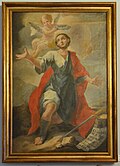 Agathangelus of RomeMartyr · Deacon of RomeJan 23
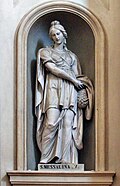 Messalina of FolignoMartyr · Virgin of FolignoJan 23
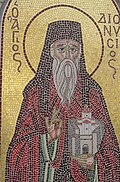 Dionysius of Mount OlympusVenerable · Monk on Mount OlympusJan 23
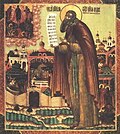 Gennady of KostromaVenerable · Founder of Gennady MonasteryJan 23
 Barlaam of ChikoyVenerable · Abbot of Chikoy MonasteryJan 23
 Alexander of VochskVenerable · HegumenJan 23
 Catherine CherkasovaVenerable Martyr · NoviceJan 23
- Amasius of TeanoSaint · Bishop of TeanoJan 23