Right-Believing
Solomon II
King of Imereti
The last king of Imereti, who died in exile at Trebizond in 1815.
- Feast
- February 7old style February 20
- Reposed
- 181519th century
- Place
- Trabzon (exile)
Life
Holy King Solomon II was the last king of Imereti, who died in exile at Trebizond in 1815 after a lifetime of struggle for the freedom and unity of Georgia. The Church of Georgia calls him "the holy king Solomon II, who gave himself for the homeland".
He was born on 7 February 1772 as David, son of Archil, brother of King Solomon I of Imereti, and of Helen, daughter of King Erekle II of Kartli-Kakheti. He grew up mostly with his mother's relatives. King Solomon I, left without an heir, bequeathed the throne to him. When Solomon I died, David was twelve, and the nobles set on the throne, against the will, David Giorgis-dze. In 1790, in the battle of Matkhoji, he was defeated, and David Archilis-dze ascended the throne as Solomon II. He began the struggle for the unification of the country, married Maria, daughter of Prince Grigol Dadiani of Odishi, held the principality of Guria, and was related by blood to the kingdom of Kartli-Kakheti. His spiritual father was Saint Hilarion Kanchaveli (Hilarion the Georgian). He strengthened the Church, rewarded worthy men with estates, confirmed the properties of the Church of Jerusalem in Imereti, and renewed the charter of the Bichvinta monastery.
After Kartli-Kakheti was joined to Russia, the Russian government tried to annex Imereti too. Solomon tried to preserve its freedom through manoeuvres between Russia and the Ottoman Empire, but without success. On 20 February 1810, by order of Tsar Alexander I, he was dethroned. He was captured by deceit and taken to Tbilisi, but managed to escape and took refuge in the pashalik of Akhaltsikhe, from where he led the national liberation movement. After the Imereti uprising was crushed in 1810, he fled again to Akhaltsikhe, then to the Ottoman Empire. He lived seven years in the town of Azmur, then in Trebizond, where he was received with honour by the pasha, a Georgian nobleman by origin. He gave the Greek church of Trebizond a Greek Gospel covered in gold. He died at Trebizond on 7 February 1815 and was buried in the yard of the Greek church. The Church of Georgia canonized him in 2005, and his remains were brought from Trebizond and buried at Gelati Monastery. His commemoration is on 7 February, old style (20 February, new style).
Commemorated the same day February 7
 Luke of SteirisVenerable · Founder of Hosios Loukas MonasteryFeb 7
 Parthenius of LampsacusSaint · Bishop of LampsacusFeb 7
 ChrysoliusSaint · Patron of CominesFeb 7
 WunnaSaint · Noblewoman of WessexFeb 7
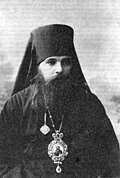 Alexander ShchukinHieromartyr · Archbishop of SemipalatinskFeb 7
 Maximus of NolaSaint · Bishop of NolaFeb 7
 Paul III of BresciaSaint · Bishop of BresciaFeb 7
- Margaret GunaropuloVenerable Martyr · Abbess of the Menzelinsk ConventFeb 7
- Cyprian YatsenkoNew MartyrFeb 7
- Mastridia of JerusalemVenerableFeb 7
- Vladimir ElizarovVenerable Martyr · MonkFeb 7
- AdauctusMartyrFeb 7