Saint
Theophanes the Myrrh-gusher
Archbishop of Cyprus
Bishop of Solea and Archbishop of Cyprus, who died in 1550; venerated locally as the myrrh-gusher.
Life
Venerable Theophanes the Myrrhgusher was Bishop of Solea and shepherd of the Greeks of Nicosia in Cyprus during the Venetian occupation, who fell asleep in 1550. Witnesses of his own time remembered him as a monk of blameless life and, after his death, as a wonderworker. He is honoured locally in Cyprus and commemorated on 17 May; he has no known canonization.
Life
Theophanes lived in Cyprus during the Venetian occupation (1489 to 1571). Nothing is known of his parents, origin or education. The information we have is little but precious, because it is handed down by a contemporary and eyewitness of the exhumation of his relics, Stefano Lusignan (1537 to 1590), a Dominican monk and vicar of the Latin Archdiocese of Cyprus, in his Chorography of the Island of Cyprus, published first in Italian in 1573 and then in French in 1580.
He loved Christ greatly, left the world and lived as a monk in the Monastery of Mangana in Nicosia, dedicated to St George. The monastery was old, from Byzantine times, but had been renewed in 1453 by Helen Palaiologina, wife of King John II of Cyprus, to house the priests who came to Cyprus after the fall of Constantinople. The Venetians demolished it in 1567 to build the new fortifications of Nicosia. The life of the monk Theophanes was exemplary: "as for his life, nothing could be found to criticise", says the biographical note in the work cited. Though he hid his virtues in humility, the Lord revealed him to people, and the bishops of the time elected him, against his will, to shepherd the Church of Cyprus. He accepted the office with great difficulty. Since the Latin archbishop had his seat at Nicosia, the saint bore the title of Bishop of Solea and administrator of the Greeks of Nicosia. Under the Venetians, Greek bishops were not allowed to live in the large cities, at the seats of their metropolises, but only in villages.
Retreat and repose
It is not known how long he stayed in office. An unusual incident led him to resign, and the resignation was hardly accepted. One day he rebuked his oikonomos, the highest church office after the bishop, for something wrong. The oikonomos, a proud and impudent man, slapped him in front of the people. The bishop, considering himself wholly unworthy of his office, went to the Latin archbishop and put his resignation into his hands. He asked for it with tears. The Venetian authorities at first refused, a sign of their respect for his person, but in the end accepted it. The meek bishop did not grow angry and did not ask for the oikonomos to be punished. His great humility shows the height of his holiness.
After his resignation he satisfied his longing for quiet. He fled the noise of the cities and took refuge in the Monastery of St John the Forerunner at Mesa Potamos, in the Troodos mountains. According to some accounts he was also abbot there. Then he went up and lived alone in a cell about 87 metres above the monastery, a place therefore named "Monastery of Goumenos". After his repose the Lord gave him the gift of miracles, as the monks of the monastery testify.
Only one incident of his life is handed down. One night he dreamed that a friend brought him a jar of honey. In the morning, just as he woke, the friend arrived with a jar full of honey. The bishop accepted the honey with thanks, then threw it against the wall and the honey spilled. He told his friend that he did this so as not to let the devil make him believe in dreams. In this way he rejected the devil's attempt to suggest that he had gained the gift of foresight. He died in 1550, according to the Cypriot scholar Neophytos Rodinos.
After four or six years his relics were moved and found incorrupt and fragrant. They were placed in the katholikon, and his head in a silver case. "I saw the exhumation and the bones mixed with soil, which gave off a scent, but not of death," writes Lusignan. His memory was kept through the Turkish period, and in 1999, in the church of the village of Treis Elies, in the Metropolis of Morphou (old Soloi or Solea), an icon of 1689, by the painter Leontios of Limassol, was found with the inscription "Saint Theophanes the New", probably depicting him as Bishop of Solea. Where his relics are today is not known; probably the fathers of the monastery hid them to protect them from the Turks.
Commemorated the same day May 17
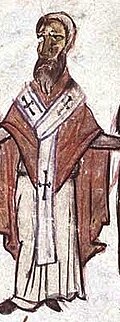 Stephen I of ConstantinopleSaint · Patriarch of ConstantinopleMay 17
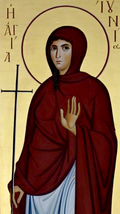 JuniaApostle · One of the SeventyMay 17
 Euphrosyne of MoscowVenerable · Grand Princess of MoscowMay 17
 Adrian of OndrusovVenerable · Monk and wonderworkerMay 17
- Julitta PetrovskaConfessor · Ukrainian asceticMay 17
- SolochonMartyrMay 17
- AdrionSaintMay 17
- AndriusMartyrMay 17
- AquilinusMartyrMay 17
- Arthemius of NeversSaintMay 17
- Basilla of AlexandriaMartyrMay 17
- CathanSaint · BishopMay 17