Martyr
Theophilus of Melitene
A martyr of Melitene, put to death for his faith in Christ.
- Feast
- November 7old style November 20
- Era
- unknown
- Order
- Martyrs
Life
Holy Martyr Theophilus of Melitene is remembered together with the martyr Hieron and others who suffered in Melitene, in the time of Diocletian and Maximian. The Azbyka page says nothing separate about Theophilus, but tells the passion of Hieron and his companions, among whom Theophilus is counted.
Hieron
Hieron was born in Tyana of the second Cappadocia, of a devout and God-fearing mother named Stratonice. Learning that the people of Armenia and Cappadocia refused to bow to idols against their orders, the emperors sent Agricolaus to Armenia and Lysias to Cappadocia, with orders to kill the Christians who would not bow to idols and to enlist all strong men and youths in the army. Lysias heard of Hieron as a sturdy and very courageous man and sent soldiers to fetch him. Hieron refused to go, thinking it harmful for a Christian to serve beside worshippers of idols. When the soldiers tried to take him by force he seized a piece of wood and beat them, and they fled. They returned in greater numbers, and Hieron withdrew with eighteen Christians into a cave and beat back the attack.
Then the commander sent one of his friends, Kyriacus, who spoke to him gently, calmed him and led him out of the cave. Hieron took leave of his mother, an old, blind widow who wept over him, and set out for Melitene with the soldiers, his kinsmen Matronianus and Antony and other believers. On the road, in the night, someone clothed in white appeared to him and announced that he was going the right way and would soon receive honour and glory from the heavenly King. Hieron told his companions that he now went with joy and entrusted his mother to Christ, the Father of orphans and widows.
At Melitene
At Melitene Hieron was imprisoned together with thirty-three other Christians. He told them that the next day they would be forced to sacrifice to idols, and urged them not to obey but to offer a sacrifice of praise to the true God. All accepted the counsel. The next day, before Lysias, they confessed that they worshipped the Maker of heaven and earth. A witness pointed out Hieron as the one who had resisted the envoys, and he confessed it openly. Lysias ordered his hand cut off to the elbow, and the other saints were beaten for a long time without mercy.
They were then thrown into prison again. One of them, Victor, a kinsman of Hieron, weakened by the beatings and fearing more, begged the clerk who kept the list of Christians to strike out his name, promising him an estate. The clerk agreed, and Victor was let out of the prison at night, but he died soon after, losing his property, his life and the crown of martyrdom. Learning of it in the morning, Hieron wept bitterly. To his two kinsmen Antony and Matronianus he left his will: his property in Pisidia to his sister Theotima, that she might keep his memory on the day of his death; the rest to his mother, with his severed hand, which she was to lay in Vadisana.
Martyrdom
On the fifth day Lysias summoned them again and, after trying in vain to turn them by gentleness and threats, had them beaten with rods and condemned them to beheading. Led by Hieron, they went to the place of execution singing the psalm blessed are the undefiled in the way, and there they knelt and prayed: Lord Jesus Christ, receive our souls. Then their heads were cut off with the sword.
Antony and Matronianus asked for the body of Hieron, but Lysias demanded for his head a price equal to its weight in gold. A rich and well known man, Chrysaphius, paid the price and kept the head with honour. Antony and Matronianus fled by night with the saint's hand and brought it to his mother Stratonice, who kissed it with tears and said that she was glad to be the mother of a martyr. The bodies of the saints were buried in secret by other Christians, and Chrysaphius later built a church on the place where they had been beheaded and laid the martyr's head there.
The saints are commemorated on 20 November.
Commemorated the same day November 7
 WillibrordSaint · Bishop of UtrechtNov 7
 Herculanus of PerugiaHieromartyr · Bishop of PerugiaNov 7
 Congar of SomersetVenerable · Welsh abbotNov 7
 Michael of KulebakiHieromartyr · ArchpriestNov 7
 Cyril SmirnovHieromartyr · Metropolitan of Kazan and SviyazhskNov 7
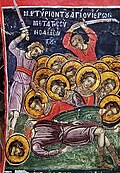 The 33 Martyrs of MeliteneHoly MartyrsNov 7
 Sergius ZverevHieromartyr · Archbishop of YeletsNov 7
- Alexander IlinskyHieromartyrNov 7
- Alexander KrylovHieromartyrNov 7
- Alexander KurmyshskyHieromartyrNov 7
 Alexis MolchanovHieromartyrNov 7
- Amarand of MoissacSaintNov 7