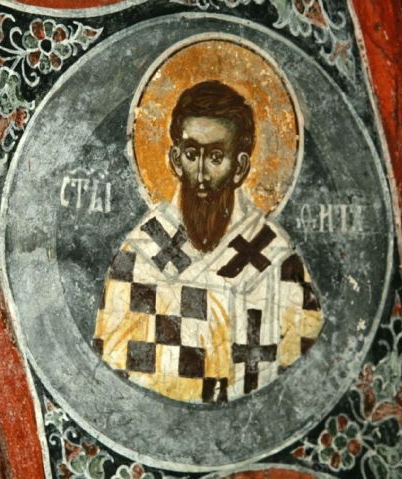
Apostle
Titus
Bishop of Crete
Disciple and companion of the Apostle Paul, recipient of one of his epistles, first bishop of Crete.
Life
The holy Apostle Titus was a disciple and companion of the holy Apostle Paul, one of the seventy apostles and the first bishop of Crete. The Epistle to Titus is addressed to him. The Church commemorates him on 25 August, and on 4 January in the synaxis of the seventy apostles.
Early life
Titus was a Greek, born of pagan parents. The synaxarion says he was a Cretan of good family and that in his youth he studied philosophy and the ancient poets, yet lived a pure life. It is told that at twenty he heard a voice in a dream urging him to leave Greek wisdom and seek what would save his soul. He read the prophets, and the Book of Isaiah fell into his hands at the forty-seventh chapter. When news of a great Prophet in Palestine reached Crete, the governor of the island, his uncle, sent him there. Tradition says that at Jerusalem he saw the Lord Jesus Christ, heard His preaching and believed in Him, and that at Pentecost he heard the apostles speak also in the Cretan language (Acts 2:11).
It is certain from Scripture that Titus was converted by Paul, who calls him "my true child in a common faith" (Titus 1:4). In the Epistle to the Galatians (2:1-3), Paul tells that he took Titus with him to Jerusalem, around 49, when he went with Barnabas to the assembly of the apostles, and that Titus was not compelled to be circumcised, which was an important sign for the reception of the Gentiles into the Church.
Ministry
Titus appears in the Second Epistle to the Corinthians as a trusted messenger of Paul. He was sent to Corinth to restore peace after the disputes in the Church and to collect aid for the poor Christians of Jerusalem, and when he returned with good news, Paul was comforted (2 Corinthians 7:6-7). Jerome says he served as secretary in the writing of that epistle.
After the third missionary journey, Paul passed through Crete with Titus and left him there: "This is why I left you in Crete, that you might amend what was defective, and appoint elders in every town" (Titus 1:5). The Epistle to Titus, written around 65, shows him the qualities of a bishop, advises the old, the young and slaves, and asks that those who corrupt the faith be rebuked. The Cretans had a bad reputation, and Paul quotes a Cretan poet: "Cretans are always liars, evil beasts, lazy gluttons" (1:12). Paul later called him to Nicopolis, and in the Second Epistle to Timothy it is said that Titus went to Dalmatia (4:10).
Repose
According to the synaxarion, when Paul was taken to Rome, Titus left his flock for a time to serve him. After Paul's death he returned to Gortyna, the chief city of Crete. He shepherded the Church in peace and enlightened the pagans. It is told that at a feast of the goddess Artemis he asked the Lord to show the mistaken people the emptiness of the idols, and the idol fell and shattered; another time a temple of Zeus collapsed before it was finished. Titus departed to the Lord in peace, at ninety-seven, his face shining like the sun.
Veneration
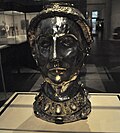
Saint Titus is the patron of Crete. His skull, all that remains of his relics, was kept in the church of Saint Titus at Heraklion, was taken to Venice during the Ottoman rule of Crete and was returned in 1966. The Catholic Church commemorates him, with Timothy, on 26 January. On 25 August, his day in the Orthodox Church, the Apostle Bartholomew is also remembered.
Commemorated the same day August 25
 Menas of ConstantinopleSaint · Patriarch of ConstantinopleAug 25
 Gregory of UtrechtSaint · Abbot at UtrechtAug 25
- Epiphanius of ConstantinopleSaint · Patriarch of ConstantinopleAug 25
 Patricia of NaplesSaintAug 25
- John II the CappadocianSaint · Patriarch of ConstantinopleAug 25
- John of KarpathosVenerable · Bishop of KarpathosAug 25
- Eulogius of EdessaConfessor · Bishop of EdessaAug 25
- Genesius of BrescelloSaint · Bishop of BrescelloAug 25
- Moses OlenitskyVenerable Martyr · HieromonkAug 25
- Confessors of EdessaHoly ConfessorsAug 25
- 202 Martyrs of EikosiphoinissaHoly MartyrsAug 25
 ArediusVenerableAug 25