Saint
Veronica
Woman of Jerusalem
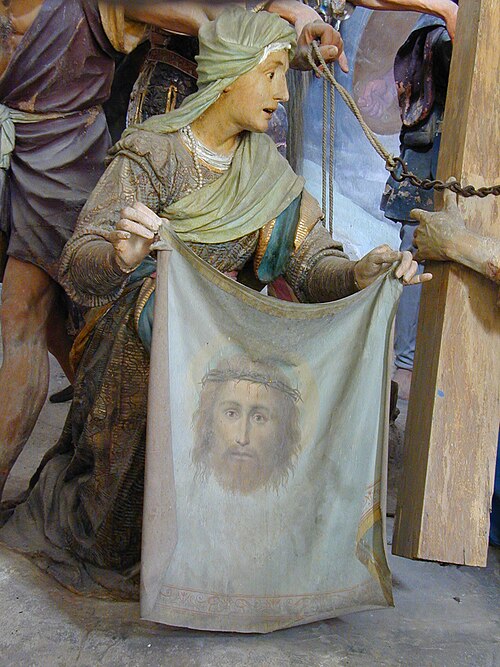
According to tradition, the woman of Jerusalem who wiped the face of Christ on the way to Golgotha.
- Feast
- July 12old style July 25
- Reposed
- 11st century
- Place
- Caesarea Philippi
Life
Saint Veronica (also called Berenike or Bernice) is honoured in Orthodox tradition as the woman of the Gospels who suffered for twelve years from a flow of blood and was healed by touching the hem of the Lord's garment. She is commemorated on 12 July. A second tradition, known in the West and also repeated in some Romanian Orthodox sources, tells of a Veronica who wiped the face of Christ on the way to Golgotha. The two accounts are explained below.
The Gospels of Matthew (9:20-22), Mark (5:25-34) and Luke (8:43-48) tell of a woman who for twelve years had suffered much under many physicians, had spent all she had, and had grown worse instead of better. Hearing of Jesus, she came through the crowd and touched His garment, saying to herself that if she only touched His clothes she would be made well. At once the flow of blood stopped. The Lord felt that power had gone out of Him and asked who had touched Him. The woman came forward trembling, fell at His feet and told the whole truth. He said to her, "Daughter, your faith has made you well; go in peace, and be healed of your disease."
The Gospels do not give her name. The name Veronica is the Latin form of Berenike, a Macedonian Greek name meaning "bringer of victory," and it appears for the woman in the apocryphal Acts of Pilate, an early work. The Synaxarion of Saint Nicodemus of the Holy Mountain says that she came from Paneas, also called Caesarea Philippi, in the north of the Holy Land. Out of gratitude she raised a statue of the Lord in front of her house, where all could honour it, and a plant that grew at its foot was said to heal various illnesses. Eusebius of Caesarea, in the seventh book of his Church History, tells of this statue at Paneas, which he says he had seen himself. Later she became a member of the early Church, and after a holy life she gave her soul to God.
The other tradition is first attested in the later Middle Ages: a woman of Jerusalem, moved to pity, wiped the face of Christ as He carried the Cross, and His likeness remained on the cloth. Scholars note that the name Veronica was linked in the West with the Latin words vera icon, "true image," and that the cloth, called a Veronica, became a relic and the sixth Station of the Cross. The Gospels do not mention it. Because of this, the Orthodox synaxarion treats the Veronica of the veil as a different person and holds that she is not the saint of 12 July. The Orthodox Church celebrates the image not made by hands, the cloth that Christ sent to King Abgar of Edessa, on 16 August. Some Romanian Orthodox sources, however, say cautiously that the same saint may also be the woman who wiped the face of the Saviour.
Nothing is known of relics. The Church sees in her an example of faith that finds healing by touching Christ with trust.
Commemorated the same day July 12
 John the IberianVenerable · Founder of Iviron MonasteryJul 12
 Michael MaleinosVenerable · Monk in Asia MinorJul 12
 Nabor and FelixHoly MartyrsJul 12
 Theodore and John the VarangiansHoly Martyrs · Varangian martyrs of KievJul 12
 Simon of VolomskVenerable · Founder of the Volomsk HermitageJul 12
- GolindouchConfessorJul 12
 Gabriel the AthoniteSaint · Macedonian bishopJul 12
 Philemon KoridzeRighteous · Opera singerJul 12
- Arsenius of NovgorodVenerable · Recluse and monastery founderJul 12
 Ansbald of PrümVenerable · Abbot of PrümJul 12
- BalaySaintJul 12
- Colman son of CronVenerableJul 12