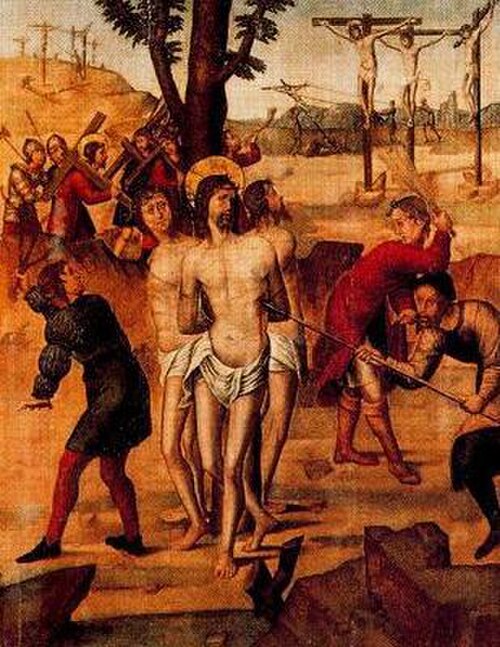
Martyr
Acacius the Centurion
Centurion of the imperial army
Cappadocian centurion of the imperial army, martyred at Byzantium in the early fourth century.
Life
Saint Acacius the Centurion, martyr, was a Cappadocian officer of the Roman army, put to the sword at Byzantium around 303 or 304, in the time of the persecution of Maximian and Diocletian. He is commemorated on 7 May in the Orthodox Church, and in the Roman Catholic tradition he is called Agathius or Achatius and is counted among the Fourteen Holy Helpers.
Life and confession According to his Life, Acacius was born in Cappadocia into the family of a Christian priest, and in the time of Emperor Maximian he became centurion of a cohort traditionally called the Martisian. When the persecutions began, he openly confessed his faith before the commander Firmus. In his answer to the judge, says the Life, he explained that he had received the faith from his parents and had been strengthened in it by seeing many miracles.
He was sent to Perinthus, also called Heraclea, in Thrace, imprisoned and put to torture. Then, together with other Christian prisoners, he was taken to Byzantium. There, by order of the proconsul Falcianus, he was scourged and, because he would not renounce Christ, beheaded, in 303 or 304.
Relics and veneration According to tradition, in the time of Constantine the Great the saint's relics were brought to Constantinople and laid in the church built in his honour, the church of St Acacius. Around 630 they were taken to Italy, to Squillace in Calabria, near the Vivarium monastery founded by Cassiodorus. There he was known as San Agario. A relic of his arm was brought in 1584 to Guardavalle by Bishop Marcello Sirleto, whence the saint's patronage of that town. Particles of the relics also reached Cuenca and Ávila in Spain, where he is called San Acato.
His veneration spread elsewhere too. In Slovenia many churches and chapels are dedicated to him; in the sixteenth century he was regarded as patron of those fighting the Turks. For the same reason he was loved by the Maniots of the Mani peninsula in Greece, who saw in his defiance of pagan Roman rule an image of their own resistance to the Ottomans. The Orthodox Church commemorates him on 7 May.
Commemorated the same day May 7
 Nilus of SoraVenerable · Founder of the Sora HermitageMay 7
 Domnius of SalonaSaint · Bishop of SalonaMay 7
 Alexis Toth of Wilkes-BarreConfessor · Protopresbyter and missionary in AmericaMay 7
 John of BeverleySaint · Bishop of YorkMay 7
 Abibus of NekresiSaint · Bishop of NekresiMay 7
 David of GarejiVenerable · One of the Syrian FathersMay 7
- Thaddeus of StepantsmindaVenerableMay 7
 Pachomius the RussianVenerable MartyrMay 7
- John of ZedazeniVenerableMay 7
- Agapius of VatopediVenerableMay 7
- Akaki AsistaviSaintMay 7
- Antipas KirillovVenerable MartyrMay 7