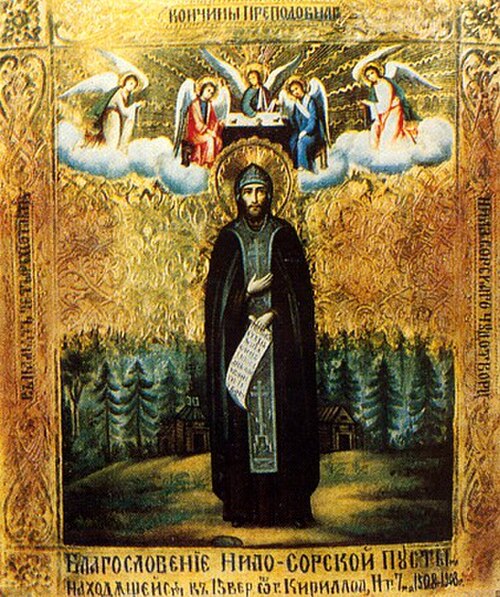
Venerable
Nilus of Sora
Founder of the Sora Hermitage
Russian monk and spiritual writer, founder of the Sora Hermitage, who died in 1508.
- Feast
- May 7old style May 20
- Reposed
- 150816th century
- Place
- Moscow
- Order
- Venerables
Life
Saint Nilus of Sora, in the world Nikolai Maikov, was a Russian monk, spiritual writer and theologian, the founder of the hermitage on the River Sora. He is regarded as the father of the skete life in Russia and of the movement called the non-possessors, which opposed monastic landownership. He fell asleep in the Lord on 7 May 1508.
Youth and pilgrimage
He was born in 1433 in Moscow. Little is known for certain of his origins. He called himself an unlearned man and a villager, but such self-abasing words are customary in writings of this kind, and he seems to have come from a family of educated officials, related to the Maikov nobility. His brother Andrei Maiko was a well-known official under Vasily II and Ivan III. Before becoming a monk Nilus worked as a scribe and copied books.
He was tonsured about the middle of the 1450s at the Kirillo-Belozersky Monastery, in the time of Abbot Cassian. The monastery was known for its stand against the owning of villages, since its founder, Saint Cyril of Beloozero, had refused villages offered by devout nobles. Nilus held a place of note among the elders there and copied books, and his handwriting can be recognized in several manuscripts of the monastery library. About 1475, together with his disciple Innocent Okhlyabin, he made a long journey to the Holy Land, to Constantinople and to Mount Athos, where he came to know hesychasm and the life of the skete and read the Holy Fathers. The journey changed him deeply, and silence and forgetfulness of the world remained the chief marks of his character.
The hermitage on the Sora
On his return, at some point between 1473 and 1489, he founded a skete on the River Sora, not far from Saint Cyril's monastery, and settled there with his disciples. Its rule rested on the ancient sketes of Egypt, Athos and Palestine. Only literate monks were received, who had served obedience in a cenobitic monastery, and they had to know the Scriptures and keep the traditions of the Holy Fathers. Nilus required his monks to labour with their hands and upheld a secluded, modest life.
His writings
Even in the quiet of the skete Nilus did not give up work with books. He was influenced above all by Gregory of Sinai, Symeon the New Theologian, John Climacus, Isaac the Syrian, John Cassian, Nilus of Sinai and Basil the Great. His chief work is the Rule of Skete Life, in eleven chapters. It is not a set of regulations but an ascetic teaching on spiritual struggle, with great care for the prayer of the mind or heart. In the Tradition to his disciples he writes about the ordering of skete life, about possessions, about the many who come from the world, and about fasting measured by the strength of body and soul. He also left several epistles, to Gury Tushin, German Podolny, Vassian Patrikeev and others, and two prayers. He also copied manuscripts and compiled collections of saints' lives.
The non-possessors and the heresy
Nilus was drawn into the dispute over the Novgorod heresy. Together with Paisius Yaroslavov he was more lenient toward the heretics than most of the clergy, led by Archbishop Gennady and Joseph of Volokolamsk. According to some sources, at the synod of 1490 he opposed the death penalty and questioned the Church's right to bring the erring back by any means but counsel, prayer and example. The synod nevertheless decided that they be burned, and a few were burned at Novgorod and Moscow.
At the synod of 1503 in Moscow, Nilus rose against the monasteries' ownership of land. He held that their estates, which covered about a third of the country, had led to the loss of the monastic spirit. He was against formalism and wanted spiritual life to come before ritual, on the foundation of the Gospel.
Veneration
Saint Nilus fell asleep in the Lord on 7 May 1508. The Russian Church honours him as a great ascetic and a father of the Church, and the saint is commemorated on 7 May, the day of his repose, and on the third Sunday after Pentecost together with the Synaxis of the Saints of Vologda.
Commemorated the same day May 7
 Acacius the CenturionMartyr · Centurion of the imperial armyMay 7
 Domnius of SalonaSaint · Bishop of SalonaMay 7
 Alexis Toth of Wilkes-BarreConfessor · Protopresbyter and missionary in AmericaMay 7
 John of BeverleySaint · Bishop of YorkMay 7
 Abibus of NekresiSaint · Bishop of NekresiMay 7
 David of GarejiVenerable · One of the Syrian FathersMay 7
- Thaddeus of StepantsmindaVenerableMay 7
 Pachomius the RussianVenerable MartyrMay 7
- John of ZedazeniVenerableMay 7
- Agapius of VatopediVenerableMay 7
- Akaki AsistaviSaintMay 7
- Antipas KirillovVenerable MartyrMay 7