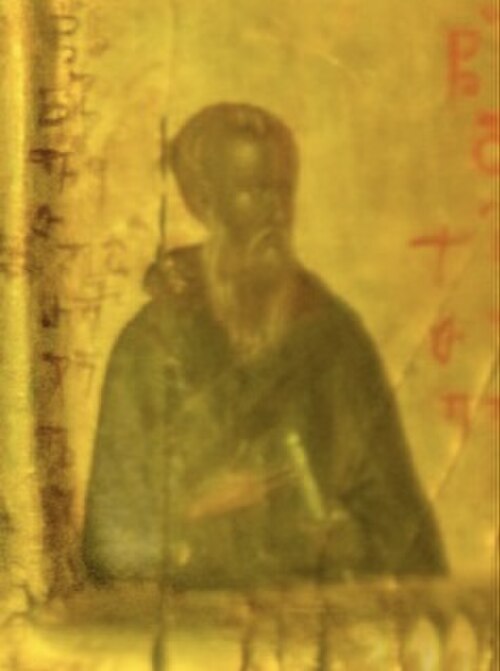
Venerable
David of Gareji
One of the Syrian Fathers
Anchorite and wonderworker, one of the thirteen Syrian Fathers of Georgia, in the sixth century.
- Feast
- May 7old style May 20
- Reposed
- 6047th century
- Order
- Venerables
Life
Venerable David of Gareji (second half of the sixth century, died about 604) was an anchorite, disciple of Saint John of Zedazeni, wonderworker, one of the thirteen Syrian Fathers of Georgia (Iberia) and founder of the David Gareji monastery. He is venerated in the Orthodox Church, above all in the Georgian. He is commemorated on 7 May (Old Style) and on the Thursday after the Ascension (Mamadavitoba); the Serbian source gives 20 May for all thirteen and, in the Serbian Church, 27 May (Old Style).
Life
He came from Antioch to Iberia, together with John of Zedazeni, to preach Christianity. He struggled on Mount Zedazeni, near the ancient capital Mtskheta, then on Mount Mtatsminda, today in Tbilisi, where the church named after him, Mamadaviti, stands, then moved to the cave of Gareji. He founded the David Gareji monastery with his disciples Dodo and Lukiane. In old age he resolved to make a pilgrimage to Jerusalem with some disciples; he left the monastery in the care of the elders Lukiane and Dodo. Reaching a hill from which Jerusalem could be seen, he hesitated, thinking himself unworthy to walk in the footsteps of the God-Man, and neither entered the gates of the city nor would meet Patriarch Elijah of Jerusalem. He told his disciples to go themselves to venerate the holy places, while he took three stones from the Holy Land and turned back. The patriarch's envoys overtook him near Nablus and, at the patriarch's order, took two stones from him, so that he should not take with him "the whole grace of Jerusalem"; he brought to Iberia only one, which became known in Georgia as a miracle-working stone, the "stone of grace", believed to have healing power and venerated by Christian pilgrims of the East and even by Muslim visitors.
According to the Serbian source the stone lies on his grave; according to the English source, in the time of the invasions of the late Middle Ages it was hidden in various places, and since the 1990s it has been kept in the Sameba cathedral in Tbilisi. Returning to the monastery, he stayed there to the end of his life; he reposed in the second half of the sixth century (in 604 according to the Russian source) and was buried in the David Gareji Lavra.
The legend of Kashveti
With David of Gareji is linked the legend of the building of the church at Kashveti. According to tradition, a woman, urged on by pagan priests, accused him of having made her pregnant. David foretold that her wrong would be shown when she gave birth to a stone; so it happened, and the place received the name "Kashveti".
Veneration
In the ninth century, at the initiative of Saint Hilarion the Iberian, his tomb was made a place of public worship. Orthodox hagiography calls him "the founder of the Georgian Thebaid" and counts him among the most venerated saints and patrons of the Georgian Church. His Life, "Life and Deeds of our Father David of Gareji", was composed in a Georgian monastery on Athos, in the circle of the disciples of Saint Euthymius the Iberian. In 2000, with the blessing of Patriarch Ilia II, the tomb was opened and cleaned, and archaeological findings showed the reliability of the written sources and of the local monastic traditions. The Lavra rests on a site of the sixth century and holds, according to the Serbian source, the relics of six thousand martyrs killed after the Paschal service in the seventeenth century. According to the Serbian source, the sick with women's illnesses and those who wish for children pray to him. In his memory the church of Saint David in Tbilisi and the church in the village of Akura were built.
Commemorated the same day May 7
 Acacius the CenturionMartyr · Centurion of the imperial armyMay 7
 Nilus of SoraVenerable · Founder of the Sora HermitageMay 7
 Domnius of SalonaSaint · Bishop of SalonaMay 7
 Alexis Toth of Wilkes-BarreConfessor · Protopresbyter and missionary in AmericaMay 7
 John of BeverleySaint · Bishop of YorkMay 7
 Abibus of NekresiSaint · Bishop of NekresiMay 7
- Thaddeus of StepantsmindaVenerableMay 7
 Pachomius the RussianVenerable MartyrMay 7
- John of ZedazeniVenerableMay 7
- Agapius of VatopediVenerableMay 7
- Akaki AsistaviSaintMay 7
- Antipas KirillovVenerable MartyrMay 7