Saint
Abibus of Nekresi
Bishop of Nekresi
One of the thirteen Assyrian Fathers, bishop of Nekresi in Georgia in the 6th century.
Life
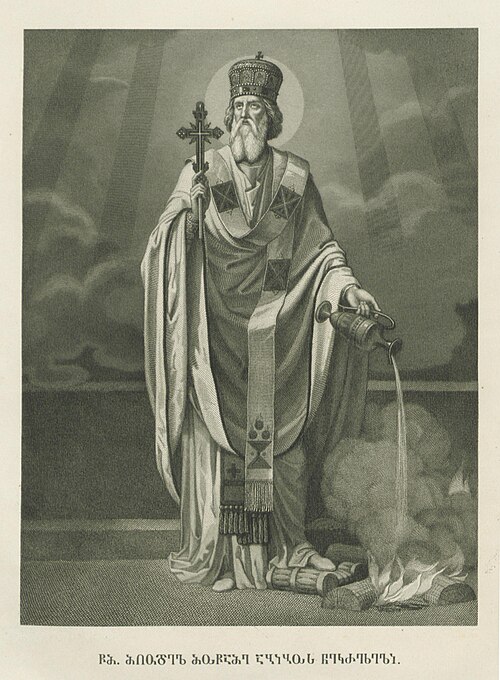
Saint Abibus of Nekresi, bishop and martyr of the sixth century, was one of the thirteen Syrian Fathers who came to Georgia with John of Zedazeni. He preached the Gospel in Kakheti, quenched a Zoroastrian fire with water, and was a disciple of John and then bishop; the Persians killed him by stoning. He is commemorated on 20 May and 29 November (7 May and 29 November by the old calendar).
Arrival in Georgia and missionary work
The year of his birth is uncertain: one source says about 510, with death about 570. He was a disciple of Saint John of Zedazeni, with whom he came from Antioch to Iberia, at the request of King Parsman VI and the Catholicos-Archbishop Eulavius, in the middle of the sixth century. He settled on Mount Zedazeni and served as deacon in the monastery founded there by his teacher. Later he carried on lively missionary work: he travelled through cities and villages, destroying superstitions, brought to Christianity the Kakhetians of Aragvispiri (today the Dusheti municipality of Mtskheta-Mtianeti) and urged the people to hold firmly to the Christian faith. He struggled against the influence of the official religion of Iran, Zoroastrianism. According to the Life of Kartli, he spread Christianity not only among Georgians but also among mountain peoples such as the Didoians, ancient forerunners of today's Dagestanis. He founded a monastery and became Bishop of Nekresi, in Kakheti.
Martyrdom
Eastern Georgia was then under Persian rule, and the ruling religion was Zoroastrianism. Not far from the church at Nekresi, the saint quenched with holy water a fire temple worshipped by the Zoroastrians. The Persian marzban, alarmed by his fruitful preaching, ordered him brought before him. Soldiers armed with clubs bound him and led him to the marzban. On the way Abibus endured many insults and beatings from them. Arrived at the goal, he was imprisoned and accused that by putting out the fire he had "killed a god". Before a great crowd the satrap demanded that he renounce the Christian faith, but the saint refused. He showed plainly the emptiness of Zoroastrianism, offering as proof the powerlessness of fire against the other elements of nature, and charged the ruler with idolatry, for which he was scourged and put to terrible tortures, but he did not waver. Then the ruler ordered him put to death. He was stoned to death at Rekhi (so an English source says), and his body was dragged through the city and cast to the beasts and birds of prey. Simeon the Stylite of the Wonderful Mountain had sent him beforehand a letter, an eulogia (thought to be a piece of prosphora) and a staff to strengthen his soul.
The body lay a long time outside the city, but neither beasts nor birds nor decay touched the holy relics. The priests and monks of Rekhi, despite the strict prohibition, took the body secretly and buried it with honor, according to the sources, at Samtavisi monastery, which lies midway between Mtskheta and Gori (the Russian and Serbian versions say that the monks buried him on the grounds of Samtavro monastery). In the time of Prince Stepanoz of Kartli the relics were moved from Samtavisi to Samtavro monastery in Mtskheta and placed beneath the altar. His holy relics now rest in the city of Mtskheta.
Sources and veneration
Abibus is mentioned in the lives of other Syrian Fathers. The separate work about him, composed in the sixth and seventh centuries, has not survived; a Life remains, based on the writings of Catholicos Arsen I the Great of Kartli. He is honored as one of the founders of Georgian monasticism. The Orthodox Church commemorates him on 7 (20) May and 29 November (12 December); the Catholic Church, on 12 and 29 November. Until 1700 his day was kept on 12 November, then moved to 12 December in the new style, which is 29 November in the old.
Commemorated the same day May 7
 Acacius the CenturionMartyr · Centurion of the imperial armyMay 7
 Nilus of SoraVenerable · Founder of the Sora HermitageMay 7
 Domnius of SalonaSaint · Bishop of SalonaMay 7
 Alexis Toth of Wilkes-BarreConfessor · Protopresbyter and missionary in AmericaMay 7
 John of BeverleySaint · Bishop of YorkMay 7
 David of GarejiVenerable · One of the Syrian FathersMay 7
- Thaddeus of StepantsmindaVenerableMay 7
 Pachomius the RussianVenerable MartyrMay 7
- John of ZedazeniVenerableMay 7
- Agapius of VatopediVenerableMay 7
- Akaki AsistaviSaintMay 7
- Antipas KirillovVenerable MartyrMay 7