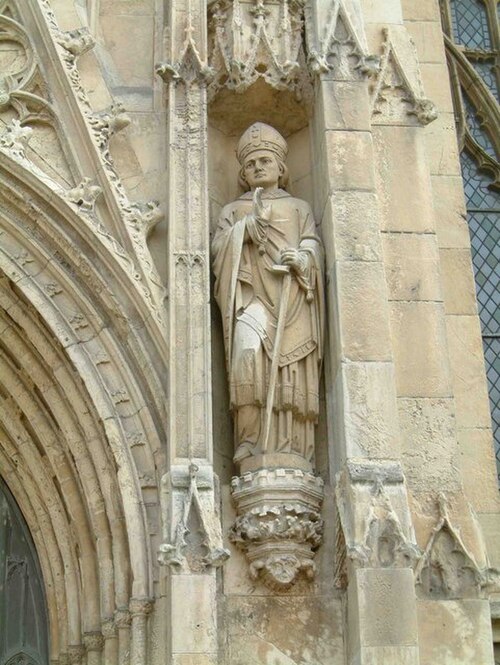
Saint
John of Beverley
Bishop of York
Bishop of Hexham, then of York in Northumbria, who founded a monastery around which Beverley grew.
Life
Saint John of Beverley was bishop of Hexham and then of York in the kingdom of Northumbria around the year 700. He founded a monastery around which the town of Beverley grew, and he was honoured as a wonderworker in life and after death. He fell asleep on 7 May 721. The Orthodox Church commemorates him on the third Sunday after Pentecost, at the Synaxis of the Saints of Britain and Ireland.
He is said to have been born of noble Anglo-Saxon parents at Harpham in Yorkshire. These reports were written only after his canonization and may not be reliable. For a time he was in the community at Whitby under Saint Hilda, as his friend Bede the Venerable records. He may have studied at Canterbury under Theodore or Adrian, not at Oxford as some sources say. He became a renowned preacher and showed great learning in expounding Scripture.
In 687 he was consecrated bishop of Hexham by Archbishop Theodore. Bede relates that John taught a deaf boy to speak, held to be a miracle and one of the earliest accounts of the education of the deaf. In 705 he was moved to York, the most important see in the region. Little is known beyond that he was diligent in visiting parishes, considerate to the poor and attentive to the training of students he kept in his personal care. Bede says John ordained him deacon and priest. Around 717 or 718 he resigned and retired to the monastery he had founded at Beverley, where he died on 7 May 721.
He was canonized in 1037 by Pope Benedict IX, before the separation of East and West, so he is venerated by the Orthodox Church as well. Around 1066 a Life of him was written by Folcard, and in the eleventh or twelfth century an account of his miracles by William Ketel. Pilgrimage to his tomb brought great prosperity to Beverley in the Middle Ages. His banner is mentioned from 1138 at the Battle of the Standard, and in 1266 it was accepted that when levies were made in Yorkshire, it was enough for Beverley to send one man with John's banner. In 1292 a new shrine of silver-gilt was commissioned, and on 25 October 1307 his relics were moved to the new tomb. King Edward I was a devotee, founded a chantry in Beverley Minster and took John's banner on his Scottish campaigns. According to tradition Henry V attributed his victory at Agincourt to his intercession. In the Middle Ages his name was also tied to the legend of a hermit who commits grave sins yet enjoys God's grace, mentioned by Julian of Norwich in her Revelations of Divine Love.
Commemorated the same day May 7
 Acacius the CenturionMartyr · Centurion of the imperial armyMay 7
 Nilus of SoraVenerable · Founder of the Sora HermitageMay 7
 Domnius of SalonaSaint · Bishop of SalonaMay 7
 Alexis Toth of Wilkes-BarreConfessor · Protopresbyter and missionary in AmericaMay 7
 Abibus of NekresiSaint · Bishop of NekresiMay 7
 David of GarejiVenerable · One of the Syrian FathersMay 7
- Thaddeus of StepantsmindaVenerableMay 7
 Pachomius the RussianVenerable MartyrMay 7
- John of ZedazeniVenerableMay 7
- Agapius of VatopediVenerableMay 7
- Akaki AsistaviSaintMay 7
- Antipas KirillovVenerable MartyrMay 7