Venerable
Acepsimas
Syrian priest and hermit
Syrian hermit and priest of the 4th century who wore chains, whose life is told by Theodoret of Cyrrhus.
- Feast
- November 3old style November 16
- Era
- unknown
- Order
- Venerables
Life
Venerable Acepsimas (Acepsimas) was an ascetic, Syrian hermit and priest of the fourth century, whose life is told by Theodoret of Cyrrhus in the fifteenth chapter of his History of the Lovers of God. He is commemorated on 3 November by the old calendar (16 November by the new). According to the Serbian source, he lived in the time of the emperor Theodosius the Great, not far from the city of Cyrrhus in Syria.
Acepsimas laboured in fasting and prayers and wore chains. The hermit's dwelling was not far from the city of Cyrrhus; he lived in a small cell. The food that was brought to him he received through a small opening, made not straight but winding, so that the curious could not look into the hermit's dwelling. His food was lentils soaked in water. For water he went once a week to the nearest spring, at night. Theodoret tells of the miracles worked by Acepsimas: the hand of a shepherd who tried at night to throw a stone at the hermit froze motionless until Acepsimas had taken water; half the body of a man who, from curiosity, tried to spy on his life from a tree, grew numb. Both repented and received forgiveness from the hermit. Acepsimas lived alone in the wilderness 60 years.
The hermit foretold that he would die in 50 days, which came true. Before his death, the head of the local church came to him and persuaded him to receive priesthood. Acepsimas knelt, and the bishop ordained him. After living a few days in the rank of priest, Acepsimas died. After the hermit's death disputes arose: many wished to take the relics (the body of the departed), each to his own village. But one man put an end to the dispute by declaring the saint's will, that his body be buried where he had lived; and so it was done.
Commemorated the same day November 3
 PirminVenerable · Missionary and founder of monasteriesNov 3
 WinefrideMartyr · Virgin of WalesNov 3
 Libertinus of AgrigentoHieromartyr · First bishop of AgrigentoNov 3
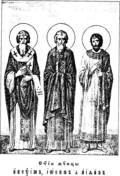 Acepsimas, Joseph and AeithalasHieromartyr · Martyrs of PersiaNov 3
 Rumwold of BuckinghamConfessorNov 3
 Alexander ZverevHieromartyr · ArchpriestNov 3
 Anna Vsevolodovna of KyivVenerable · Princess of KyivNov 3
 Basil ArkhangelskyHieromartyr · PriestNov 3
 Peter OrlenkovHieromartyr · PriestNov 3
 Pimen of ZografVenerable · Monk and icon painterNov 3
- Nikoloz MnatobiSaintNov 3
- Theodorus of AncyraConfessorNov 3