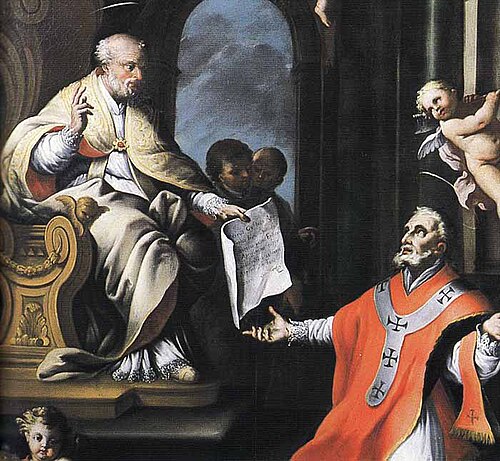
Hieromartyr
Libertinus of Agrigento
First bishop of Agrigento
Venerated as a martyr and first bishop of Agrigento, by tradition sent to Sicily by Saint Peter.
- Feast
- November 3old style November 16
- Reposed
- 2002nd century
- Place
- Agrigento
- Order
- Martyrs
Life
Saint Libertinus is venerated as a martyr and as the first bishop of Agrigento in Sicily. He is commemorated on 3 November. Our sources show him with an ancient veneration at Agrigento, not with a separate Orthodox glorification. The birth and death dates on the record, 1 and 200, have no meaning, and the sources say that there is no certain data on his life; the earliest source was written no earlier than the fifth century.
According to tradition, Libertinus was sent to Agrigento by the Apostle Peter to preach the Gospel and Christianize the city in the first century. However, it is possible that he lived later, in the third century, and was martyred in the persecutions of Decius or Diocletian; he seems to have been a contemporary of Saint Marcian, the first bishop of Syracuse, which helps the dating. Tradition holds that his preaching was so effective that it aroused the displeasure of the Roman authorities, who arrested him and demanded that he renounce the Christian faith. After his refusal Libertinus received martyrdom together with Saint Peregrinus, on Mount Crotaleo, whose location is unknown; he is said to have been either stoned to death or killed with a sword.
He worked miracles and built a church, perhaps on the site of the present cathedral of Agrigento. It is told that, just before he died, he uttered a Latin verse: Iniquitous people, guilty people, you will not see my bones. The northern gate of the city, Bibbirria, is said to derive from a corruption of his last words; more probably, however, the name comes from Arabic and means Gate of the Winds (Bab er rijah). According to Giuseppe Fumagalli, these verses were a common saying in communities that did not possess the relics of their patron saint.
At his tomb, according to tradition, numerous miracles took place in the years after his death. A cult of him existed at an early date in Agrigento. In the life of Saint Gregory of Agrigento, written by Leontius, it is stated that the Church of Agrigento owned a house in Palermo named after Libertinus. Libertinus was invoked for help in 1625, during a plague that struck Agrigento.
Commemorated the same day November 3
 PirminVenerable · Missionary and founder of monasteriesNov 3
 WinefrideMartyr · Virgin of WalesNov 3
 Acepsimas, Joseph and AeithalasHieromartyr · Martyrs of PersiaNov 3
 Rumwold of BuckinghamConfessorNov 3
 Alexander ZverevHieromartyr · ArchpriestNov 3
 Anna Vsevolodovna of KyivVenerable · Princess of KyivNov 3
 Basil ArkhangelskyHieromartyr · PriestNov 3
 Peter OrlenkovHieromartyr · PriestNov 3
- AcepsimasVenerable · Syrian priest and hermitNov 3
 Pimen of ZografVenerable · Monk and icon painterNov 3
- Nikoloz MnatobiSaintNov 3
- Theodorus of AncyraConfessorNov 3