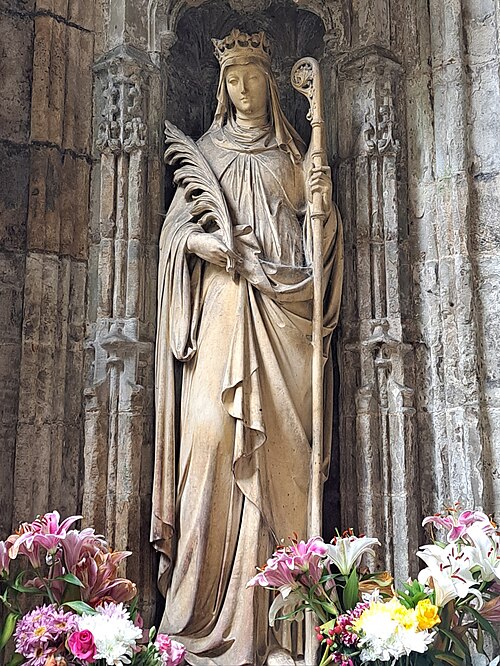
Martyr
Winefride
Virgin of Wales
Welsh virgin of the seventh century, remembered at the healing spring of Holywell.
- Feast
- November 3old style November 16
- Reposed
- 6807th century
- Place
- Gwytherin
- Order
- Martyrs
Life
The Holy Martyr Winefride (Winifred, Gwenfrewi), a virgin of Wales of the seventh century, is remembered above all at the healing spring of Holywell. Her story was celebrated as early as the eighth century, but became popular in England in the twelfth, when her life was first written down. Her feast is on 3 November. The Russian Orthodox Church venerates her as Winifred of Trefynnon, on the third Sunday after Pentecost, on the day of the Synaxis of the Saints of the British Isles and Ireland.
Life and legend
The oldest accounts of her life date to the twelfth century. According to legend, Winifred was the daughter of a chieftain of Tegeingl, the Welsh nobleman Tyfid ap Eiludd; her mother, Wenlo, was a niece (in other sources, sister) of Saint Beuno and belonged to a family closely connected with the kings of south Wales. It is said that Caradog, son of Prince Alan, learning of the girl's beauty, wished to ask for her hand. At the moment of his arrival the girl's parents had gone to Mass. Learning that Winifred had decided to become a nun, Caradog fell into a rage and, trying by entreaty and threats to change her mind, since she refused his suit, pursued the frightened girl as she fled toward the church where her parents were, and cut off her head. A healing spring appeared where her head fell. Later, through the efforts of Beuno, Winifred's head was rejoined to her body and she was restored to life. Seeing the murderer leaning on his sword with an insolent and defiant air, Beuno invoked the chastisement of heaven and Caradog fell dead on the spot; the popular belief is that the ground opened and swallowed him.
Beuno left Holywell and returned to Caernarfon; before he left, the tradition is that he seated himself upon a stone, which now stands in the outer well pool, and promised there in the name of God "that whosoever on that spot should thrice ask for a benefit from God in the name of Saint Winefride would obtain the grace he asked if it was for the good of his soul." After eight years spent at Holywell, Winifred received an inspiration to leave the convent and retire inland. She went on pilgrimage to seek a place of rest and ultimately arrived at Gwytherin near the source of the river Elwy; she later became a nun and abbess at Gwytherin. More elaborate versions relate many details of her life, including a pilgrimage to Rome. Another source says that Tyfid was the father of Owain Pennifer and that Caradog was killed by Owain, her brother. Ranulf Higden (died 1364) says in the Polychronicon that the children and descendants of the unnamed culprit barked like puppies until they asked mercy at Winefride's well or at her shrine in Shrewsbury. The Catholic Encyclopedia said she was born with the name Geneva around 600 and died on 3 November 660; the Oxford Dictionary of National Biography dates her death around 650.
Sources and the view of historians
The details of her life are gathered from a manuscript in the British Museum, said to be the work of the British monk Elerius, a contemporary of the saint, and from a life in the Bodleian Library, believed compiled in 1130 by Robert, prior of Shrewsbury (died 1168), who is credited with greatly promoting her cult, by translating her relics from Gwytherin to Shrewsbury Abbey and writing the most influential life. Given the late date of the earliest surviving written accounts, her existence has been doubted since the nineteenth century. She is not recorded in any Welsh pedigree of saints nor in the thirteenth-century calendar of Welsh saints. There is, however, evidence of her cult from centuries before her first life: two small pieces of an oak reliquary of the eighth century were discovered in 1991 and identified, from earlier drawings, as belonging to the Arch Gwenfrewi, the reliquary of Winifred. The reliquary probably contained an article of clothing or another object associated with the saint, not her bones. According to the historian Lynne Heidi Stumpe, the reliquary is "good evidence for her having been recognized as a saint very soon after her death," and so of her historicity; it may even be "the earliest surviving testimony to the formal cultus of any Welsh saint."
Veneration
Veneration of Winifred as a martyr saint is attested from the twelfth century. She is venerated mostly in England, not in Wales, which led Caesar Baronius to list her as an "English saint" in his Roman Martyrology of 1584. In 1138 her relics were carried to Shrewsbury to form the basis of an elaborate shrine. To enhance the prestige of the abbey, Abbot Nicholas Stevens built a new shrine for Saint Winifred in the fourteenth century and had some monks steal the relics of Saint Beuno from Rhewl. William Caxton's 1483 edition of the Golden Legend includes her story; the following year he printed a separate Life. The shrine and well at Shrewsbury became major pilgrimage goals in the late Middle Ages, but the shrine was destroyed by Henry VIII in 1540. Saint Winefride's Well in Flintshire, originally formed from a mountain spring, housed below the town on the side of a steep hill, is one of the oldest continually visited pilgrimage sites in Britain and is known as "the Lourdes of Wales"; in November 2023 it was granted the status of National Shrine for England and Wales.
Commemorated the same day November 3
 PirminVenerable · Missionary and founder of monasteriesNov 3
 Libertinus of AgrigentoHieromartyr · First bishop of AgrigentoNov 3
 Acepsimas, Joseph and AeithalasHieromartyr · Martyrs of PersiaNov 3
 Rumwold of BuckinghamConfessorNov 3
 Alexander ZverevHieromartyr · ArchpriestNov 3
 Anna Vsevolodovna of KyivVenerable · Princess of KyivNov 3
 Basil ArkhangelskyHieromartyr · PriestNov 3
 Peter OrlenkovHieromartyr · PriestNov 3
- AcepsimasVenerable · Syrian priest and hermitNov 3
 Pimen of ZografVenerable · Monk and icon painterNov 3
- Nikoloz MnatobiSaintNov 3
- Theodorus of AncyraConfessorNov 3