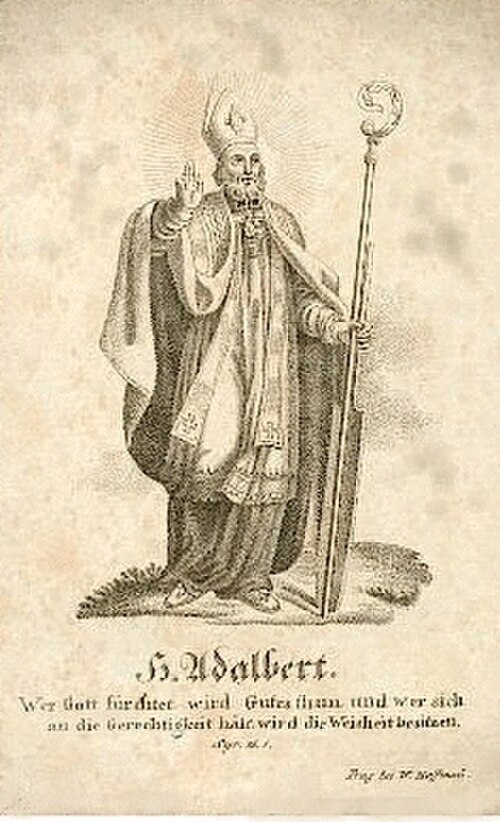
Saint
Adalbert of Magdeburg
Archbishop of Magdeburg
First archbishop of Magdeburg from 968, missionary to the Polabian Slavs, who died in 981.
Life
Adalbert of Magdeburg was a German Benedictine monk and missionary, the first archbishop of Magdeburg, known as the apostle of the Slavs of the Elbe lands. He was born around 910, probably in Lorraine or Alsace, and died on 20 June 981. He lived before the separation of the Churches, and his commemoration is kept on 20 June.
Youth and the mission to Rus
He probably came from Lorraine. From about 950 he worked in the chancery of Archbishop Wichfrid of Cologne, and from 953 he entered the service of Otto I, the future emperor. In 958 he became a monk at the Benedictine monastery of St Maximin in Trier, where he received a good literary and theological formation, and in 961 he was consecrated bishop.
In 959 Princess Olga of Kiev had asked Otto I to send a bishop to preach Christianity. Libutius was named first, but he died in March 961. Adalbert went to Kiev in his place. The mission failed: by the time he arrived, power had passed to Olga's son Sviatoslav, who remained a pagan; some of Adalbert's companions were killed, and he had to leave. Afterwards Kievan Rus received Christianity from Constantinople, in the time of Vladimir.
On the way back, in the Czech town of Libice, he confirmed the young Vojtěch Slavnikovic and gave him his own patron's name. The youth was to become a martyr and saint, known as Adalbert of Prague. Adalbert returned to the German lands in 962.
Abbot and archbishop
In 963 to 965 he served at the court of the future Otto II, and in 966 he became abbot of Wissembourg in Alsace, where he guided the education of the monks and wrote most of the Continuation of the Chronicle of Regino, covering the years 907 to 967 and containing valuable news about early Rus, including his own mission. In 967 he accompanied the young Otto to Italy and was in Rome when Otto was crowned.
In 968 he was appointed archbishop of Magdeburg, a see founded by Pope John XIII at Otto I's request in order to train missionaries for the Slavic peoples in the east. On 18 October 969 the pope placed the pallium upon him in Rome. Under him the dioceses of Naumburg, Meissen, Merseburg, Brandenburg, Havelberg and Poznań were organized. He also founded a famous school, which produced Adalbert of Prague, Bruno of Querfurt and Thietmar of Merseburg. He also wrote a theological epistle to the bishop of Minden.
His end
He died on 20 June 981 at Zscherben near Halle in Saxony-Anhalt and was buried in Magdeburg cathedral. He is venerated as a saint in the Catholic Church and also appears in Orthodox calendars. He is commemorated on 20 June.
Commemorated the same day June 20
 Silverius of RomeSaint · Bishop of RomeJun 20
 Naum of OhridVenerable · Disciple of Cyril and MethodiusJun 20
 Nicholas CabasilasRighteous · Byzantine theologian and mysticJun 20
 Methodius of OlympusHieromartyr · Bishop of OlympusJun 20
 Callistus I of ConstantinopleSaint · Patriarch of ConstantinopleJun 20
 Florentina of CartagenaVenerableJun 20
 Latuinus of SéesSaint · First bishop of SéesJun 20
 Gleb of VladimirRight-Believing · Prince of VladimirJun 20
 Mina of PolotskSaint · Bishop of PolotskJun 20
 Kallistos AngelikoudesVenerable · Abbot of Katafygi MonasteryJun 20
- HectorSaintJun 20
- Aristocles of SalamisHieromartyrJun 20