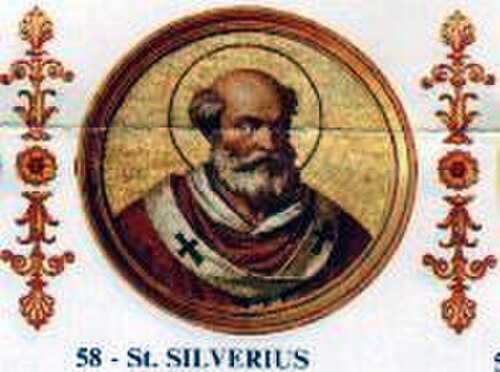
Saint
Silverius of Rome
Bishop of Rome
Bishop of Rome from 536 to 537, deposed and exiled during the war between Byzantines and Goths.
Life
Silverius of Rome was bishop of Rome from 8 June 536 until 537, in the hard years of the war between the Byzantine Empire and the Goths of Italy. Wrongly deposed and sent into exile, he died in want on a barren island, and the Church honours him as a confessor.
Election
He was the son of Pope Hormisdas, born before his father entered the clergy. While he was still a subdeacon, the Gothic king Theodahad pressed for his election as bishop of Rome. The historian Jeffrey Richards thinks the king wanted a man friendly to the Goths on the eve of the war. The Book of the Popes claims that Silverius bought his seat, but this is not proved.
Deposition and exile
On 9 December 536 the general Belisarius entered Rome with Silverius's approval. After the Goths under King Witiges besieged the city, Silverius was accused of planning to hand it over to them. In March 537 Belisarius deposed him, after his wife Antonina had sat in judgment. The sources differ in detail. Some say the true cause was his refusal to take back Anthimus, the Monophysite patriarch of Constantinople, whom the empress Theodora wanted restored. The deacon Vigilius, who was in Constantinople, was brought to take his place.
Silverius was sent to Patara in Lycia. The bishop there asked the emperor Justinian for a fair trial, and the emperor ordered him returned to Italy. But once he arrived, Silverius was handed over to Vigilius, who sent him to the barren island of Palmarola in the Pontine Islands. There he starved to death after a few months. The date of death is 2 December 537 in some sources and, in the Roman tradition, 20 June.
Veneration
He was recognised as a saint by popular acclaim, without a formal canonization. His name first appears in a list of saints in the eleventh century. He is the patron of the island of Ponza, where fishermen tell that he came to their help in a storm. The Roman calendar keeps him on 20 June, and English-language Orthodox calendars that include Western saints keep him on 2 December.
Commemorated the same day June 20
 Naum of OhridVenerable · Disciple of Cyril and MethodiusJun 20
 Nicholas CabasilasRighteous · Byzantine theologian and mysticJun 20
 Methodius of OlympusHieromartyr · Bishop of OlympusJun 20
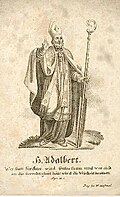 Adalbert of MagdeburgSaint · Archbishop of MagdeburgJun 20
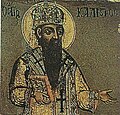 Callistus I of ConstantinopleSaint · Patriarch of ConstantinopleJun 20
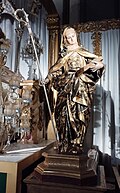 Florentina of CartagenaVenerableJun 20
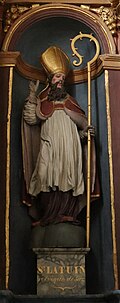 Latuinus of SéesSaint · First bishop of SéesJun 20
 Gleb of VladimirRight-Believing · Prince of VladimirJun 20
 Mina of PolotskSaint · Bishop of PolotskJun 20
 Kallistos AngelikoudesVenerable · Abbot of Katafygi MonasteryJun 20
- HectorSaintJun 20
- Aristocles of SalamisHieromartyrJun 20