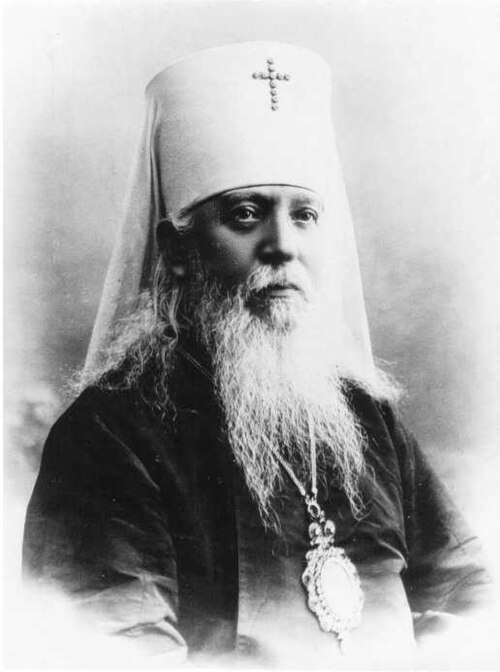
Confessor
Agathangel Preobrazhensky
Metropolitan of Yaroslavl
Metropolitan of Yaroslavl and Rostov, born in 1854, who died at Kineshma in 1928.
- Feast
- October 3old style October 16
- Reposed
- 192820th century
- Place
- Kineshma
- Order
- Confessors
Life
Saint Agathangel Preobrazhensky, Hieroconfessor, was Metropolitan of Yaroslavl and Rostov, a hierarch of long service in Siberia, the Baltic lands and Yaroslavl, one of those who defended the Church in the hardest years of Soviet persecution. Born in 1854 in a village of the Tula governorate, he passed to the Lord on 16 October 1928 at Kineshma. In August 2000 he was numbered among the New Martyrs and Confessors of Russia; he is commemorated on 3 October Old Style.
Youth and studies
Born Alexander Lavrentyevich Preobrazhensky in the village of Mochily, Venev district, into the family of Fr Lavrenty Ivanovich Preobrazhensky, he graduated from the ecclesiastical school at Venev in 1871 and recalled that as a pupil he liked to stay long at the cemetery, among graves and crosses, and ask the Lord with tears to make him worthy to be a servant of the altar and to offer the bloodless sacrifice for the departed. He studied at the Tula seminary (1877) and the Moscow Theological Academy, graduating in 1881 as candidate of theology with a thesis on the Hexaemeron of John, exarch of Bulgaria, a study of its language and text from a manuscript of 1263, which showed his philological learning.
From 1881 he taught Latin at the ecclesiastical school at Ranenburg, then was assistant superintendent of the school at Skopin and taught religion. After eleven months of marriage his wife, Anna Fyodorovna, daughter of an archpriest, died of a severe infection, and with her the newborn child. The blow decided him: he felt that the path he had chosen was not his lot, and he hastened to leave the world, take up his cross and join the monks. On 7 March 1885 he was tonsured a monk and on 10 March ordained hieromonk. From 1886 he was inspector of the Tomsk seminary, as hegumen, and from 1888, as archimandrite, rector of the Irkutsk seminary.
Bishop in Siberia and the Baltic lands
On 10 September 1889 he was consecrated Bishop of Kirensk, second vicar of the Irkutsk diocese. From 1893 he was Bishop of Tobolsk and Siberia, travelling for missionary purposes in the remote parts of the diocese. He received the orders of Saint Anna (1896), Saint Vladimir (1900) and Saint Alexander Nevsky (1907). From 4 October 1897 he was Bishop of Riga and Mitau, and on 6 May 1904 he was raised to archbishop. Through his labour many churches were renewed and built. In 1905 he convened a diocesan council, which decided changes in church life: admitting laypeople to the election of clergy and some changes and shortenings in the services in Latvian and Estonian churches. In January 1906 he called on the clergy of the diocese to intercede with the authorities for those drawn into the revolutionary movement, and, if intercession was refused, to ask at least that execution of the sentence be postponed until a special decision by the head of the region.
On 13 August 1910 he was named Archbishop of Lithuania and Vilna and abbot of the Holy Spirit monastery in Vilna. A moderate monarchist, he refused to approve a solemn procession to the Muravyov monument, demanded by far-right organizations, and settled for a memorial liturgy; the incident was the reason for his transfer to Yaroslavl, in place of Archbishop Tikhon (Bellavin). From 22 December 1913 he was Archbishop of Yaroslavl and Rostov, supported the army by organizing hospitals and sending priests to the front, and was close to the monarchist movement. In November 1917 he was raised to metropolitan and he was a member of the Local Council of 1917 to 1918. In February 1918, following the council's decision, Patriarch Tikhon named him second candidate for locum tenens.
Locum tenens and opposition
Because of criminal proceedings against Tikhon and the opposition of the Renovationists, on 12 May 1922 the patriarch temporarily transferred patriarchal rights and duties to him, summoning him to Moscow, but the authorities would not let him leave Yaroslavl. After the so-called "Memorandum of the Three" of 16 June 1922, in which Metropolitan Sergius Stragorodsky and Archbishops Evdokim and Seraphim recognized the Renovationist administration as the only lawful supreme church authority, he issued on 18 June an epistle to all pastors and children of the Church, calling on them not to submit to it and on the bishops to govern their dioceses on their own by the canons until the supreme church authority was restored.
On 28 June 1922 he was placed under house arrest at the former Spassky monastery in Yaroslavl, on 22 August moved to a solitary cell of the prison, and in autumn to the internal prison of the secret police in Moscow. On 25 November 1923 he was sentenced to three years of exile and stayed in the village of Kolpashevo in the Narym region from 1923 to 1925. Patriarch Tikhon's testament had named him second candidate for locum tenens, but after the patriarch's death in April 1925, since the first two were in exile, the third, Metropolitan Peter Polyansky, took the office. After his exile, between autumn 1925 and spring 1926, he was imprisoned at Perm. After Peter's arrest, urged by the head of the sixth section of the secret police, Tuchkov, he issued on 18 April 1926 an epistle announcing that he had taken the office of locum tenens, but after meeting Metropolitan Sergius on 13 May and learning the real state of the Church, he renounced it on 8 June 1926 and returned to Yaroslavl. The difficulties over the question of governing the Church had been fostered by the authorities to stir up discord among the hierarchy.
The break with Metropolitan Sergius appeared openly after the Declaration of 29 July 1927. Metropolitan Agathangel was supported by his vicars, Archbishop Seraphim of Uglich, former Archbishop Varlaam of Perm and Bishop Eugene of Rostov, and by Metropolitan Joseph Petrovykh of Leningrad, who was at Rostov. They sent on 6 February 1928 an "act of separation", saying that they no longer recognized the right of Sergius and his Synod to the supreme government of the Church, remained in communion with the locum tenens Peter and the Eastern Churches and would govern their diocese on their own, according to the Word of God and the canons. They did not want a schism, but as Metropolitan John Snychev said, by the sense of the canons, separation from the first hierarch is already schism. Metropolitan Sergius, understanding that Agathangel had not entered into opposition out of love of power but out of ignorance of some aspects of church life, wrote to him on 10 February asking him not to break communion and to be patient. In March the Synod decided to suspend the vicars, but not him. Archbishop Paul Borisovsky, then Archbishop Juvenal Maslovsky and Archpriest Vladimir Vorobyov, were sent to Yaroslavl, and on 16 May 1928 the bishops of Yaroslavl were reconciled with Metropolitan Sergius.
Repose and veneration
In 1928 his health worsened and heart attacks multiplied, and in mid-September he took to his bed. Before his death he received communion often. He was buried at Yaroslavl, in the basement of the church of Saint Leontius of Rostov, only on the seventh day after his death, but a witness recalled that no smell of decay was perceived, and at times a fragrance seemed to come from the coffin. On the tombstone was written "The great hierarch Agathangel". Today the shrine with his relics lies in the Kazan cathedral of the Kazan convent in Yaroslavl. At the Jubilee Council of Bishops in August 2000 he was numbered, as hieroconfessor, among the New Martyrs and Confessors of the Russian Church, for veneration throughout the Church.
Commemorated the same day October 3
 Dionysius the AreopagiteHieromartyr · Bishop of AthensOct 3
 Damaris the AthenianMartyr · Athenian convert of Saint PaulOct 3
 The Two HewaldsHoly Hieromartyrs · Missionaries in SaxonyOct 3
 Dionysius of the Kiev CavesVenerable · Hieromonk of the Kiev CavesOct 3
 RusticusHieromartyr · Priest, companion of St. DenisOct 3
 Eustathius of ApsiliaMartyrOct 3
- Menna of LorraineMartyrOct 3
- AbdalmasihMartyrOct 3
- Candidus of RomeMartyrOct 3
- ClervieSaintOct 3
- Dionysius of NovgorodVenerableOct 3
- EusebiusMartyrOct 3