Venerable
Dionysius of the Kiev Caves
Hieromonk of the Kiev Caves
Monk and hieromonk of the Kiev Caves Lavra, who died after 1463, commemorated on October 3.
- Feast
- October 3old style October 16
- Era
- unknown
- Order
- Venerables
Life
Venerable Dionysius of the Caves (nicknamed Shchepa, died after 1463) was a monk and hieromonk of the Kyiv Caves Monastery. He is commemorated (Old Style) on 3 October and on 28 August, in the Synaxis of the Venerable Fathers of the Far Caves. His life is known only through the story of a miracle in the Caves Paterikon.
The Paschal miracle
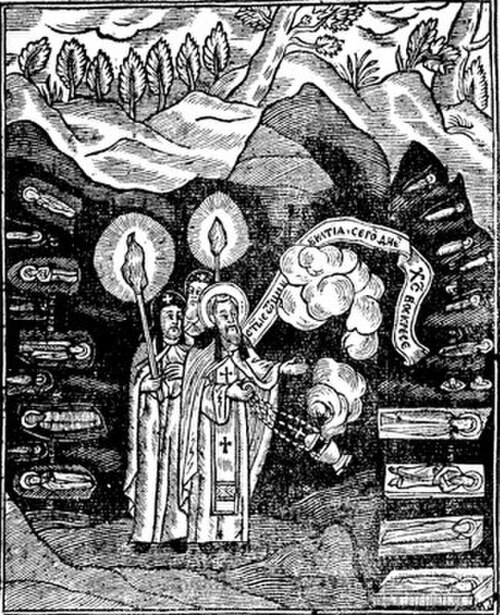
The Caves Paterikon tells of a miracle that took place in the caves of the monastery at Pascha of the year 6971 (1463), in the time of Prince Semyon Alexandrovich and his brother, Prince Michael, and of Archimandrite Nicholas. Dionysius, nicknamed Shchepa, took care of the cave. On the great day he came into the cave to cense the bodies of the departed and, reaching the place called the Community, said after censing: "Fathers and brothers, Christ is risen. Today is the great day." And there resounded in answer, like a mighty thunder: "Truly Christ is risen." According to tradition, after this Dionysius spent the rest of his life enclosed in the caves.
Veneration
The beginning of local veneration is not known. His name is in the canon of the Venerable Fathers of the Caves, written in 1643 by Meletius Syrigos at the request of Metropolitan Peter Mogila. Veneration in the whole Church began after the permission of the Holy Synod in the second half of the eighteenth century to include the names of some Kyivan saints in the general menologia. The day 3 October was chosen because on that day the hieromartyr Dionysius the Areopagite is commemorated. The earliest depiction is an engraving from the "Paterikon or Otechnik of the Caves" (Kyiv, 1661), which shows the Paschal miracle: Dionysius in monastic dress and epitrachelion, bareheaded and with the cowl pushed onto his shoulder, with a halo without inscriptions; beside him two monks with torches; his Paschal greeting to the brothers buried there is written on a white ribbon coming from his mouth, and the reply of the departed in the engraving's caption, in two lines of verse.
Commemorated the same day October 3
 Dionysius the AreopagiteHieromartyr · Bishop of AthensOct 3
 Damaris the AthenianMartyr · Athenian convert of Saint PaulOct 3
 The Two HewaldsHoly Hieromartyrs · Missionaries in SaxonyOct 3
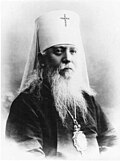 Agathangel PreobrazhenskyConfessor · Metropolitan of YaroslavlOct 3
 RusticusHieromartyr · Priest, companion of St. DenisOct 3
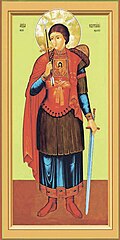 Eustathius of ApsiliaMartyrOct 3
- Menna of LorraineMartyrOct 3
- AbdalmasihMartyrOct 3
- Candidus of RomeMartyrOct 3
- ClervieSaintOct 3
- Dionysius of NovgorodVenerableOct 3
- EusebiusMartyrOct 3