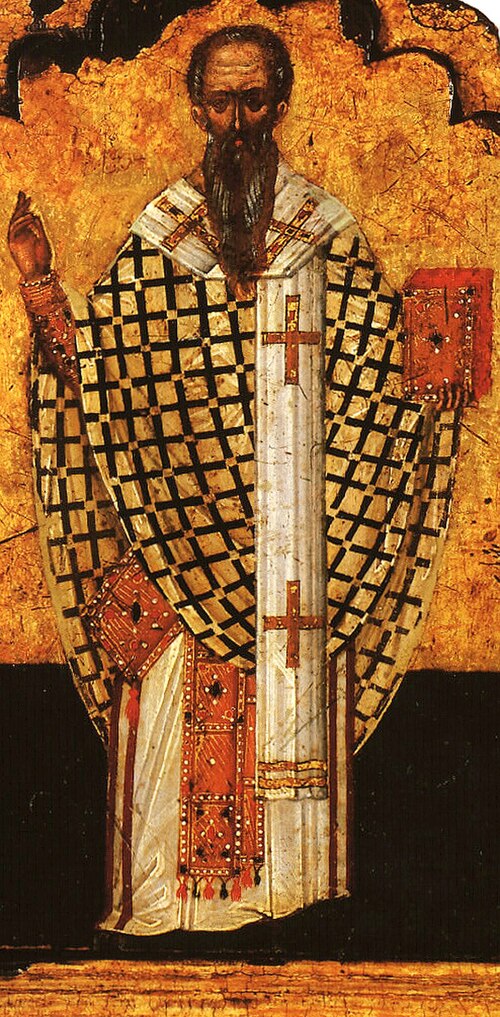
Hieromartyr
Dionysius the Areopagite
Bishop of Athens
Judge of the Areopagus in Athens, converted by the Apostle Paul and made the first bishop of the city.
Life
Saint Dionysius the Areopagite was a judge of the Areopagus court of Athens who was converted by the preaching of the holy Apostle Paul, and who, according to tradition, became the first bishop of Athens and died as a martyr. The Church numbers him among the Apostolic Fathers and remembers him on 3 October. Later, from about the sixth century, a body of mystical writings was circulated under his name and had a great influence in East and West. Modern scholars do not hold him to be their author.
Conversion
The Acts of the Apostles (17:16-34) tell that Paul preached before the Areopagus in Athens about the "unknown God," and that a few believed, among them "Dionysius the Areopagite and a woman named Damaris." That is all that Scripture says of him.
The synaxarion, which follows later accounts, adds that he was born in Athens into a distinguished family, studied philosophy and the science of the stars, and then went to Heliopolis in Egypt. There, with his friend Apollophanes, he saw the sun darken at midday on the day of the Lord's Crucifixion, against the order of nature, and said, "Either the Creator of the world is suffering, or this visible world is coming to its end." Returning to Athens, he sat on the council of the Areopagus. Hearing Paul, he accepted the faith and was baptized with his household. According to this account, Damaris was his wife.
Bishop and witness
The synaxarion says that Dionysius stayed for three years beside the Apostle Paul, who made him bishop of Athens. He was also said to have gone to Jerusalem, where he met the Apostles and saw the Most Holy Mother of God, and to have been present at her burial. He wrote to Paul that he was so overcome by the grace in her presence that he would have taken her for God Himself, had he not been taught otherwise. In the Church's memory he is also close to the other disciples of the Apostle Paul and to Hierotheus, whom some sources count as the first bishop of Athens before him.
Martyrdom
The Slavonic and Romanian synaxarion, which follows Saint Demetrius of Rostov, tells of his later years in the West. He placed another bishop at Athens, went to Rome and was sent by Saint Clement of Rome to Gaul with the priest Rusticus and the deacon Eleutherius. He preached to the pagans, built a church at Paris, and brought many to Christ. Under Domitian the governor Sisinnius had the three arrested. Dionysius was beaten, laid on an iron bed over fire, and thrown to wild beasts, but came out unharmed. In prison he celebrated the Divine Liturgy, and the faithful who came saw a great light. Then the three were beheaded on the hill Montmartre. According to a very old tradition, the body of Dionysius rose and carried his head to the house of a pious woman, Catulla, who buried it. The account says he was ninety years old.
Historians point out that this account joins two different men, Dionysius the Areopagite of the first century and Denis, bishop of Paris, who was martyred in the third century. The union was made in the West by the abbot Hilduin in the ninth century, and modern scholars hold the two to be distinct persons.
The writings under his name
A body of four treatises and ten letters, On the Divine Names, On Mystical Theology, On the Celestial Hierarchy and On the Ecclesiastical Hierarchy, came to light in the East at the beginning of the sixth century under the name of Dionysius. They are first cited in 532, at a meeting in Constantinople where the followers of Severus of Antioch used them in argument. Hypatius of Ephesus rejected them then, saying that earlier Fathers had never known them. In time the Church accepted them, helped by the notes of John of Scythopolis and by Saint Maximus the Confessor, who commented on them. They were later cited by Councils, and Saint John of Damascus, Saint Gregory Palamas and many in the West drew on them.
In the Celestial Hierarchy he describes nine ranks of angels, from the seraphim to the angels, ordered in three triads, who bring divine light to the lower orders and to man. The Ecclesiastical Hierarchy treats the Church and its Mysteries as an image of this order. In the Divine Names and Mystical Theology he teaches that God is known both by what can be said of Him and by what cannot, and that union with Him is reached by prayer and purity of heart.
Since the studies of Hugo Koch and Joseph Stiglmayr in 1895, most scholars hold that the author depended on the philosopher Proclus, who died in 485, so that he wrote in the late fifth or early sixth century and used the apostle's disciple as a pen name. A few Orthodox theologians, among them Father Dumitru Stăniloae, have defended the traditional date. The Church values the writings for their teaching, whatever the question of authorship.
Veneration
The Church commemorates Saint Dionysius on 3 October as hieromartyr and protector of Athens, where several churches bear his name, and the walkway around the Acropolis is called after him. The feast of the Synaxis of the Archangels, on 8 November, is closely linked with his teaching about the heavenly ranks.
Commemorated the same day October 3
 Damaris the AthenianMartyr · Athenian convert of Saint PaulOct 3
 The Two HewaldsHoly Hieromartyrs · Missionaries in SaxonyOct 3
 Dionysius of the Kiev CavesVenerable · Hieromonk of the Kiev CavesOct 3
 Agathangel PreobrazhenskyConfessor · Metropolitan of YaroslavlOct 3
 RusticusHieromartyr · Priest, companion of St. DenisOct 3
 Eustathius of ApsiliaMartyrOct 3
- Menna of LorraineMartyrOct 3
- AbdalmasihMartyrOct 3
- Candidus of RomeMartyrOct 3
- ClervieSaintOct 3
- Dionysius of NovgorodVenerableOct 3
- EusebiusMartyrOct 3